
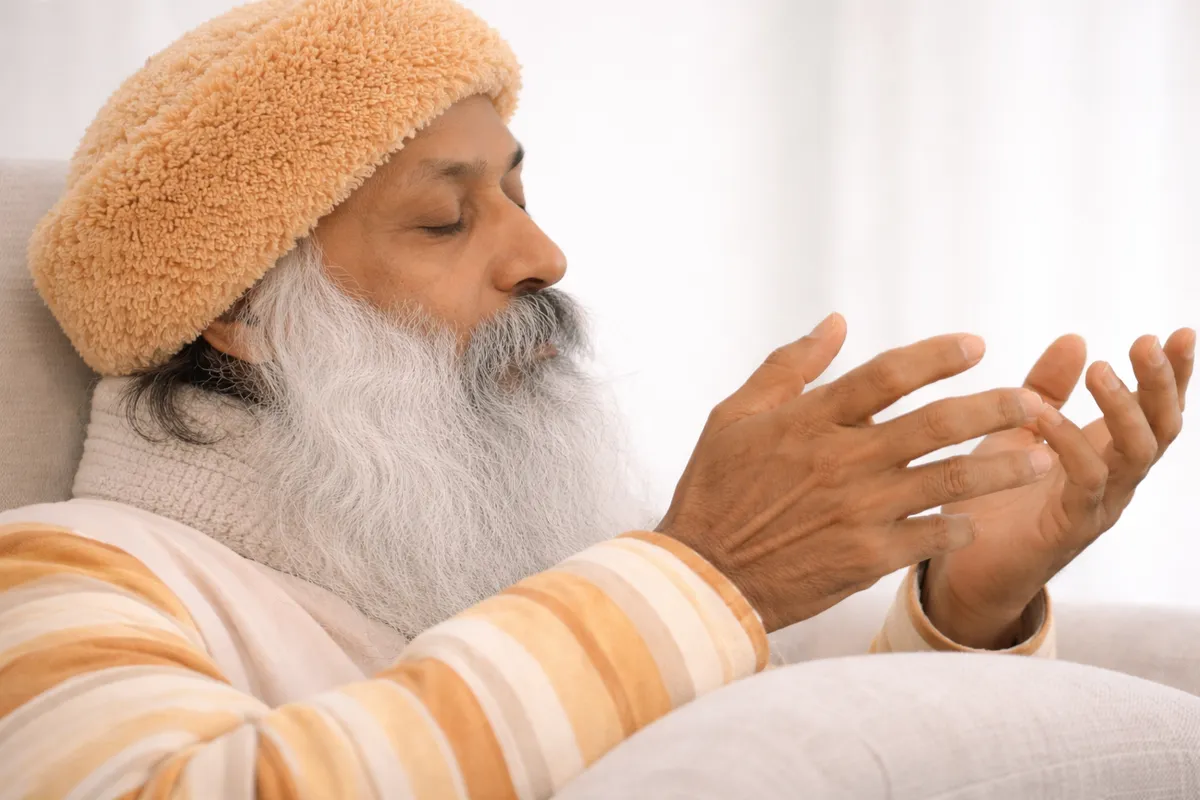
According to Osho, there is no 'how' to see what is; any method or strategy distorts. Drop mind—thoughts, ideologies, prejudices—and rest in silent, transparent stillness. Function from not-knowing, like a child: open, available, mirror-clean. In this unmediated innocence, reality reflects itself and shatters projections, revealing the real beyond the two-percent filter of thought.
Stop trying; be quietly open like a child with no opinions, and reality will show itself.
From the Discourses
Passages where Osho speaks to this question — each links to the complete discourse.
Osho, how to see what is?
Akam, THERE IS NO HOW TO SEE WHAT IS, because if you are carrying a how you will distort it. That which is needs no method, technique, to see it -- just silence, a transparent stillness, no thought in the mind, not even the thought of a certain method. No strategy, because all strategies are bound to distort. In fact, no mind is needed to see that which is. Mind means thoughts. And if there is a traffic of thoughts, you will never be able to see what is, you will see something else. You will see what your thoughts allow you to see. Your thoughts prevent much reaching you. You will be surprised to know what modern psychological researchers have come to know: ninety-eight percent of the reality is not allowed to enter in your being; the mind only allows two percent. So whatsoever you see is only two…
Question: BELOVED MASTER, DO I EVER SEE ANYBODY OR ANYTHING AS THEY REALLY ARE? Prem Shanta, mind is incapable of seeing. Mind is blind -- blind with a thousand and one prejudices, blind with concepts, ideologies, philosophies, religions, blind with your past experience. Your eyes are so much covered with dust, layer upon layer, that you can't see that which is. And whatsoever you see is your interpretation of reality, not reality itself. You never hear what is said to you, you never see what confronts you. You see that which you want to see; you see that which you are capable of seeing. And you hear that which you want to hear; you hear that which you already believe in. Your mind continuously goes on screening; it allows only that which fits with it, it does not allow anything in which does not fit with it.
Beloved Osho, being with you I feel so blissful and liberated, and there seems to be no end to it. You must have tricked me. What is your secret?
And in fact the no seems to be more rational, more loving, more meaningful, more humane. Rather than arguing with that man, Arjuna had just to say: "I have accepted your idea that whatsoever happens, happens according to God" -- and then should have left for the Himalayas. He wanted to be a sannyasin, a meditator in the Himalayas. Krishna would not have been able to stop him -- just because of his own argument. Arjuna could have said, "If war is to happen, God will bring me back -- but you keep quiet." Hence Hindus would not like anybody else to be accepted as a prophet of God. Mohammed talks nonsense. You cannot expect anything better from an uneducated man who could not write, who could not read, who had never been in any way a meditative man. He married nine women. Now, I cannot support that, because in…
That's the kind of thing krishnamurti is always saying.
I don't know what he says. But I say: this is seeing. Only when you are mindless is seeing there. The mind is the destroyer, it is a destructive force. So do not try to be whole. You cannot try. There cannot be any effort because every type of effort is the effort of one particular mind against other minds. That is why effortlessness has to be understood clearly. You cannot achieve it because every type of achievement is the longing of a particular type of mind. You can only understand it. "This is so. This is the suchness." The mind is fragmented. The mind is not one; it is poly-psychic. You don't have a mind; you have many minds. These minds are the experiences of the past to which you have become attached, associated, to which you are clinging. Why are you clinging? Because to exist mindlessly in dangerous,…
Beloved Osho, it seems to me that I don't understand anything
If I say something, there is no need to believe in it. There is no need to disbelieve either. Remain open. If I say something, then try it. Then look at the trees without any ideas whatever. Look at the birds and the sky with no knowledge. Drop language and see whether what I am saying gives you clarity. If you can drop the word "rose" and then see the rose flower, what happens? You will immediately feel a new kind of relationship arising between you and the flower. Don't even call it a flower; there is no need. Your language is not needed to support it; it exists without language. Why bring language in? Put language aside. Put aside your continuous gibberish that goes on inside the mind. Just look. In the beginning it is difficult -- the language will come up again and again, just out of old…