
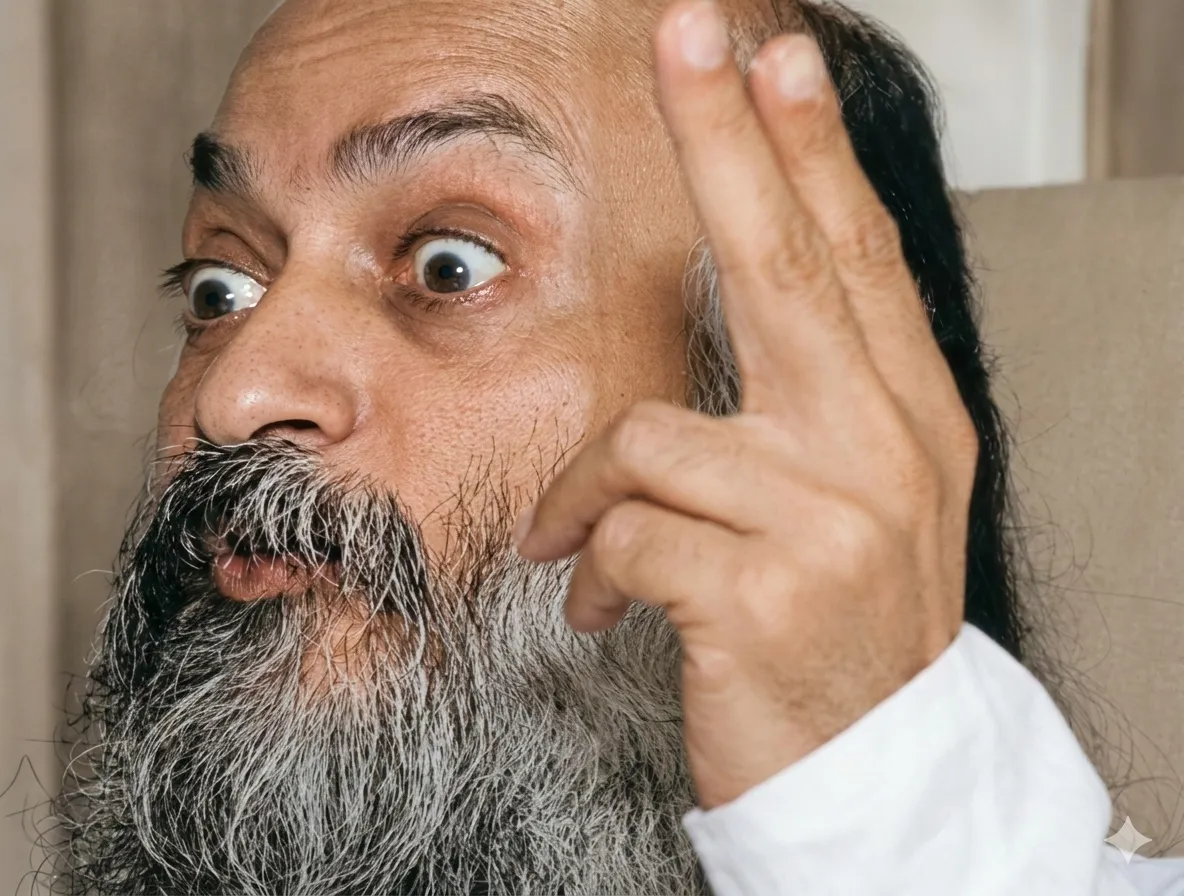
Be honest about being a sannyasin, stay loving and playful if he’s upset, and show your happiness—maybe teach him to watch his breath.
From the Discourses
Passages where Osho speaks to this question — each links to the complete discourse.
Beloved Osho, in a few days I am going to visit my eighty-year-old father whom I have not seen for seven years. He is very insistent about seeing me but at the same time very unhappy that I am a sannyasin. How to make him feel good and still not feel like a hypocrite?
You are not going... that's the only way! In the first place to go to Europe in such conditions of nuclear radiation is dangerous; there is no point. Secondly, to make him unhappy while he is dying at the age of eighty is not good. If you go as a sannyasin he will be more unhappy than if you don't go. For seven years you have not gone. If you go as a non-sannyasin you will feel unhappy that you are being a hypocrite, and there is every possibility that it will be discovered that you are simply pretending to be a non-sannyasin. So why harass the old man? And it is not certain that he is going to die. As far as I know the longer a person lives the less is the possibility of death. Have you ever heard of anybody dying at one hundred twenty, one hundred…
The children are always afraid. The fear is that if they are true then the parents are hurt. If they want to satisfy the parents they have to be untrue; then it hurts them. This is the problem. Parents don t allow authenticity they don't want you to be yourself. They have a certain idea of how you should be, what you should be. If you are that, they are happy; if you are not that, they are unhappy. And nobody can fulfill their idea, nobody at all, because you are not here in this world to fulfill anybody's idea. And your parents cannot conceive who you are going to be. The future is open -- utterly open and unpredictable -- but each parent tries to control the future and each parent feels frustrated. It is very difficult to find a parent who is satisfied.
Surrendering means surrendering the ego and living without the ego. Go, try, but come back! [A sannyasin who is leaving says she is worried about seeing her father again: I really want him to approve of what I'm doing. I feel even though he was here and he's been talking about you as well, I still feel he's so disapproving of it all, of what I'm doing.] Mm mm. It has nothing to do with you. Every father will feel that way, because these so-called love-relationships -- the father's relationship to the children, the mother's relationship to the children or children's relationship to their father -- are all possessive relationships. We don't yet know how to relate and not possess, so wherever there is a possessive relationship there will always be a problem. Now suddenly he will see that you belong to me more than to him. Mm?
[A new sannyasin asks if Osho can help his father understand his taking sannyas because he is suffering over it.] You can help him but his understanding cannot be guaranteed. If somebody wants to suffer then there is no way to help. If he is really that much closed -- that he thinks only the thing he thinks is sane and everything else is insane -- then he deserves suffering; he is earning it. This kind of attitude is bound to create trouble. A mind who is open does not suffer because he can see alternatives and he is always ready to look at things in a different and new way. But if a mind is closed then nobody else is responsible; the suffering is his own responsibility. But I am not saying to make him suffer.
Osho, I have heard that a seeker has to pass through four stages of sadhana: tariqat, shari’at, marifat, and haqiqat. The last is haqiqat, where the seeker meets his beloved and comes face to face with Truth. Osho, please explain the first three states.
These words are from the Sufis—very significant, and very straightforward. The first is tariqat. Tariqat means: the way, the method, the discipline, the means, the yoga. Tariqat means: something has to be done; only then will you attain—without doing, you will not receive. One has to walk a path; find the way; make a footpath. One has to bring some discipline into life, give it an order. Tariqat means learning the way to become worthy of it. When you go to have an audience with an emperor, you learn the etiquette of his court. You don’t just walk in. If you do, you will not be accepted. You learn how to sit there, how to stand there, how to bow there. If you are going to meet an emperor, you must taste something of the flavor of the emperor’s way of life. If you are going to meet the Divine,…
दूसरा प्रश्न: ओशो, मैंने सुना है कि साधक को साधना के चार चरणों से गुजरना पड़ता है: तरीकत, शरीअत, मारिफत और हकीकत। अंतिम है हकीकत, जहां साधक अपने सनम से मिलता है और सत्य के साथ उसका साक्षात्कार हो जाता है। ओशो, कृपया पहली तीन स्थितियों को समझायें।
… बहुत सीधे-साफ भी हैं। पहला है तरीकत। तरीकत का अर्थ होता है: तौर-तरीका, विधि-विधान, उपाय, योग। तरीकत का अर्थ होता है: कुछ करना है, तो उसे पा सकेंगे; बिना किये तो न मिलेगा। कुछ रास्ता चलना है; मार्ग खोजना है; पगडंडी बनानी है। कुछ जीवन में अनुशासन लाना है, व्यवस्था देनी है। तरीकत का अर्थ होता है, उसके योग्य हो सकें, इसका तौर-तरीका सीखना है। तुम किसी सम्राट के दर्शन करने जाते हो, तो तुम उसके दरबार का तौर-तरीका सीखते हो। ऐसे ही तो नहीं चले जाते। ऐसे ही तो स्वीकार न हो सकोगे। तुम सीखोगे कि कैसे वहां बैठेंगे, कैसे वहां उठेंगे, कैसे वहां झुकेंगे। सम्राट से मिलने जा रहे हो तो सम्राट के जीवन का जो ढंग है उस ढंग का कुछ स्वाद तुम्हें लेना होगा।