
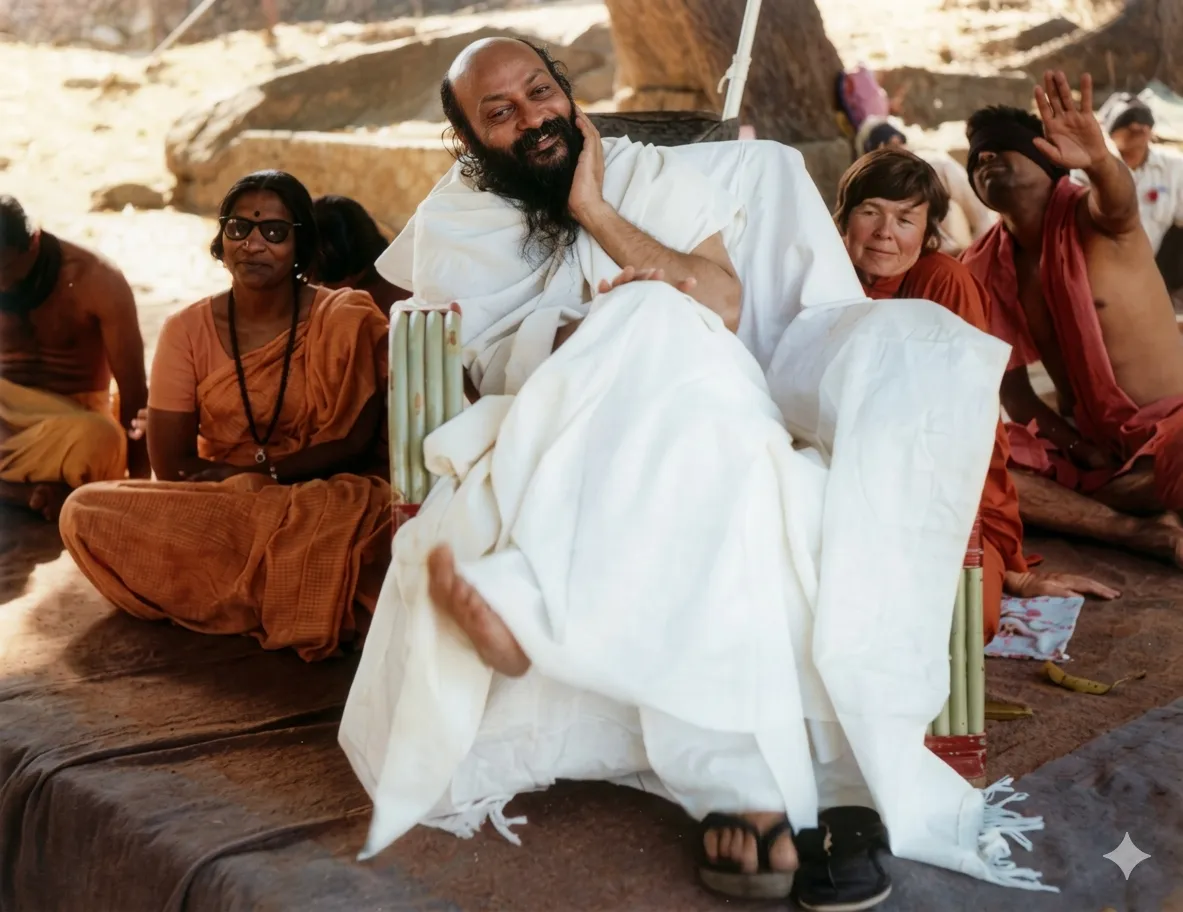
Osho's perspective on Vipassana
When Osho Spoke About Vipassana
Passages from the discourses where this theme comes alive.
Osho, in the practice of Vipassana, when does catharsis occur? I practice Vipassana. How can my work in music assist me toward awareness?
Vipassana is an age-old method of meditation. It must have been discovered thousands of years ago; who discovered it, no one knows. It is a wondrous process, the simplest device to get acquainted with oneself. The word Vipassana means: to sit silently and become a witness to yourself. Pashy means: to see. Vipassana means: just sit silently within and watch. This breath came in, this breath went out—watch that too. The heart beat—watch that too. Sit silently inside and watch whatever is happening. And by and by, all the noises disappear and a vast emptiness surrounds you. Buddha spread the process of Vipassana throughout the world. But there is a hitch: two and a half thousand years have passed since Buddha. The method of Vipassana is the same, unchanged. But man’s waywardness is not the same—he has gone further and further into it. Vipassana is simple for an innocent, guileless…
प्रश्न: ओशो, विपस्सना की साधना में कैथार्सिस कब होती है? मैं विपस्सना का अभ्यास करता हूं। मेरा संगीत का कार्यक्षेत्र होश की दिशा में मेरे लिए किस प्रकार सहायक हो सकता है?
विपस्सना सदियों पुरानी पद्धति है ध्यान की। इसकी खोज हजारों वर्ष पहले हुई होगी। किसने इसे खोजा, पता नहीं है। अदभुत प्रक्रिया है। स्वयं से परिचित होने का सरलतम उपाय है। विपस्सना शब्द का अर्थ है: चुपचाप बैठ कर अपने आपका साक्षी हो जाना। पश्य का अर्थ है: देखना। विपस्सना का अर्थ है: बस चुपचाप भीतर बैठ कर देखना। यह श्वास भीतर आई, यह श्वास बाहर गई, इसको भी देखना। यह हृदय धड़का, इसको भी देखना। चुपचाप भीतर बैठ कर, जो भी हो रहा है, उसे देखना। और देखते-देखते ही सारी आवाजें विलीन हो जाती हैं और एक महाशून्य तुम्हें घेर लेता है। बुद्ध ने विपस्सना की प्रक्रिया को सारे जगत में विस्तीर्ण किया। …
Beloved Osho! Yesterday, for the very first time I did Vipassana meditation at the camp. I felt such a flight! Please shed more light on Vipassana.
Buddha says: if you try to regulate the breath in any way, great fruit never comes from effort. The effort is yours; you are small. Your effort cannot be bigger than you. Your hands are small; wherever the imprint of your hand falls, smallness will remain. Therefore Buddha did not say: change the breath. Buddha did not endorse pranayama. He said: you simply sit; the breath is already moving—just sit and watch it as it is moving. As one sits by the roadside and watches the passersby, or sits on a riverbank and watches the flowing current. What will you do? If a big wave comes, you will watch; if no wave comes, you will watch. Cars and buses pass on the road—you watch; if none pass, you watch. Cows and buffaloes pass—you watch. Whatever is there, as it is, keep looking at it just so. Do not impose even…
पहला प्रश्न: प्यारे ओशो! कल प्रथम बार मैंने शिविर में विपस्सना ध्यान किया। इतनी उड़ान अनुभव हुई! कृपया विपस्सना के बारे में और प्रकाश डालें।
बुद्ध कहते हैं, तुम अगर चेष्टा करके श्वास को किसी तरह नियोजित करोगे, तो चेष्टा से कभी भी महत फल नहीं होता। चेष्टा तुम्हारी है, तुम ही छोटे हो; तुम्हारी चेष्टा तुमसे बड़ी नहीं हो सकती। तुम्हारे हाथ छोटे हैं; तुम्हारे हाथ की जहां-जहां छाप होगी, वहां-वहां छोटापन होगा। इसलिए बुद्ध ने यह नहीं कहा है कि श्वास को तुम बदलो। बुद्ध ने प्राणायाम का समर्थन नहीं किया है। बुद्ध ने तो कहा: तुम तो बैठ जाओ, श्वास तो चल ही रही है; जैसी चल रही है बस बैठकर देखते रहो। जैसे राह के किनारे बैठकर कोई राह चलते यात्रियों को देखे, कि नदी-तट पर बैठ कर नदी की बहती धार को देखे। तुम क्या करोगे? आई एक बड़ी तरंग तो देखोगे और नहीं आई तरंग तो देखोगे। राह पर निकली कारें, बसें, तो देखोगे; नहीं निकलीं, तो देखोगे। गाय-भैंस निकलीं, तो देखोगे। जो भी है, जैसा है, उसको वैसा ही देखते रहो। जरा भी उसे बदलने की आकांक्षा आरोपित न करो। बस शांत बैठ कर श्वास को देखते रहो। देखते-देखते ही श्वास और शांत हो जाती है। …
Beloved Osho, watching the breath is my meditation. I find it miraculous. Is it a method that needs to be dropped, and if so, does it drop on its own? Would you speak more about vipassana meditation?
Kaveesha, there is nothing more to say about vipassana meditation. The word `vipassana' means watching, particularly watching the breath -- as it comes out, as it goes in. You simply continue to watch it, its movement in and out. And the method has not to be dropped, because when the time comes it disappears of its own accord. When your watchfulness is perfect, the method disappears. All the methods that I have given to you are such that you will not need to drop them. Just use them to perfection, and the moment they are perfect they will drop on their own -- just like ripe fruit falling from the tree. And when a method disappears on its own, it has a beauty; then your watchfulness is unscratched. You are on the right path; just continue till the method disappears of its own accord, and you are left simply a…
Beloved master, the other night during darshan, listening to your answer to nivedano's question, I had tears running down my face. For the first time in the seven years I've been with you, I could not only intellectually understand, but really feel that to look inside oneself is the only way to find the real treasures of life. Even though I am feeling this so strongly, it doesn't make it easier to meditate, to look inside. In the past my favorite subject for you to talk about has always been love and relationships. Now, I can't get enough of hearing you talk about meditation. Beloved master, c
Prem Sampurna, there are hundreds of methods of meditation, but perhaps vipassana has a unique status; just the same way as there have been thousands of mystics, but Gautam Buddha has a uniqueness of his own. In many ways he is incomparable, in many ways he has done more for humanity than anybody else. In many ways his search for truth was more sincere, more authentic than anybody else's. Why am I reminded of Gautam Buddha? I am reminded of Gautam Buddha because you have asked a question about vipassana meditation. That is the meditation through which Gautam Buddha became enlightened. The very word vipassana in Pali, the language in which Gautam Buddha spoke... he was perfectly acquainted with Sanskrit; as a prince he was well educated in the highest literature of those days. But when he started speaking he never used Sanskrit because Sanskrit was the language of the…
What is Vipassana meditation?
definitionProfound Quotes on Vipassana
Explore our structured collection of meaning-mapped quotes regarding Vipassana.