
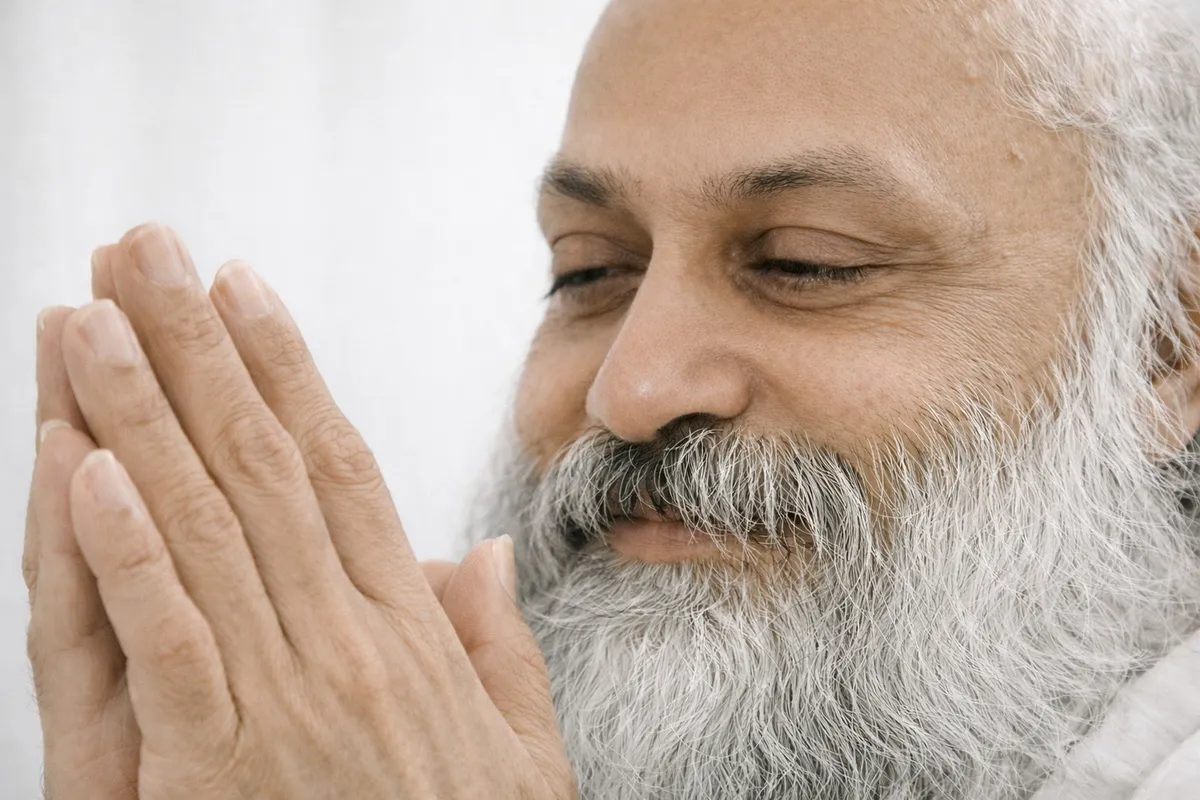
Osho rejected both of the usual ways of dealing with anger. Expressing it turns it into a habit; repressing it lets it accumulate until it explodes. His way was a third one: know the anger, watch it, and do not become identified with it.
The passages below come from his discourses, several of them from Osho Live's own English translations of his Hindi talks.
From the Discourses
Passages where Osho speaks on anger — each links to the complete discourse.
Osho, ever since I first heard you, this question has been on my mind: just as a disturbed person has anger—for himself—does a peaceful person also have anger—for others, for society?
Yes, yes—there will indeed be anger. Even a truly peaceful man has anger; he has his war, his struggle. But not for himself—that is the only difference. The disturbed person fights too, but he fights for himself. The peaceful person will fight for others; he too will be filled with anger, but there is no anger left in him for himself. His anger no longer has any inner, private cause. So I say: the individual should be peaceful, and there should be a revolution in society. I hold that only a peaceful person can bring revolution, because how will a disturbed person bring it? What is most needed to bring revolution is a quiet, steady mind—and that he does not have. But up to now it has happened that the peaceful person has not brought revolution. The reason was that his peace was dead; it was not alive. A man…
ओशो, आपको पहली बार सुना था, तब से यह प्रश्न मन में है कि जैसे अशांत व्यक्ति का गुस्सा होता है, क्रोध होता है--अपने लिए। वैसे ही क्या शांत व्यक्ति का भी क्रोध होता है, गुस्सा होता है--दूसरों के लिए, समाज के लिए?
हां-हां, बिलकुल होगा गुस्सा। बिलकुल ही शांत आदमी का गुस्सा भी होता है, युद्ध भी होता है उसका, संघर्ष भी है उसका। लेकिन अपने लिए नहीं है, इतना ही फर्क है। अशांत व्यक्ति भी लड़ता है, लेकिन वह अपने लिए लड़ता है। शांत व्यक्ति दूसरे के लिए लड़ेगा भी, क्रोध से भी भरेगा, लेकिन अपने लिए अब उसका कोई क्रोध नहीं है। क्रोध का उसका कोई अब भीतरी कारण नहीं है। तो मैं जो कहता हूं, व्यक्ति शांत होना चाहिए और समाज में एक क्रांति आनी चाहिए। मेरा मानना है कि शांत व्यक्ति ही क्रांति ला सकता है, क्योंकि अशांत व्यक्ति बेचारा कहां से क्रांति लाएगा! क्रांति लाने के लिए जो शांत चित्तता चाहिए, वही उसके पास नहीं है। लेकिन शांत व्यक्ति अब तक--यह रहा है अब तक--कि अब तक जो शांत व्यक्ति रहे हैं, उन्होंने कोई क्रांति नहीं लाई है। और उसका कारण यह था कि उनकी शांति भी मुर्दा थी, वह शांति जिंदा नहीं थी। तो एक आदमी ऐसे भी शांत हो सकता है कि बिलकुल मुर्दा हो जाए, निष्क्रिय हो जाए, तो भी शांत हो जाता है। …
Anger comes in a second—then how can we suppress it in a second?
No, no—I am not talking about suppression. I am not saying suppression. (The audio recording of the question is not clear.) Find solitude—close the door somewhere, sit quietly—and watch whatever arises. Just watch; do not do anything. It will arise for a moment—watch exactly that. No worry. You are mistaken in thinking anger arises for only a moment; its surge lingers for a long time. The flare-up may be a moment, but its trailing line of smoke can go on and on. No worry if you cannot see it in its full youth; even if it appears in its old age, there is no harm. Even if only its final streak is visible, there is no harm. Begin the experiment of seeing. As the practice of seeing grows dense, one day it will be caught right at its birth. For now, it will be like this—that you will see its…
आपने एक प्रश्न पूछा है कि आनंद का थोड़ी देर को अनुभव होता है, फिर वह आनंद चला जाता है। तो वह आनंद और अधिक देर तक कैसे रहे?
(प्रश्न का ध्वनि-मुद्रण स्पष्ट नहीं है।) हां, मेरी धारणा मैं आपको बताऊं...
According to last night's technique, when anger, violence, sex, etc., arises, one should consider it and then suddenly quit it. But when one does it, one sometimes feels sick and uneasy. What are the reasons for these negative feelings?
Only one reason: your consideration is not total. Everyone wants to quit anger without understanding it; everyone wants to quit sex without understanding it. And there is no revolution without understanding. You will create more problems and you will create more misery for yourself. Do not think of renouncing anything, just think of how to understand it: understanding, not renunciation. There is no need of thinking to quit anything. The only need is to understand it in its totality. If you have understood it in its totality, the transformation will follow. If it is good for you, if it is good for your being, it will grow. If it is bad for you, it will drop. So the real thing is not quitting, it is understanding. Why do you think about renouncing anger? Why? Because you have been taught that anger is bad. But have YOU understood it as bad?…
Beloved Osho, I am angry with my parents for the first time. They are simple people, and I say to myself that it is not their fault that they have no understanding of Osho. But my anger is so much in conflict with my love that it hurts. I am so angry writing this that I can't even formulate the question. Can you help please?
Animals are not creating anything, they are simply producing carbon copies. And now science has come to a point where they have discovered that carbon copies can really be produced! It is a very dangerous idea. If we make banks -- and sooner or later we are going to make them; once an idea is there it is going to become a reality. And scientifically it is proved that it is one hundred percent possible... there is no problem. We can have banks in the hospitals for both the male sperms and female eggs. And we can create exactly the same two sperms and exactly the same two eggs, so two children are born which are exactly the same. One child will be released into the world; the other will grow in a fridge, unconscious, but all his parts will be exactly the same as the other person. And if…
Read 8 more passages on anger
Beloved Osho, though we can be aware of anger and refrain from hurting others with it, inner anger seems to remain in a dormant state, and at times it becomes aroused by outer happenings. It doesn't seem possible to entirely throw it as it is deep-rooted in early, wrong training, and a lifetime of struggle in the world. Isn't the total disappearance of anger simultaneous with enlightenment? Does an enlightened one ever have any anger?
The first thing: if you feel angry and if you think that it is needed for it to be suppressed, suppress it for the time being -- because it is useless just to be angry with someone and then create a chain. Then he will be angry and then more anger will be created, and this can continue even for lives. Everything has a continuity of cause and effect; it becomes a chain. So if you feel anger and you see it is going to be destructive to you and to the other person, smile, have a false face. And move to your room, close the doors, take your pillow and beat it. Write the name of the person on the pillow and do whatsoever you wanted to do with the person. Don't suppress it in the system because that is too dangerous. Anger is poison, and when the body…
Osho, I am ignorant. All around me there is nothing but darkness. What is the path for me?
Music! Darkness is only proof that light can be. Darkness is only evidence that light is possible. So do not look at darkness with a negative outlook. Do not look with the eyes of an atheist; look with the eyes of a theist. Then even in darkness you will sense light hidden within it. Darkness is the womb of light. Do not be alarmed by darkness, nor afraid, nor anxious—be blissful, for the morning must be coming! And the denser the darkness, the nearer the dawn. Deep is this darkness; by the veils of selfishness we have been plundered. A wall of dead matter stands encircling, people speak as if turning their faces away; in this sky there is no sun, no moon, no star. An infinite ocean of imagination this, roaring as it girds the body, fierce— nothing is understood; where is the dusky shore? Beloved, give me that…
आखिरी प्रश्न: ओशो, मैं अज्ञानी हूं। मेरे चारों ओर अंधकार ही अंधकार है। मेरे लिए क्या मार्ग है?
संगीत! अंधकार केवल एक बात का प्रमाण है कि आलोक हो सकता है। अंधकार केवल एक चीज का सबूत है कि आलोक संभव है। इसलिए अंधकार को नकारात्मक दृष्टि से मत देखो। नास्तिक की दृष्टि से मत देखो। आस्तिक की दृष्टि से देखो। तो फिर तुम्हें अंधकार में भी रोशनी छिपी मालूम पड़ेगी। अंधकार तो गर्भ है रोशनी का। अंधकार से घबड़ा न जाओ, न भयभीत, न चिंतित--आनंदमग्न, क्योंकि आती होगी सुबह! और जितना अंधकार घना होता है, भोर उतनी ही करीब होती है। गहन है यह अंध कारा; स्वार्थ के अवगुंठनों से हुआ है लुंठन हमारा। खड़ी है दीवार जड़ की घेर कर, बोलते हैं लोग ज्यों मुंह फेर कर, इस गगन में नहीं दिनकर, नहीं शशधर, नहीं तारा।
A friend has asked, Osho, I am very restless, and so much energy gets used up in this restlessness. How can I make use of it, and what is its cause?
But the anger remains there; it will not change by your turning away. It will change by your standing your ground and seeing it. If you turn your back, anger will make deeper wounds within and lay down roots. Fix both your eyes on anger. This is the moment to consciously see anger. When lust seizes the mind, do not run. Do not panic. Do not chant Ram-Ram. Look lust straight in the face. A direct encounter with the passions is necessary. But man has been taught to run. He has been told, wherever something bad appears—run away. But where will you run? The bad is within you; it will go with you. There is no way to run away from yourself. If evil were outside somewhere, we could run. It stands within—we will have to change it. We will have to use this manure. And using it is not…
एक मित्र ने पूछा है, ओशो, मैं बहुत बेचैन हूं और मेरे पास इतनी बेचैनी है कि सारी शक्ति इस बेचैनी में ही समाप्त हो जाती है। तो मैं इस बेचैनी का क्या उपयोग कर सकता हूं और इस बेचैनी का कारण क्या है?
लेकिन क्रोध वहां पड़ा है, वह बदलेगा नहीं। आपके हटने से नहीं बदलेगा; आपके जम जाने से और देखने से बदलेगा। आप पीठ कर लेंगे, तो क्रोध और घाव बना देगा भीतर, और जड़ें जमा लेगा। आप अपनी दोनों आंखें क्रोध पर गड़ा दें। और यह क्षण है कि आप होशपूर्वक क्रोध को देख लें। कामवासना मन को पकड़े, तो भागें मत। घबड़ाएं मत। राम-राम मत जपें। कामवासना को सीधा देखें। सीधा साक्षात्कार जरूरी है वासनाओं का। लेकिन आदमी को भागना सिखाया गया है। उसको कहा गया है, जहां भी कुछ बुरा दिखाई पड़े, भाग खड़े होओ। लेकिन भागोगे कहां? बुरा तुम्हारे भीतर है, वह तुम्हारे साथ चला जाएगा। अपने से भागने का कोई भी रास्ता नहीं है। अगर बुराई कहीं बाहर होती, तो हम भाग भी जाते। वह हमारे भीतर खड़ी है, उसको बदलना पड़ेगा। इस खाद का उपयोग करना पड़ेगा। और इसका उपयोग करना बहुत कठिन नहीं है।
Question: A ZEN STUDENT CAME TO BANKEI AND SAID: 'MASTER, I HAVE AN UNGOVERNABLE TEMPER -- HOW CAN I CURE IT?' 'SHOW ME THIS TEMPER,' SAID BANKEI, 'IT SOUNDS FASCINATING.' 'I HAVEN'T GOT IT RIGHT NOW,' SAID THE STUDENT, 'SO I CAN'T SHOW IT TO YOU.' 'WELL THEN,' SAID BANKEI, 'BRING IT TO ME WHEN YOU HAVE IT.' 'BUT I CAN'T BRING IT JUST WHEN I HAPPEN TO HAVE IT,' PROTESTED THE STUDENT. 'IT ARISES UNEXPECTEDLY, AND I WOULD SURELY LOSE IT BEFORE I GOT IT TO YOU.' 'IN THAT CASE,' SAID BANKEI, 'IT CANNOT BE PART OF YOUR TRUE NATURE. IF IT WERE, YOU COULD SHOW IT TO ME AT ANY TIME. WHEN YOU WERE BORN YOU DID NOT HAVE IT, AND YOUR PARENTS DID NOT GIVE IT TO YOU -- SO IT MUST COME INTO YOU FROM THE OUTSIDE.
What need to learn?' But paper boats do not cross; they sink midway. And this conduct trained on the surface will throw you into great inner conflict. A conflict will go on within. Whatever you want to do, you will not do; whatever you do, you will not want to do. You will smile on the surface and burn with anger within. Your life will become hell, stretched in two directions. What is unrest? The seeds of hypocrisy bring unrest. What is torment? You are pulled between two so that you can be neither here nor there. On the surface you feel anger is bad and should not be done; inside anger boils. Then you put on a mask, hide your face, cover your mouth with false faces. But whom are you deceiving? Even if you succeed in deceiving the other, before your own inner soul you will remain naked.
और फिर यह जो ऊपर-ऊपर से साधा गया आचरण है, यह तुम्हें बड़ी भीतरी कलह में डाल देगा। एक कांफ्लिक्ट, एक द्वंद्व तुम्हारे भीतर चलता ही रहेगा। क्योंकि जो भी तुम करना चाहोगे, करोगे नहीं; और जो भी तुम करोगे वह तुम करना न चाहोगे। मुस्कुराओगे ऊपर, भीतर क्रोध से भरे रहोगे। तुम्हारा जीवन नरक बन जाएगा। तुम दोनों दिशाओं में तने रहोगे। अशांति और क्या है? पाखंड के बीज अशांति लाते हैं। संताप और क्या है? कि तुम इस तरह खिंचे हो दो चीजों में कि न इस तरफ हो पाते हो, न उस तरफ हो पाते हो। ऊपर से तुम्हें लगता है कि क्रोध बुरा है, क्रोध करना नहीं; और भीतर क्रोध उबलता है। तब तुम एक मुखौटा ओढ़े लेते हो, मुंह छिपा लेते हो, झूठे चेहरे मुंह पर ढांक लेते हो। पर तुम किसको धोखा दे रहे हो? दूसरे को चाहे तुम देने में सफल भी हो जाओ, अपनी ही अंतरात्मा के समक्ष तो तुम नग्न ही रहोगे। वहां तो कोई मुखौटे काम न देंगे। और वहां तो तुम जानोगे ही कि असलियत क्या है। सत्य इस तरह के मुखौटों से कभी उपलब्ध नहीं हो सकता। …
"please explain how it is possible that one can be spiritually transformed by being total in actions that are of anger, hatred and violence."
In any situation, the volcano may erupt. It is erupting every day. Someone kills someone, and just a day before he was as normal as you. No one ever suspected that he was going to be a murderer. No one suspects about you, and you have so many thoughts in your mind to murder. You have thought, you have planned it many times. The idea to murder someone else or yourself has come to you. It has happened to you if you are not absolutely idiotic. Psychologists say that an intelligent man is bound to think of suicide at least ten times in his life -- at least ten times! -- and ten thousand times you think to murder someone. You never do it, that is another thing. But you can do it; the possibility is always there. Make your anger a total act in meditation, and then see what…
Osho, yesterday you described the cathartic practice of pillow‑beating to release anger. In the same way, what practices should be done for the cessation of lust, greed, attachment, and ego? Please shed some light on these.
The friend I mentioned yesterday—today his companion told me he actually pulled out a knife and ripped the pillow to shreds. I hadn’t even suggested that! It makes us laugh: how can someone stab a pillow? But when we can rip a living person apart, we don’t laugh—so what’s the difficulty in slicing a pillow? When someone tears a living person, the “juice” is in the tearing itself; the person is incidental. That same juice can arise with a pillow. In fact, more so—because with a pillow you need impose no limits at all. So shut yourself in your room, and when your root “disease” wants to show itself, let it show. Consider this meditation. Let it come out in every pore of your being. Shout, jump, do whatever is happening—let it happen. And watch from behind—you will even feel like laughing. You will be surprised: “I can do this?”…
प्रश्न: ओशो, जैसे कल आपने कैथार्सिस, फुट पिलो बीटिंग के जरिए क्रोध-निवृत्ति का प्रयोग बताया, वैसे काम, लोभ, मोह और अहंकार की निवृत्ति के लिए कौन से प्रयोग किए जाएं, कृपया इन बातों पर दृष्टि डालिए।
जिस मित्र का मैं कल कह रहा था, आज उसके साथी ने मुझे आकर खबर दी है कि आज तो चाकू निकाल कर उसने तकिए को चीर-फाड़ डाला है। यह तो मैंने कहा भी नहीं था। हमें एकदम हंसी आएगी कि तकिए को कोई चाकू से कैसे चीरेगा-फाड़ेगा? लेकिन जब जिंदा आदमी को चीर-फाड़ सकते हैं हम, तब हंसी नहीं आती, तो तकिए को चीरने-फाड़ने में कौन सी कठिनाई है? और जब एक आदमी जिंदा आदमी को भी चीरता-फाड़ता है, तब भी जो रस है वह चीरने-फाड़ने का है, आदमी से कुछ लेना-देना नहीं है। वह तकिए में भी उतना ही रस आ जाता है। और तकिए में रस ज्यादा आ जाता है, क्योंकि तकिए पर कोई भी सीमा बांधने की जरूरत नहीं है। तो अपने कमरे में बंद हो जाएं और अपने मूल, जो आपकी बीमारी है, उसको जब प्रकट होने का मौका हो, तब उसे प्रकट करें। इसको मेडिटेशन समझें, इसको ध्यान समझें। उसे पूरा निकालें। उसको आपके रोएं-रोएं में प्रकट होने दें। चिल्लाएं, कूदें, फांदें, जो भी हो रहा है उसे होने दें। और पीछे से देखें, आपको हंसी भी आएगी। हैरानी भी होगी। …
Osho, we find that our tendencies are stronger than our understanding. When watched with awareness, the waves of hatred, jealousy, anger—all these tendencies—seem to rise from the navel center. The witnessing and the rising of the wave happen together. Please tell us why these waves arise from the navel center. Is the unconscious related to the navel center? And is there a large accumulation of these tendencies in the unconscious, or are they produced moment to moment?
The stream of consciousness itself is not divided. The split into conscious and unconscious exists because of repression. First understand this well. A child is born with consciousness one and undivided. There is neither a conscious mind nor an unconscious mind—no such two parts. But soon the division starts, because we teach the child what is right and what is wrong; what is auspicious and what is inauspicious; what to do and what not to do. And all that we brand as “don’t,” “bad”—what will the child do with it? Calling something bad does not destroy it. We say anger is bad. The child hears and understands—but anger doesn’t vanish just because we label it bad, because anger is natural. The child has not learned anger; he is born with it, just as he is born with a body, with eyes and hands. And existence uses anger: anger is energy.…
प्रश्न: ओशो, हम पाते हैं कि हमारी समझ से वृत्तियां ज्यादा मजबूत हैं। होश से देखने पर घृणा, ईर्ष्या, क्रोध,इन सारी वृत्तियों की लहरें नाभि-केंद्र से उठती हुई दिखाई देती हैं। साक्षीभाव और लहर का उठना एक साथ घटता है। कृपया यह बताएं कि ये लहरें नाभि-केंद्र से क्यों उठती हैं? क्या अचेतन नाभि-केंद्र से संबंधित है? तथा क्या इन वृत्तियों का अचेतन में बहुत बड़ा संचय है या क्षण-क्षण ये वृत्तियां पैदा होती रहती हैं?
चेतना की धारा विभाजित नहीं है। चेतन और अचेतन, दमन के कारण विभाजित हैं। पहले यह बात ठीक से समझ लें। बच्चा पैदा होता है, तो उसकी चेतना एक और अखंड है। न तो वहां कोई चेतन मन है और न अचेतन मन। ऐसे दो भाग नहीं हैं। लेकिन जल्दी ही भाग होने शुरू हो जाएंगे। क्योंकि हम बच्चे को सिखाएंगे, क्या ठीक है, क्या गलत है। हम उसे बताएंगे, क्या शुभ है, क्या अशुभ है; क्या तुम करो, क्या तुम न करो। और जो-जो हम कहेंगे न करो, जो-जो हम कहेंगे बुरा है, वह बच्चा क्या करेगा? बुरा कहने से कोई चीज नष्ट तो होती नहीं। कहा हमने कि क्रोध बुरा है। बच्चे ने सुना और समझा। लेकिन इतना कहने से कि क्रोध बुरा है, क्रोध नष्ट तो नहीं होता, क्योंकि क्रोध स्वाभाविक है। बच्चे ने क्रोध सीखा नहीं है, जन्म से पाया है। जैसे शरीर पाया है, आंखें और हाथ पाए हैं, ऐसे ही क्रोध भी पाया है। और प्रकृति क्रोध का उपयोग करती है। क्रोध ऊर्जा है। बिना क्रोध के बच्चा मर जाएगा। …
Anger in Osho's Words
The threads that run through his discourses on anger.
Knowing, Not Fighting
Fighting your own energy can only defeat you.
So it is not a question of fighting with the anger, it is a question of knowing the anger -- because, remember, there is no greater energy than knowing, and there is no greater stupidity than fighting with one's own energies.The Inner Journey, Chapter 7, Para 63 →
Why Repression Fails
Suppressed anger does not disappear; it accumulates.
Generally, very hot-tempered people do not kill, because their anger is released day by day. But the one who goes on suppressing anger—many times people say, “He was so simple; how did he do this?” He suppressed it for a long time. The surge accumulated. ... Any craving, any impulse—if indulged, it becomes a habit; if suppressed, it can make you neurotic. So the second path is no path.Upasana Ke Kshan, Chapter 2, Question 6 →
Ride the Wave and Watch
The danger is identification, not anger itself.
Ride on the wave of anger and watch it. The problem arises when anger rides on you and the watcher is lost. Then you get identified. Nothing is wrong in anger. Just don't get identified; watch it.The True Sage, Chapter 10, Question 6 →
The Mask of Control
What happens when anger is merely hidden behind good manners.
You will smile on the surface and burn with anger within. Your life will become hell, stretched in two directions.Tao Upanishad, Chapter 93, Para 1 →
Questions Osho Answered on Anger
18 questions in the library — the most sought-after:
A calm person may still get mad, but only to help others and fix unfairness, not because their own ego is hurt.
If you bottle anger, it builds like poison and, when poked, it spills onto others and hurts you too—so let it out safely, not on people.
If you drop these suddenly because others say they’re bad, you just push them down without really seeing them, and that inside fight makes you feel ill.
Being mad at your parents mostly hurts you; they didn’t know better, so choose kindness and break the pattern.
When anger suddenly shows up, go somewhere quiet and just watch it without judging or acting; like steam, it rises and disappears, and with practice it won’t stick around.
Feeling “right” to be angry is mostly your mind protecting a pretend good-image; drop the mask, look honestly, and the anger melts.
If desire still grabs you while you watch it, you weren’t truly awake—practice steady awareness on easy things (like breathing) before tackling strong urges.
Saying sorry after you get mad is polite, but only noticing your anger as it begins can make it melt away.
Frequently Asked
Not as a solution. Indulged anger becomes a habit. Osho's way was neither expression nor repression but awareness.
Because it accumulates. Osho observed that people who keep suppressing anger can one day explode far more dangerously than those who are openly hot-tempered.
Let the wave of anger come, but remain the watcher of it rather than becoming identified with it. Osho said nothing is wrong in anger itself; the problem is losing the watcher.