
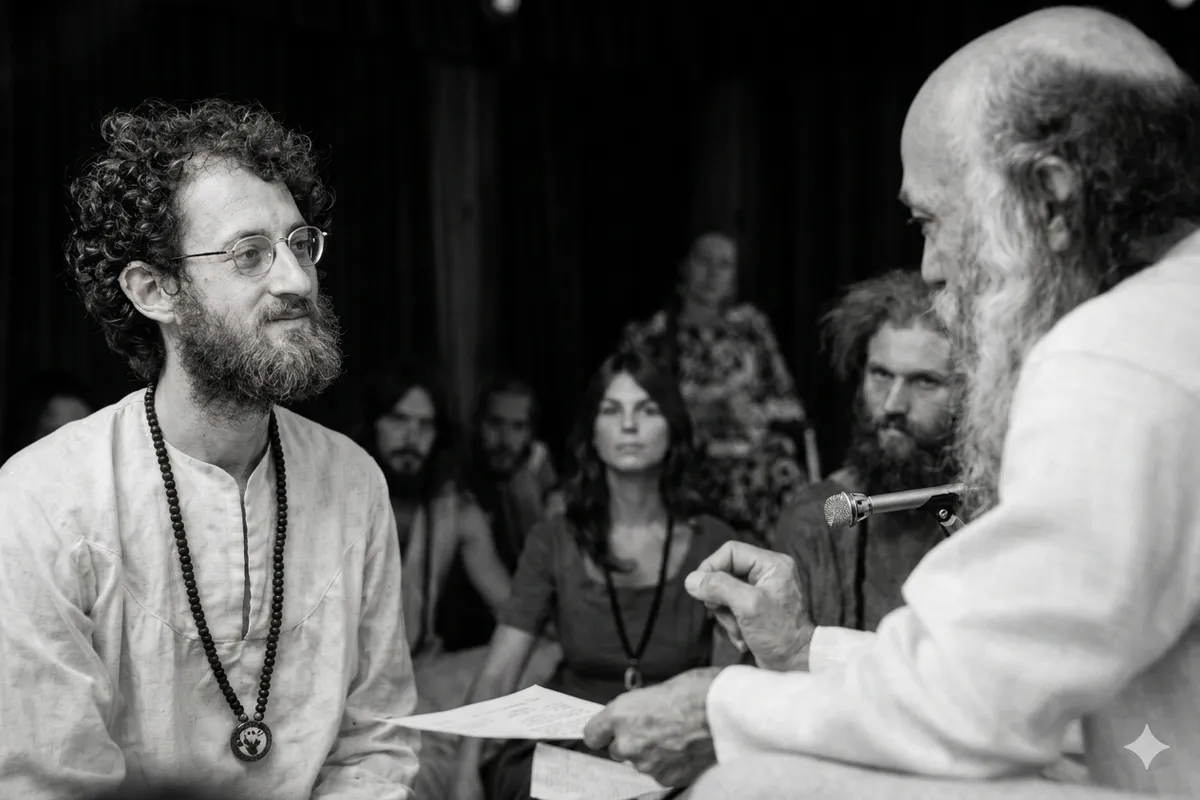
Don’t look for a technique; just keep noticing you are the watcher, not your thoughts or memories, and real knowing will arise by itself.
From the Discourses
Passages where Osho speaks to this question — each links to the complete discourse.
Osho, you say, “As He wills, let us become mere instruments; whatever role in life we have been given, let us fulfill it.” But letting what happens happen—i.e., flowing along with the body, mind, and ego—gives rise to suffering. So should we keep applying the principle of instrumentality even in relation to the body, mind, and ego, and go on suffering? How do we solve the riddle between the principle of instrumentality and the continuous reality of suffering?
That supreme bliss is beyond both pleasure and pain. It is neither like night nor like day. It is twilight. The sun has set, night has not yet come; the light remains—very gentle, sweet, non-aggressive—that is twilight. Morning has come, the sun is not yet risen, the night has gone—such is the twilight. One who abides in that twilight—that is what we call prayer. That is why Hindus call their prayer sandhya. Sandhya means one who has stopped in between the dualities, who has found the truce between the two. Between pleasure and pain, love and hate, victory and defeat, night and day, life and death—one who has found the pact and stands in that concord. Seek that interval of conjunction. Krishna says, it is simple to find. If you cease to be the doer, you will find it instantly. It is only through your doer-ship that you keep missing.…
दूसरा प्रश्न: ओशो, आप कहते हैं, जो उसकी मर्जी, हम निमित्त-मात्र हो जाएं; जो भी जीवन में अभिनय मिला है, उसे हम पूरा करें। परंतु जो होता है, उसे होने देने से अर्थात शरीर, मन और अहंकार के साथ बहने से दुख उपजता है। तो क्या हम शरीर, मन और अहंकार के संबंध में भी निमित्त का सूत्र मानते रहें और दुख पाते रहें? निमित्त के सूत्र और दुख के सतत यथार्थ की पहेली को हम कैसे सुलझाएं?
वह परम आनंद सुख-दुख दोनों के पार है। वह न तो रात जैसा है, न दिन जैसा है। वह तो संध्याकाल है। सूरज जा चुका, रात अभी आई नहीं; रोशनी कायम है--बड़ी धीमी, मधुर, अनाक्रामक--वह संध्याकाल है। सुबह हुई, अभी सूरज आया नहीं, रात जा चुकी, ऐसा संध्याकाल है। उस संध्याकाल में जो ठहर गया, उसी को हम प्रार्थना करना कहते हैं। इसलिए हिंदू अपनी प्रार्थना को संध्या कहते हैं। संध्या का अर्थ है, द्वंद्व के बीच में जो ठहर गया; दो के बीच में जिसने संधि खोज ली। सुख-दुख, प्रेम-घृणा, जीत-हार, रात-दिन, जीवन-मृत्यु, सब दो के बीच में जिसने संधि खोज ली, और जो संधि में खड़ा हो गया। उस संधिकाल को खोजो। कृष्ण कहते हैं, सरल है खोज लेना। अगर तुम कर्ता न रह जाओ, तत्क्षण मिल जाएगा। तुम्हारे कर्ता होने से ही तुम चूकते चले जाते हो।
Beloved Osho, through studying texts like vedanta and the ashtavakra geeta, I have learnt that whatever is worth attaining has already been attained. Making efforts for it is going astray. I have deepened this conviction, so why has self-realization not happened? Please show me the path.
He said, "If you don't believe me: here, it is written on the handle, 'A gift for my beloved brother, from your sister.' I was coming out of a restaurant and these letters on the umbrella -- I thought it seems I do have a sister. When it is written it has to be believed. And perhaps there is some sister or cousin.... And religious people have always said you should take every woman except your wife as your mother or sister." When something is published -- and in the scriptures... belief in the written word is very strong. When you tell someone something, he asks where it was this published. If you say where he will believe what you said. It is as if there is some power in writing. Say how ancient it is -- people will accept it. It is as if truth is somehow related to…
One needs experience of one's own. Only trust your own experience, then you are on the right track. In trusting your own experience you will come closer and closer to truth. And when the trust in oneself becomes absolute, unwavering, God is revealed. God cannot be manufactured by the mind; it has to be lived and experienced through the heart. It is a love phenomenon, not a logical conclusion. OSHO (TO PRAGITO): You are ready for many things! Just don't hold back! All that is needed her is flowing with the energy that is available; nonresistance is all that is needed. Our mind naturally resists. The mind is a great no-sayer. It is very afraid to say yes because yes means its death. It lives through no, no is its nourishment.
Osho: That sentence is beautiful. Be still means don't make yourself still. Be still means be still. Don't make any effort to be still, just be still. And if you are doing something to be still, then the stillness will simply be a created, cultivated stillness not the real. Question: "Be still and know.... " Osho: Then you know ultimately -- there is no sense in prolonging the sentence -- be still, and you know. There is no question of knowing. It comes by itself. Just be still.... QUESTION: EVERY MAN SPEAKS FROM HIS OWN EXPERIENCE, HIS OWN LEVEL, RIGHT? ISN'T IT POSSIBLE THAT THERE MIGHT BE A TECHNIQUE THAT WOULD WORK THAT PERHAPS YOU HAVEN'T EXPERIENCED.
Osho, yesterday you said that jealousy is included in respect. I have immense respect for you, but the jealousy inherent in it keeps poisoning it, and I feel guilt and pain. Does reverence transcend this poison-laced respect?
It needs a little explaining—it's a delicate point. Whenever you respect someone, you do so because you see in that person something you do not have. You respect because you glimpse in the other something you would also like to possess. A beggar respects an emperor because he, too, longs to be an emperor. So on the one hand he respects, and inside he also envies. Because he is not yet an emperor but wants to be. You have attained what he wants to attain. He respects you as skillful, successful: “I stand far back in the line; you have gone ahead to where I should have been.” So you are powerful, clever, intelligent, strong—he respects you. But inside a fire of jealousy also burns—if he gets the chance, he would like to be in your place and push you aside. And if the beggar gets that chance, he will…
तीसरा प्रश्न: ओशो, आपने कल कहा, आदर में ईर्ष्या सम्मिलित है। आपके प्रति मुझमें अपार आदर है, लेकिन उसमें निहित ईर्ष्या उसमें जहर घोलती रहती है और मैं ग्लानि और पीड़ा का अनुभव करता हूं। क्या श्रद्धा इस विष-भरे आदर का अतिक्रमण करती है?
भिखारी सम्राट का आदर करता है, क्योंकि उसकी भी आकांक्षा है कि सम्राट हो। तो एक तरफ आदर भी करता है, भीतर ईर्ष्या भी करता है। क्योंकि सम्राट अभी वह है नहीं, सम्राट होना चाहता है। तुम हो गए हो, तुमने वह पा लिया है जो वह पाना चाहता है। इसलिए तुम्हें आदर भी करता है कि तुम कुशल हो, सफल हो, मैं पंक्ति में बहुत पीछे खड़ा हूं, तुम आगे पहुंच गए हो, तुम उस जगह पहुंच गए हो जहां मुझे होना चाहिए था। इसलिए तुम शक्तिशाली हो, होशियार हो, बुद्धिमान हो, बलशाली हो, तुम्हारा आदर करता हूं। लेकिन एक भीतर ईर्ष्या की आग भी जलती है--अगर मुझे मौका मिले तो उस जगह मैं होना चाहूंगा, तुम्हें हटाना चाहूंगा। और जब मौका मिल जाएगा इस भिखारी को तो यह सम्राट को हटा कर धक्का दे देगा, सिंहासन पर बैठ जाएगा।