
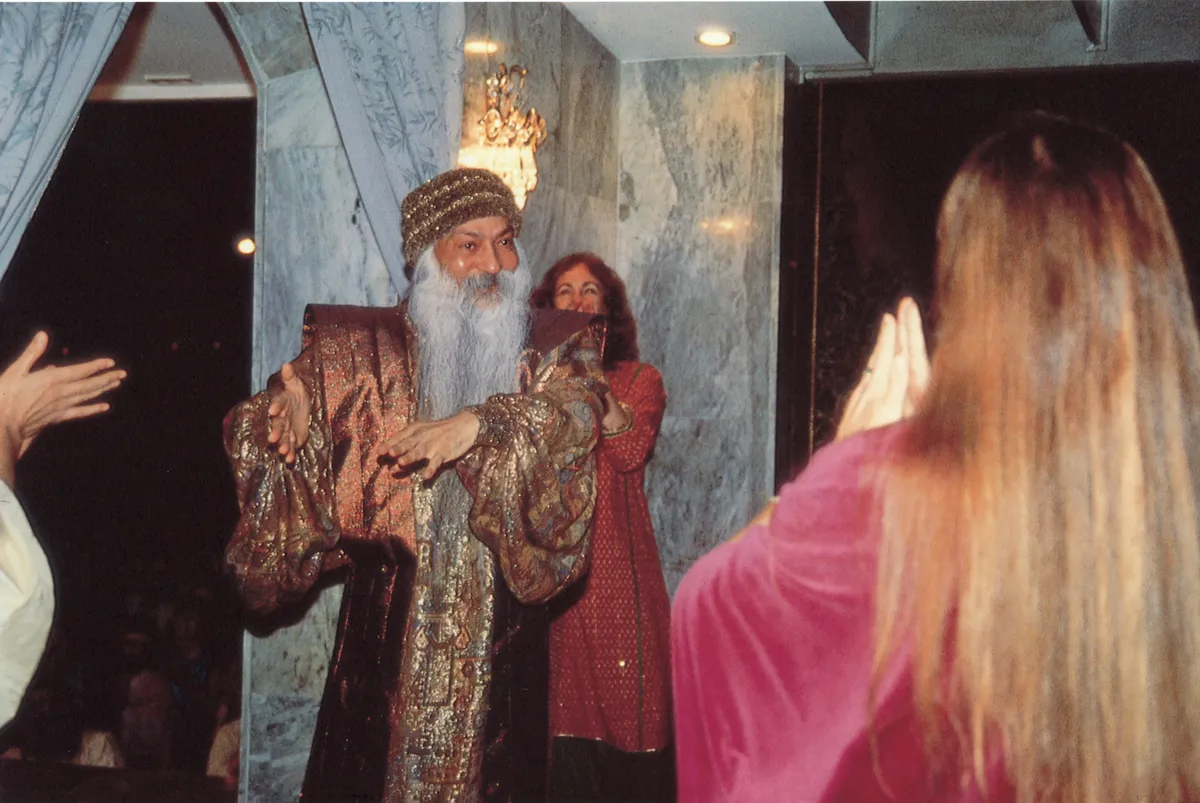
Try your very best until you see you can’t do it alone—then real help can reach you.
From the Discourses
Passages where Osho speaks to this question — each links to the complete discourse.
Osho, you say that truth is attained by the Master’s grace. Then why do you also encourage the ego’s effort?
Truth is attained by the Master’s grace, but the Master’s grace will not come without effort. Where will you find the Master’s grace? The Divine is received as grace; but the Master has to be sought, and you must gather the fitness to be near the Master. Effort must be made—and yet remember, what is ultimate is received without effort. This may sound contradictory, but these are the two wings, the two oars—effort and grace. Only with both is the journey completed. There are two kinds of delusions in the world. Some people think, “By effort alone it will be attained.” Such people never meet the Divine, because their ego never falls; effort only strengthens it. The doors close even tighter instead of opening. And some believe, “It does not come by effort; only grace gives it.” They just sit; they never rise, they never walk. They waste it in…
Beloved Osho, you say that one attains truth with the grace of the master. Then why do you also encourage the effort of ego?
Truth is attained by the grace of the master. But you cannot get the grace of the master without effort. The divine is attained through grace, but one has to seek the master; one has to have the ability to be near the master. Effort has to be made, but always remember that the ultimate is attained without effort. This will seem contradictory to you but these are the two wings, the two oars -- effort and grace. The journey is completed with these two. In this world there are two types of illusion. Some people think that they will attain the divine by their effort. They never attain because their ego never disappears; the effort makes it even stronger -- the doors remain closed instead of opening. There is also the other type of people who believe that the divine cannot be attained through effort, but only through grace.…
Osho, it is said that one attains God only by God’s grace. Then is human effort useless for the attainment of God?
The Jain scriptures do not instruct the monk to fold hands in greeting. He can only bless you—not greet you. But a blessing from one who cannot bow is worth two pennies. Without that much humility, his blessing will not work; it will go in vain. His blessing is barren; no flowers can bloom from it. The Jain monk is a monk—but with great pride in being a monk. The Hindu monk is not a monk—but there is one advantage there: no ego. Choose half, and there is both benefit and danger. The Jain monk grows more and more stiff. The more he fasts, the more vows he takes, the more austerities he performs, the deeper the rigidity; the thicker the sense of “I.” This “I” has to be dropped one day. If you fatten it too much, how will you drop it? It is not a friend; it is…
Question: First question: Osho, God-realization through grace—how does it happen? Effort is the shadow of man’s ego. Grace is the fragrance that arises in a state of egolessness. By effort you get the small. Man’s fist is very small. You can hold pebbles in your fist; try to hold the Himalayas and you’ll be in trouble. By effort you get the petty—because man’s power is limited. By grace you receive the vast. Effort is a clenched fist; grace is an open hand. “I will get it”—the untruth is already there in this. Because the “I” itself is the untruth. The day you know “I am not,” that day it is found. In truth it was always found—only the stiffness of “I” did not let it be seen. What comes by grace is not that it comes today—it is already here, always here.
Osho, you have said that the divine is found not by effort but as grace; Sahajo, in a mood of awed gratitude, sings of the grace of her master Charandas, and Kabir of the grace of his master Ramananda. Upon you, whose grace descended? Did you attain the supreme enlightenment without a master’s grace? Please say something about this.
I have explained two approaches to you: the jnani and the bhakta. The jnani attains through his own worthiness; the bhakta through his prayer. The jnani “acquires” the divine by austerity; it is his achievement. He is a claimant. “If I have found, I have found it by my own labor.” Hence the religion and culture that Mahavira founded is called the Shramana culture. Shramana means: not by grace, but by effort. That is why Mahavira is known as the Shramana Bhagwan—one who attained the ultimate through effort. The jnani says, “Through austerity, renunciation, and merit I attained God—not for free, not by anyone’s grace. I earned it.” That is the jnani’s claim. The bhakta says, “Through prayer, worship, dancing, cajoling—by pleasing you. I had no worthiness of my own. I danced and delighted you. I sang your songs, praised your glory, won you over. In some deep moment of…