
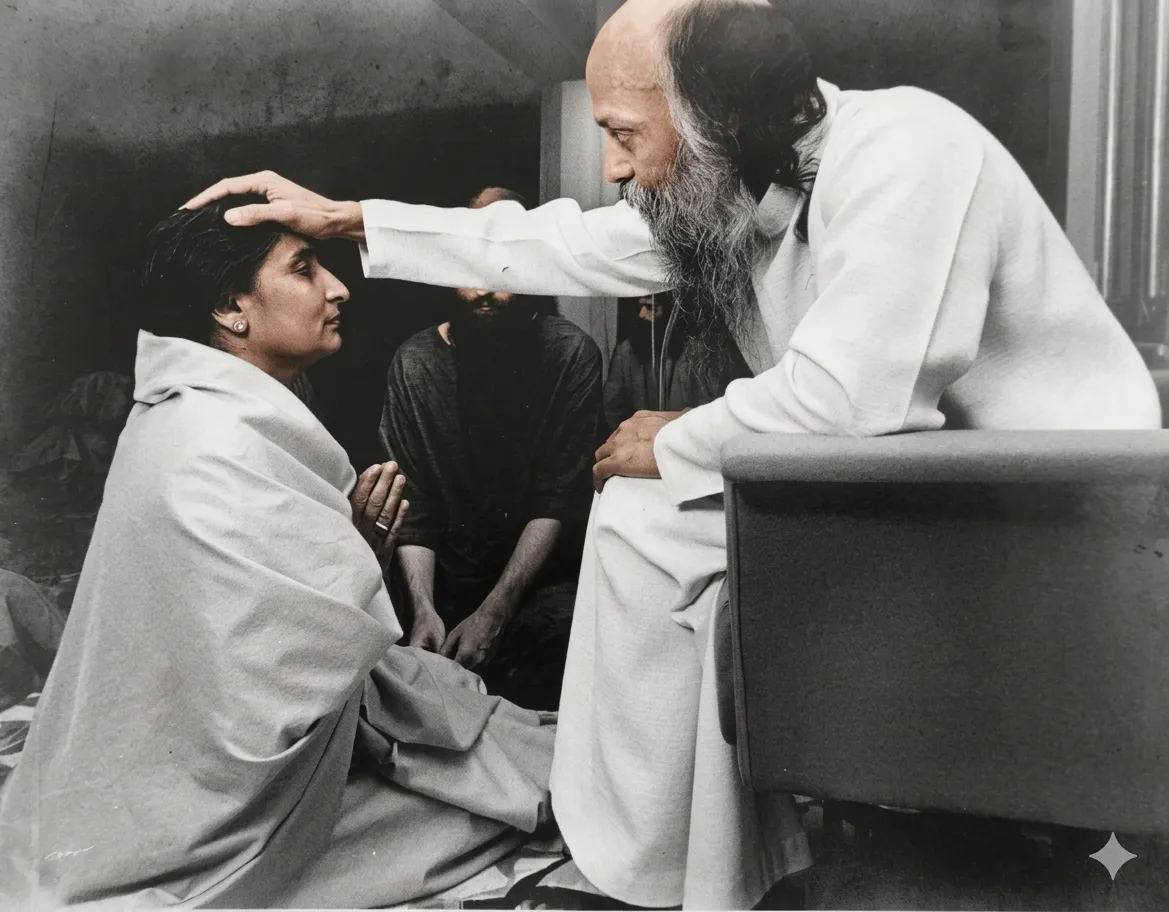
According to Osho, ‘religion’ feels threatening in Poona because here you meet religion itself, not its worn-out word or churchly ritual. Institutions leave you unchanged, but real religion dismantles your conditioning, shakes the ego, and initiates irreversible transformation. That immediacy frightens you—yet it’s the authentic call. The fear is real because the change is real, not theatrical.
Being here is scary because it’s not pretend religion—it actually tries to change you, and your ego resists.
From the Discourses
Passages where Osho speaks to this question — each links to the complete discourse.
Why is religion a dirty word for me, and why does it threaten me far more here in poona than it ever did before?
Religion HAS become a dirty word. It has been used too much and abused too much. It has passed through thousands and thousands of hands. It is just like an old coin or an old currency note which has been passing through many hands and has become dirty. Everything used too much becomes dirty -- not only religion. All beautiful words have become dirty.'God','love','ecstasy' -- all have become dirty. The reason is natural, obvious. Because the words are so beautiful, humanity tends to use them too much. Just look at advertisements and you will find all the beautiful words -- used for cigarettes, soaps, cars, furniture. All beautiful words. The advertisement for a cigarette can even say that the cigarette is ecstatic. Now, a beautiful word is being dirtied. Every film, every movie, is thought to be'marvelous','fabulous'. If everything is fabulous, and every movie is fabulous, then nothing is fabulous.…
Osho, what is the definition of God?
Words are very small. If you say God is light, then what of darkness? The scriptures have said that God is light. Suppose we accept this as a definition—then what about darkness? Where will darkness go? Darkness is too; in fact it is far more than light. Light sometimes is and sometimes is not; darkness is always, eternal. Where will you place darkness? If you say God is light, darkness is left out. If you say God is darkness, then light is left out. If you say God is both darkness and light, a contradiction arises: they cannot be together. Try to have both darkness and light in the same room. If you bring in light, darkness disappears; if you preserve darkness, you cannot have light. Then how can both be together? That becomes an impossibility. So you cannot say “both” either. Then the fourth device is to say: it…
Osho! Basically, you are a herald of religion—of the original, essential religion. You yourself seem to be religion. But the surprising thing is that right now your strongest opposition comes from the religious establishment itself! The recent statements by two Shankaracharyas are fresh examples. Would you kindly shed some light on this?
The death of his father shook Shankaracharya utterly. But the mother, already in grief, would be left alone if Shankara took sannyas. She refused. The story says: Shankara went to bathe in the river, and a crocodile caught his leg. A crowd gathered on the ghat; the mother came running. Shankara said, “The crocodile says it will let go if you allow me to take sannyas.” What could the mother do? With tears she said, “All right, then become a sannyasin—at least live. If you live, even as a sannyasin, I will see you some day.” And the story says the crocodile let go. That is just a story; crocodiles were not that wise then, nor now! If man is not so wise, what of crocodiles! I spoke of Mulla—he did marry. Fourteen-year-old girl, eighty-year-old groom. The next day friends asked, “How was the wedding night?” “Don’t ask—great joy! Only…
Osho, what is the relationship between meditation and patience?
If you sit to meditate to remove mental restlessness, you will keep looking back again and again: “Has it gone yet?” And the irony is that when you begin to meditate, restlessness will increase. Because what has been repressed will start surfacing; catharsis will begin. The rubbish you have kept hidden within and never allowed to express—meditation will break open those doors too. It will clean the house. Dust piled up for years, for births, will rise again; there will be gusts and storms. For a while even the little peace you had will be lost. Then you will panic: “I came for peace, and even what I had is gone.” Without patience, you could even become unhinged, because meditation brings such a great storm. The disease is not from a day or two; it’s from lifetimes. Meditation will break through all the layers to reach your innermost core. In…
Question: First question: Osho, at a press conference, India’s former prime minister Shri Morarji Desai said: “Acharya Rajneesh’s ashram cannot be permitted to come to Kutch, because Acharya Rajneesh’s movement is not only extremely dangerous and deadly, it also maligns Indian religion and culture.” Shri Desai sharply attacked Gujarat chief minister Shri Madhavsinh Solanki’s statement that in a democracy like India any religious leader is free to set up an ashram anywhere, saying that such freedom cannot be used to promote evil deeds. “During my tenure,” he added, “I even ordered an inquiry into Acharya Rajneesh’s activities.” He also said that Acharya Rajneesh would never be able to establish his ashram in Kutch if the people of Kutch gathered the courage to oppose him collectively. And finally Shri Desai said, “Acharya Rajneesh calls me sexually repressed and keeps criticizing me, but I accept his criticism as a blessing.