
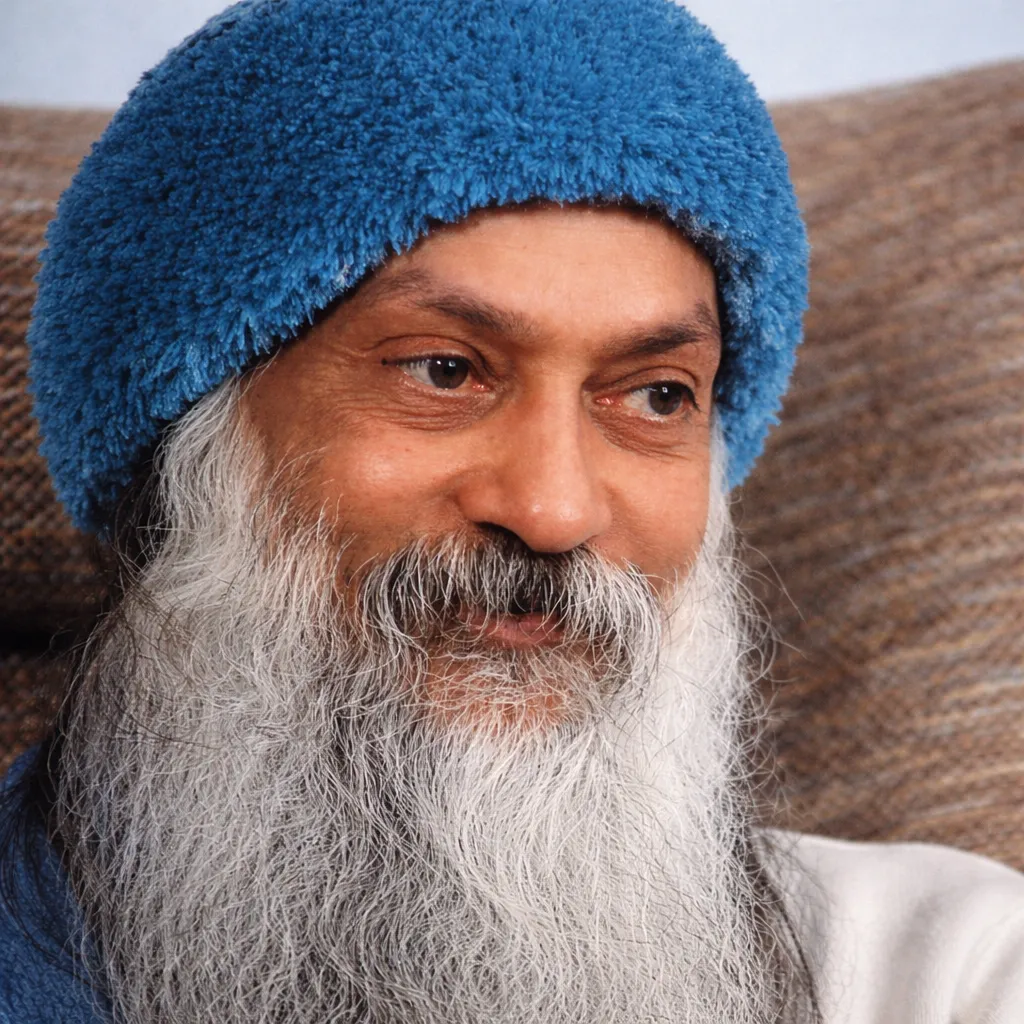
If you drop your ego, there’s no ‘you’ left to hurt; even death feels like joining something bigger, not being destroyed.
From the Discourses
Passages where Osho speaks to this question — each links to the complete discourse.
Osho, you said that when the self is dissolved, the whole of existence begins to protect one. Then why was that fakir—who beheld the formless God everywhere—killed by the British soldiers?
The one who reaches the temple is the one who has understood that asking is futile; who has understood that by asking nothing is obtained except sorrow; who has understood that however much you try, the beggar’s bowl remains empty, it never fills. The one who reaches the temple goes to give thanks, not to ask. The day thanksgiving begins to arise within you day and night—flowers bloom and gratitude rises within you; clouds pour from the sky and gratitude arises within; a child laughs and gratitude arises within; you breathe, and your very being is so peaceful that gratitude arises— Thanksgiving rising day and night is Bhaj Govindam. There is hardly any need to “do” devotion. By “doing” devotion, has anyone ever found the Beloved? It is a matter of a continuous feeling. What God has given is far beyond your worthiness—when you see this, that day will you…
Beloved Osho, you have said that when the self surrenders, the whole existence then protects. Then why was the fakir who could see the formless everywhere, or who could feel the presence of godliness everywhere, murdered by the english soldiers?
It appears like murder to you, but not to him. You see it as murder because you are under illusion. He saw only the divine in that spear; he saw that the death was a meeting with the divine. Existence protected him in the sense that even death did not seem like death to him. Death became the door of the ultimate bliss. To you it seems that he died, he was finished. When the Ganges flows into the sea, to you it seems that it is finished. But ask the Ganges: it will say, "I have disappeared and thus become the sea." The Ganges will say, "The fear of annihilation was there before but now it has disappeared. Before this I was very narrow, bounded by the two banks. I could have been finished. I was limited so I could have died. But now I have become unlimited, now…
Psychologists say: some people reached the last moment of death and were saved by chance. Their testimonies are unique. Once a man slipped in the Alps and fell — a dreadful gorge; certain death. But his head did not strike rock; he landed on soft grass and survived. Such people report: in the moment of dying they experienced supreme bliss. The little interval between falling and touching the grass — in that interval they knew the utmost joy of life. Thousands of such incidents exist. Someone was drowning; he had drowned, as far as he knew. People pulled him out, pressed the water out; he survived. Such people say: at first there was pain and panic — but soon it was certain: I am dying. They consented. Who could hear? The voice echoed, no answer. They consented.
“In surrender alone lies the security of the whole”—this was the opening of the sutra. In the whole sutra from different angles—do not fight, let go, do not struggle, bend, do not dispute, do not claim, do not justify yourself, yield, do not be stiff, do not stand with a swagger—Lao Tzu has said the same truth from many sides. The essence is surrender. Let us understand the last point well—it is the essence. There is a word “struggle,” and a word “surrender.” In struggle, one fights the other, wants to win; and the result is defeat. In surrender, the other is not “other”; there is no opposition, no enmity. In surrender the other is accepted without conflict—as when a blade of grass bends before the storm, surrenders. It does not make the storm an enemy; it accepts a friendship—thinks, The storm is playing with me.
Osho, you have earlier said, “Live moment to moment, live in the present.” Now you are saying, “Return to the past.” What should we do?
So it is with the mind—there are ruts. The past means endless grooves. However much you understand, your intellect agrees, you make decisions, you resolve—at the moment of resolve you feel something is going to change. But not even an hour passes before your decision breaks. Then only self-condemnation is produced, nothing else. Your saints, your fakirs, your priests and pundits—most of the time they only succeed in producing self-condemnation in you, nothing else. Their words are logically correct. You cannot even say they are wrong; you have to admit they are right. In that admission you take a decision. But against what are you deciding? Inside are grooves carved since who knows when, deep tracks. Walking in them has become a habit. It is easy to walk in them. They will pull you again and again. The meaning of returning into the past is: these grooves must be erased.…