
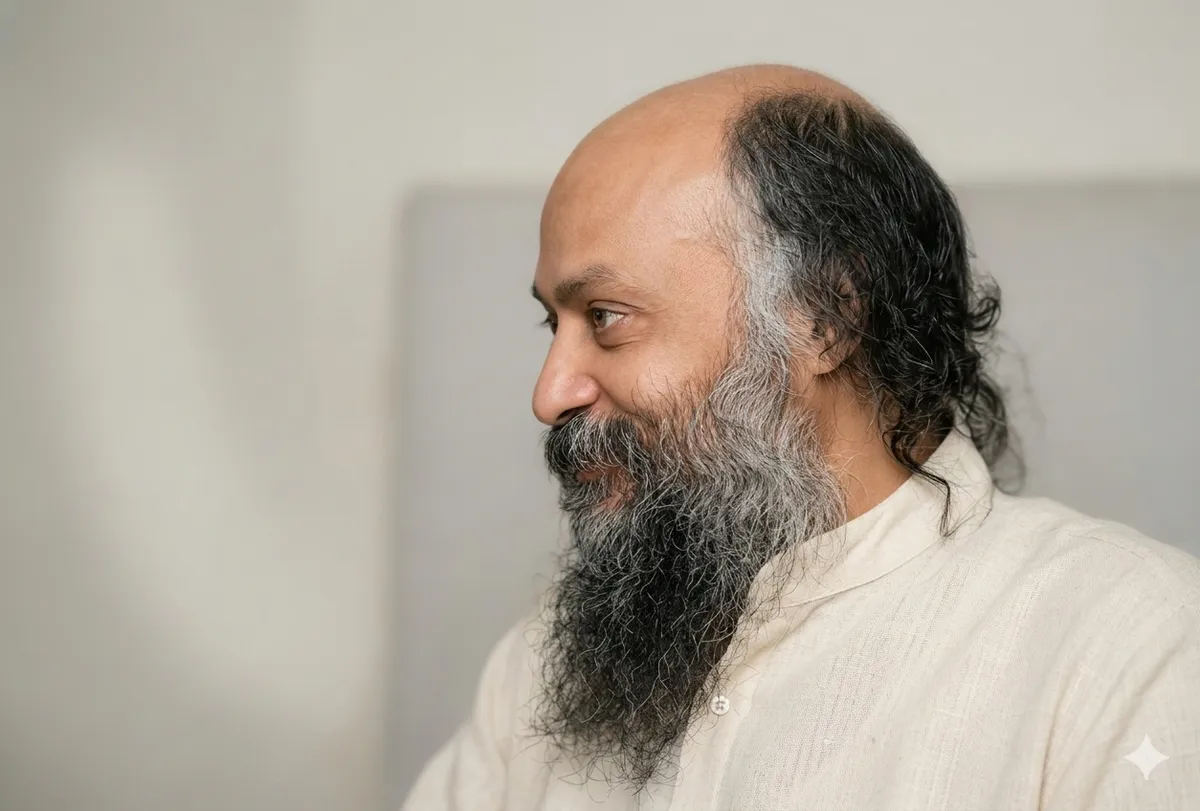
When 'surrender' is misused, it feels like being forced to obey and shrink; real surrender is simply relaxing into a shared, gentle presence without losing yourself.
From the Discourses
Passages where Osho speaks to this question — each links to the complete discourse.
Osho, what is surrender? I used to think I knew. Now it is a mystery.
THE FALSE KNOWLEDGE de-mystifies existence; the true knowledge re-mystifies it. Knowing, if authentic, makes life more of a mystery than it has ever been before. Knowledge certainly covers your eyes with dark clouds, creates a wall of thick smoke, and you start feeling you know. In fact, you are going deeper into ignorance. To be knowledgeable is to be more ignorant than even the ignorant ones. The Upanishads have a tremendously significant statement. They say: The ignorant man is lost in darkness, but the knowledgeable is lost in deeper darkness than the ignorant -- because the knowledgeable lives in an "as if" world. He thinks he knows, but he knows not. He only believes; he has not seen. He believes in God, he believes in love, he believes in surrender, but belief is always a cover-up. Your wound is covered, but it is not healed that way. In fact, the…
What is the difference between waiting for godot and waiting for god?
It is as if the sun has risen in the morning and you are sitting in your room with closed doors and windows, in darkness. Open the doors, you become available to the sun. The sun was already available -- just the meeting happens. You cannot wait for God. All waiting is for Godot. Godot means the one who never comes, who CANNOT come, whose arrival is impossible. And the only impossible thing is that which has already happened -- how can it happen again? You are alive, and you are waiting for life, Now, this is ridiculous. The real man of religion does not think in terms of God. He thinks in terms of life or, even better, of living -- because life can again become an abstract idea. Living, moment-to-moment living. In that very living, one knows what God is, because one knows who one is. Your idea…
Beloved Osho, during the discourses you gave in poona, you were often talking about surrender. When you were in silence sheela was misusing the sense of surrender to make people obedient, and then, even hearing the words "just surrender" made me feel closed. Now, being here with you, the word "surrender" does not only reach my mind but my being, and I feel comfortable with its true meaning. Would you please talk about surrender?
It is not only the word "surrender"... there are many words. When heard, they have one meaning; when experienced, they have a totally different meaning. And the problem is how to make you comprehend the experienced meaning through the word. It may be surrender, it may be love, it may be trust. You heard me talk about surrender. Then certainly it seemed to be that "surrender" means submission, that "surrender" means a kind of spiritual slavery, that "surrender" means you do not have any say even about your own life; somebody else commands it. Then "surrender" means simply to follow, to believe, never doubt, never enquire. It hurts. All these meanings hurt. They hurt your individuality, they hurt your self-respect, they hurt your freedom. That's why it was possible in the commune that while I was silent the word "surrender" could be misused. But when you are near me --…
What is the meaning of surrender? How is surrender?
Coming closer to me, you will be able to imbibe my spirit. That is the meaning of surrender: that you are ready to come close to me, that you are not afraid, that you will not protect yourself against me, that you will not be defensive, that simply you are ready to come closer to me, that you are attracted, that you have heard my call, that something has clicked in your heart and you will try to know who this man really is, what manner of man. You would like to enter into my emptiness and be surrounded by my emptiness. Sannyas is the visible effort of surrender. Many people come to me and they say, "We don't take sannyas. Can't you help us?" I say, "I will try my best, but it won't be of much help because you will continuously protect yourself. You will be defensive." Sannyas…
Beloved Osho, to be disobedient and to surrender seem to me polar opposites. Please explain how the two can be lived.
They are not polar opposites. Just a little awareness.... Be disobedient to your ego -- that is the meaning of surrender. If you want to be disobedient to the person you are surrendering to, then they are opposite, polar opposites. Then why surrender? Surrender simply means you trust the person more than your ego, you trust the person more than your own mind. Surrender happens only in a situation where you have found someone whom you can trust more than you can trust yourself. Then disobey your ego. But people never think in that way. They never think of disobeying their ego, they are always disobeying others. And they don't understand that disobeying others may be just obeying their own ego. This is what has happened with J. Krishnamurti. For his whole life he has been a teacher of thousands of people, telling them to disobey, to be rebellious, not…