
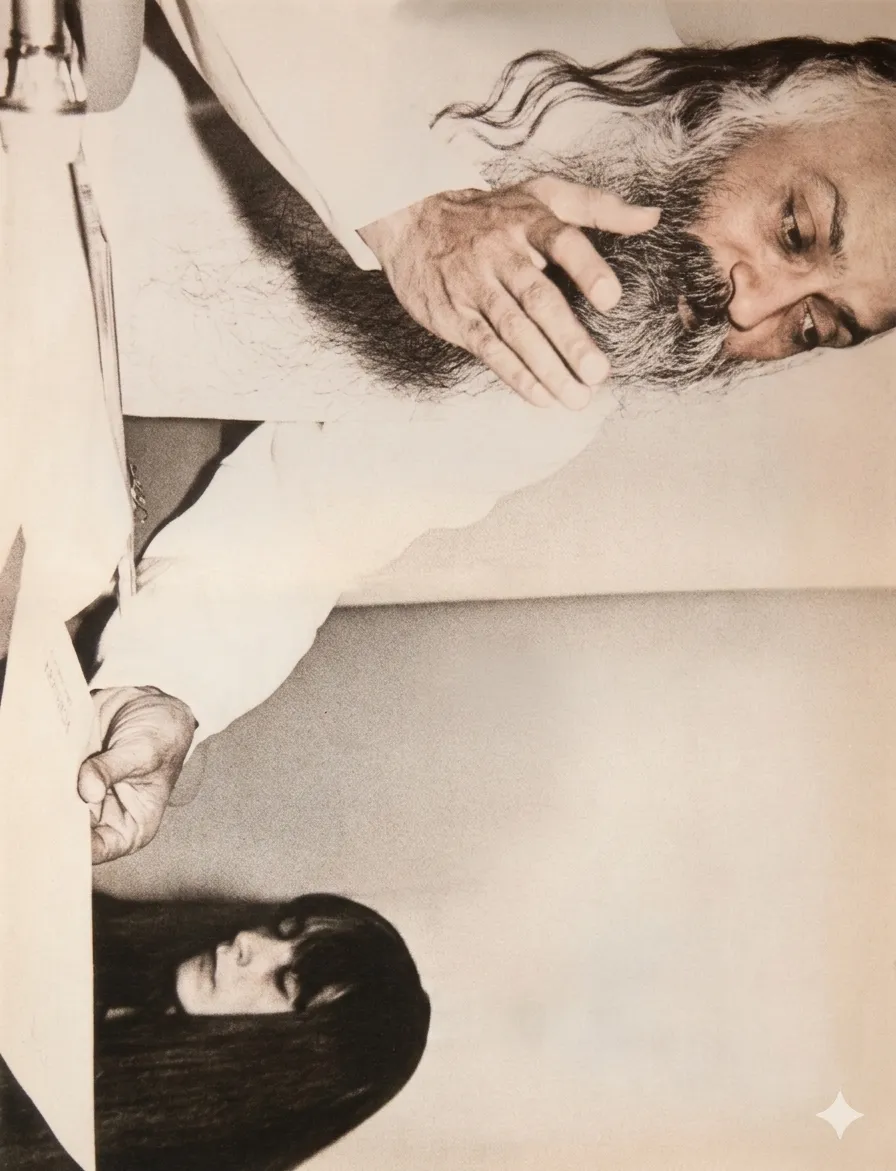
When you stop wanting, you naturally let go; and when you truly let go, wanting stops—they’re the same thing.
From the Discourses
Passages where Osho speaks to this question — each links to the complete discourse.
If desire comes to an end, will surrender to you happen on its own?
It has already happened, it has already happened. If surrender happens, desire will cease. If desire ceases, surrender will happen. They are two sides of the same coin; there is no difference between them—none at all.
Osho, what does surrender mean?
Resolve means: I. Surrender means: not-I. Resolve means: the sense of doership. Surrender means: the sense of non-doership. Resolve means: only through what I do can anything happen; without my doing, nothing will happen—effort is everything. Surrender means: grace is everything. What will happen through my doing? If the Beloved does, it happens. I am only a hollow reed of bamboo; if He plays, I become a flute. His song is everything. I should give Him passage, not become an obstruction. I should step aside from the path. A tiny bud walked along the riverbank and reached—then stepped down into the stream! The lover, bound for tryst, descended from steps to the waves. On the faces of the stars a shimmer came. So much is joined. When even a tiny bud steps into a ripple, in the eyes of stars at immeasurable distances a sparkle appears. Over the whole current…
A friend has asked, Osho, after surrendering oneself at God’s feet, will feelings of pleasure and pain no longer arise in us? And if they do, what is the way to stop them?
Bliss is not pleasure. Dictionaries and language make it seem that bliss is “super-pleasure.” Don’t think that even by mistake. Bliss is related to pleasure exactly as it is to pain—or not related at all. Bliss means the state of consciousness where both pleasure and pain have become meaningless. After surrender there is bliss. If there isn’t, understand that there is no surrender. Do not conclude that there is no bliss after surrender; if there is no bliss after surrender, understand that surrender has not happened. After surrender, bliss is. Surrender is the body and bliss its soul. But the surrender must be total. Total surrender means: now I have no choice. I no longer say, “Let this happen,” and I no longer say, “Let that not happen.” Now I am not. Now I have no decision. I have put the reins into his hands. If he leads to the…
Osho, in reference to the subject of offering to the divine, please explain what is the significance of will and surrender? What are the similarities and differences between will and surrender?
THE END is always the same, but the beginning differs, and all the differences belong always to the beginning. The nearer you reach, the less is the difference between paths. In the beginning will and surrender are diametrically opposed. Surrender means absolute will-lessness. You have no will of your own, you feel helpless, you feel you cannot do anything. You are so totally helpless that you cannot even say that will exists; the very concept of will is illusory. You have no will. Rather, on the contrary, you have destiny, not will, so you can only surrender. It is not that you surrender: rather, it is that you cannot do anything else. So surrender is not an act. Rather, it is a recognition. It is not an act! How can surrender be an act? How can you surrender? If you surrender, then how will you call it surrender when you…
Osho, why does every desire come carrying its opposite? Is its dividedness inevitable? And is no whole and undivided desire possible? What is desire?
One day, by mistake, he wandered into the camp of a Muslim chieftain. He was going along in ecstasy, dancing; the camp happened to be in the way—that was all. The women, frightened, screamed. A naked man, dancing in ecstasy, had walked in—they thought he was mad. Seeing a naked sadhu intrude, the chieftain, too, grew angry. He drew his sword and struck. One of Sadashiva’s hands was cut off and fell to the ground. But Sadashiva’s joy suffered no interruption. The hand fell, blood began to flow, yet the dance continued. Just as he had been dancing, he turned and kept dancing as he walked away. The chieftain was astonished, and also pained—he had never seen such ecstasy. And that a hand could be cut off and he would not even notice—such ecstasy! The man was in some other realm. Looking into his eyes, it was as if he…