
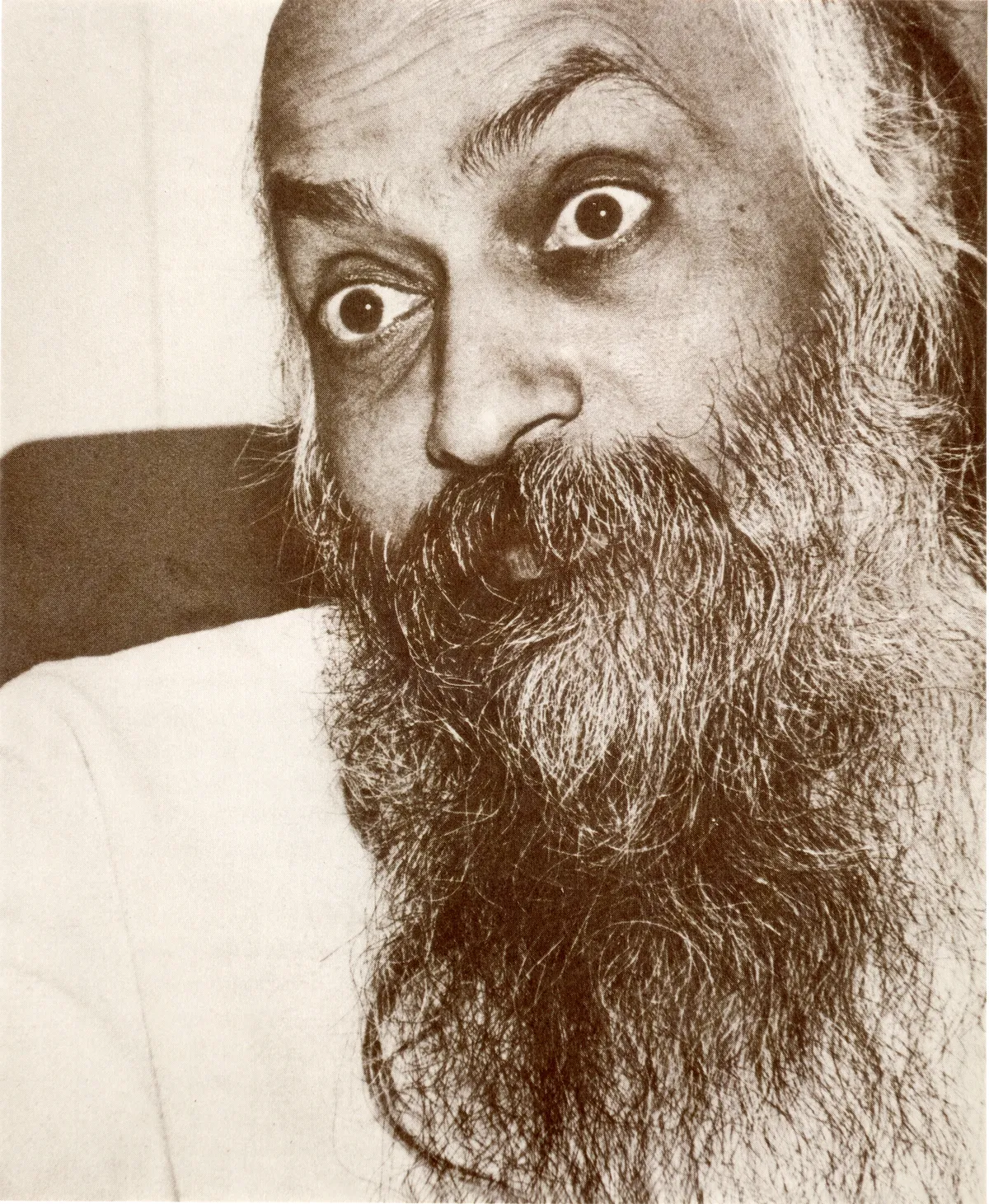
We get scared of new things because they might change who we think we are, so we hold onto the old even if it makes us unhappy.
From the Discourses
Passages where Osho speaks to this question — each links to the complete discourse.
What has gone wrong? Why is it that people meet everything new reluctantly, and with fear, rather than with eager joy?
The new does not arise out of you, it comes from the beyond. It is not part of you. Your whole past is at stake. The new is discontinuous with you, hence the fear. You have lived in one way, you have thought in one way, you have made a comfortable life out of your beliefs. Then something new knocks on the door. Now your whole past pattern is going to be disturbed. If you allow the new to enter you will never be the same again, the new will transform you. It is risky. One never knows where you will end with the new. The old is known, familiar; you have lived with it for long, you are acquainted with it. The new is unfamiliar. It may be the friend, it may be the enemy, who knows. And there is no way to know. The only way to know…
Beloved Osho, why is the new so scary? My wanting and need for recognition are gone along with the doing. Even though deep inside I am tremendously thankful and happy, I find part of myself feeling guilty. I see as well that laziness is not one of my qualities. Beloved Osho, I can't find the new way for me to be total in my work. It is becoming very painful. Can you please bring some light and guidance to me?
They will not be recorded in any history book, but they will transform many who will come in contact with him. With his tears he has bridged his heart with my heart, his being with my being. He is one of the silent workers who go on doing, without bragging about anything. This joke is for Veeresh, not to have any more tears but to have great laughter. A frustrated spinster was a menace to the police. She kept phoning up to say that there was a man under her bed. Before long she was sent to the mental hospital where she was treated with the latest drugs until one day she declared that she was cured. "You mean, Miss Rustavian," asked one of the panel of shrinks, "that you can no longer see a man under you bed?" "No, I can't," she replied, "I can see two." The doctors…
Osho, I get frightened whenever I try to do anything new. How can I be free of this fear?
Had the sky not pulled me, I would have been a burden upon the earth. Being drawn by the sky gave me, for the first time, the capacity to come to earth; now I am no burden. Had the sky not pulled me, I would have been a burden upon the earth. By falling I proved that I had risen to my utmost strength. Today it is not weakness—my might is great at your feet— I have not fallen from weakness; by my strength I had risen to the sky. The strength was spent, the limit reached. Now that I have fallen, it is not from weakness but as the culmination of the flight of power. This state of surrender is the final outcome of ego. This is the supreme paradox. One who understands it has nothing left to understand in life. Like a swan pierced with arrows, I have…
Why does one cling to the old? Why is one afraid of the new?
There is a natural reason in it. With the old one is efficient, with the new one is awkward. With the old you know what to do, with the new you will have to learn from ABC. With the new you start feeling ignorant. With the old you are knowledgeable: you have done something again and again, you can do it mechanically, you need not have any awareness, With the new you will have to be alert, aware, otherwise something may go wrong. Have you not watched it? When you learn driving, you are so alert. When you have learned it, you forget about it. You sing a song, you listen to the radio, you talk to the friend or you think a thousand and one thoughts, and driving continues as a mechanical thing, robot-like -- you are not needed. The old becomes mechanical, habitual. That's why with the new…
Osho, why am I afraid of your neo-sannyas? I do not feel even a little afraid of the old-style sannyas.
Does any Jain read the Gita? Could a Jain really understand it? Impossible. He would find himself opposed at every turn; anger would arise at every step. He would find arguments against Krishna immediately. For Krishna tells Arjuna, “Do whatsoever God wills.” The Jain will say, “And if God is making him renounce, why are you making him fight? How can you decide what God wants?” If Arjuna were truly a Jain, he would have thrown down the Gandiva bow and said, “All right. Now I shall do only what God makes me do. God says, ‘Take the peacock-feather whisk and the begging bowl; sit under a tree; do tapas.’ It is the voice of my inner self!” You know this “voice of conscience.” Delhi politicians have popularized—or polluted—the phrase. Whenever they need to come or go, suddenly their “inner voice” is heard! Krishna deluded him—that is how Jains will…