
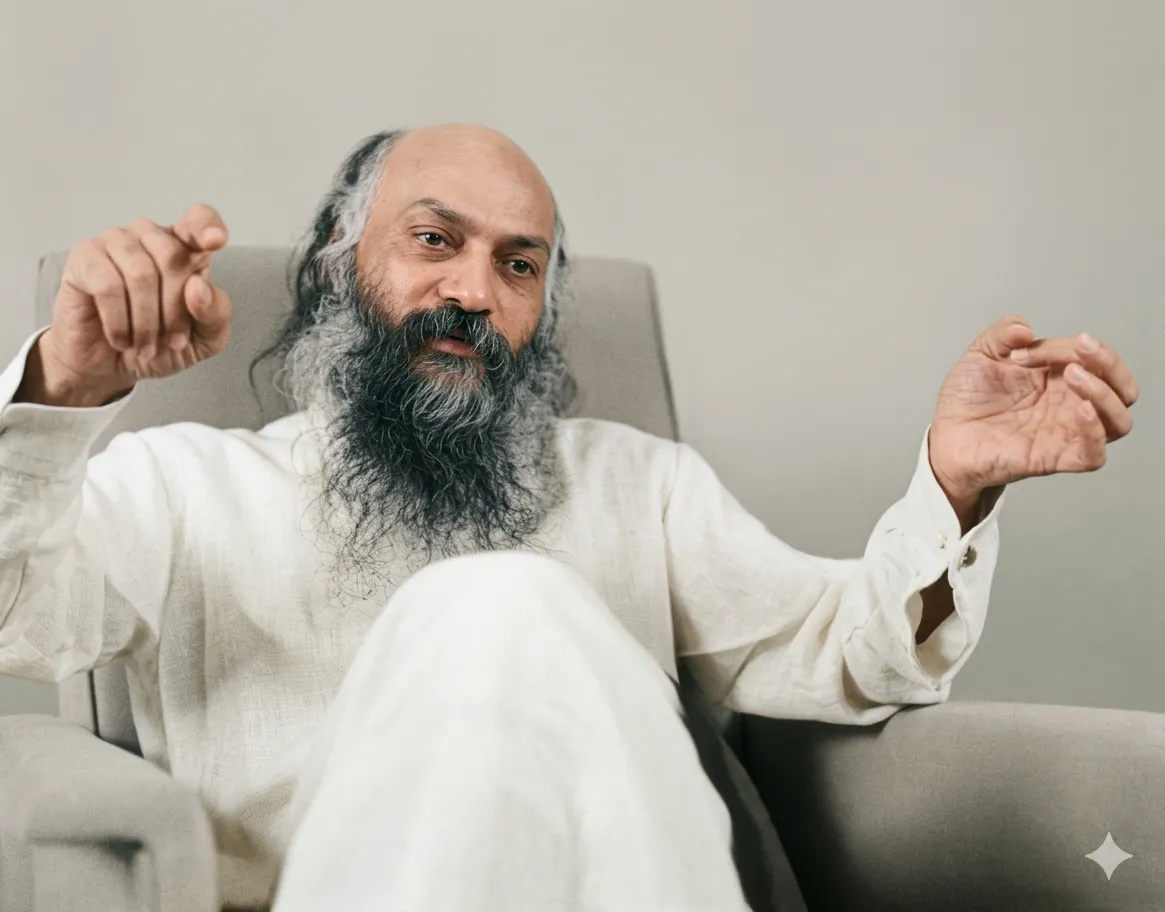
You like the words you can follow, but you fear they’ll shake your beliefs; be quiet inside and brave enough to change.
From the Discourses
Passages where Osho speaks to this question — each links to the complete discourse.
This morning in the dancing meditation I found myself crying heart-rent tears of happiness. What is this strange paradox?
Life is a paradox; paradox in its nature. It is not strange. But you are so much addicted to logic that whenever life reveals itself to you, it looks strange. Logic has been continuously taught to you -- that contradictory things cannot exist together. Logic has been teaching you that either it is day or it is night; either it is life or it is death, either it is happiness or it is unhappiness. The whole mechanism of logic is of 'either-or'. And life is both together. Life is all together. Whenever you reach to the deepest sadness, suddenly you will see it is turning into happiness. Or, you reach to the deepest happiness and you will see that it is turning into sadness. At the centre they meet; only on the periphery are they separate. It is just as if you make a circle, and from the centre you…
Whenever a certain feeling of opening comes and a certain peace, always a strong anxiety and a depression follow and make me very tired. It seems to be a vicious circle. What is the attitude to take?
And what is good in sadness? The depth. Sadness is very deep, no laughter can be as deep as sadness. No laughter can be as deep as sadness, because laughter is always superficial, a little profane, a little vulgar. Sadness has a sobriety of its own, sadness has a depth of its own, sadness has a deep feeling -- the feeling of the valley, very deep and penetrating. It has something sacred about it, holy about it. A man of bliss is in that depth, in that holiness, in that sacredness. He is both, and is not both; he transcends both and he is a harmony of both. A man of bliss is a miracle, a rare combination of opposites, a rare synthesis of opposites. So don't think that this is vicious, it is natural. All that you have to do is to remember that you are separate. When happy,…
Day by day, near you, I find myself liking my sadness. What is happening to me, Osho?
That's how it should be. If you can like your sadness also, then the sadness is no longer sad. The sadness is sad because you dislike it. The sadness is sad because you would not like to be in it. The sadness is sad because you reject it. Even sadness becomes a flowering of tremendous beauty, of silence, of depth, if you like it. Nothing is wrong; that's what I want you to be: to like everything that happens, even sadness. Even death has to be loved; only then will you transcend death. If you can accept death, love and welcome it, now death cannot kill you; you have transcended it. When sadness comes, accept it. Listen to its song. It has something to give to you. It has a gift which no happiness can give to you, only sadness can give it. Happiness is always shallow; sadness, always deep.…
Osho, living in the ashram I feel very blissful; but sometimes, suddenly, I become sad. What is this sadness that comes and goes? Please explain.
Even so, Ranjan will sometimes remember. The husband may not remember. In America, a husband whose wife has gone off to India—will he remember! For him it’s like the cat’s luck finding the cream pot open. He must be tasting freedom. But Ranjan—she has a woman’s heart—sometimes worry will come, and sadness will seize her. Watch that sadness with witnessing. Gradually it will disappear. And if ever you do go back home, go only as a witness. Do not go before that. So that there, too, you can see it all as a dream—whether sweet or bitter. Whatever happens outside in this world has no ultimate value. What happens within is the only value. Ranjan, look to the inner! Unfurl, O petals—open your fragrant doors. On the little couch of the far horizon dawn has awakened, the sky has smiled. The splendor of the rising sun is scattered on the…
दूसरा प्रश्न: ओशो, आश्रम में रह कर बहुत आनंदित हूं; पर कभी-कभी अचानक उदास हो जाती हूं। यह उदासी क्या है, जो आती है और चली जाती है? कृपया समझाएं।
लेकिन फिर भी रंजन को कभी-कभी याद आ जाती होगी। पति को शायद याद न भी आती हो। अमरीका में कोई पति हो और पत्नी हिंदुस्तान चली आए--उसको कहीं याद आने वाली पत्नी की! यह तो बिल्ली के भाग्य से छींका टूटा! स्वतंत्रता अनुभव कर रहे होंगे। लेकिन रंजन को, स्त्री का हृदय है, कभी-कभी चिंता आती होगी, उदासी पकड़ लेती होगी। उस उदासी को साक्षीभाव से देखना। धीरे-धीरे समाप्त हो जाएगी। और अगर कभी जाना भी हो तुझे वापस घर अपने, तो साक्षी होकर ही जाना। उसके पहले जाना नहीं। ताकि वहां भी देख सके कि सब सपना है--अच्छा हो तो, बुरा हो तो। इस जगत में जो भी बाहर हो रहा है, उसका कोई भी मूल्य नहीं है। जो भीतर हो रहा है, वही एकमात्र मूल्यवान है। रंजन, भीतर की सुध ले! मुकुल दल खोलो सुरभित द्वार। दूर क्षितिज की लघु शय्या पर, ऊषा जागी, विहंसा अंबर। बिखरा वैभव उदयाचल का, सरिता के ढुलमुल जल कन पर उज्ज्वल जग का कोना-कोना, ओ मेरे सुकुमार।
Osho, why am I extremely sad when there is no reason at all to be sad?
Perhaps for that very reason. When there is a reason for sadness, one can at least understand: well, there is a cause; at least there is a cause, so I am sad. There is a pretext. No one will call you mad. You can say: my wife died, my son went to jail, my shop collapsed, I went bankrupt. Then there is logic to your sadness. With logic, you feel safe. You can say it is perfectly natural to be sad. What else can I do? If your wife died, you too would be sad. If your business went bankrupt, you too would cry. So it isn’t only me who weeps. You can give reasons for your tears. The greatest sadness is when there is no reason at all. Then it becomes absurd. You cannot even say why you are sad. You cannot defend your sadness. You cannot gather arguments…
पूछा है: ओशो, मैं अत्यंत उदास क्यों हूं, यद्यपि उदासी का कोई भी कारण नहीं है?
उदासी का कारण भी हो तो आदमी को समझ में आता है कि चलो कारण तो है; कम से कम कारण तो है, इसलिए उदास हूं। बहाना तो है। कोई पागल तो न कह सकेगा। बता सकता हूं कि पत्नी मर गई, कि बेटा जेल चला गया, कि दुकान डूब गई, दिवाला निकल गया। तो उदासी में तर्क है। तर्क है तो तुम सुरक्षित हो। तुम यह कह सकते हो कि उदास होना बिलकुल स्वाभाविक है। कर भी क्या सकता हूं? तुम्हारी पत्नी मरती, तो तुम भी उदास होते। और तुम्हारी दुकान का दिवाला निकलता, तो तुम भी रोते। तो कोई मैं ही रो रहा हूं, ऐसा नहीं है। तो तुम्हारे आंसुओं के लिए तुम तर्क दे सकते हो। सबसे बड़ी उदासी तो तब होती है, जब उदास होने का कोई कारण भी नहीं होता। तब बड़ी बेबूझ बात हो जाती है। तब तुम कह भी नहीं सकते कि क्यों उदास हूं। अपनी उदासी की रक्षा भी नहीं कर सकते। अपनी उदासी के लिए तर्क भी नहीं जुटा सकते। तब तुम बिलकुल असहाय हो जाते हो। ऐसा भी होता है। ऐसे होने के पीछे कई कारण हैं। …