
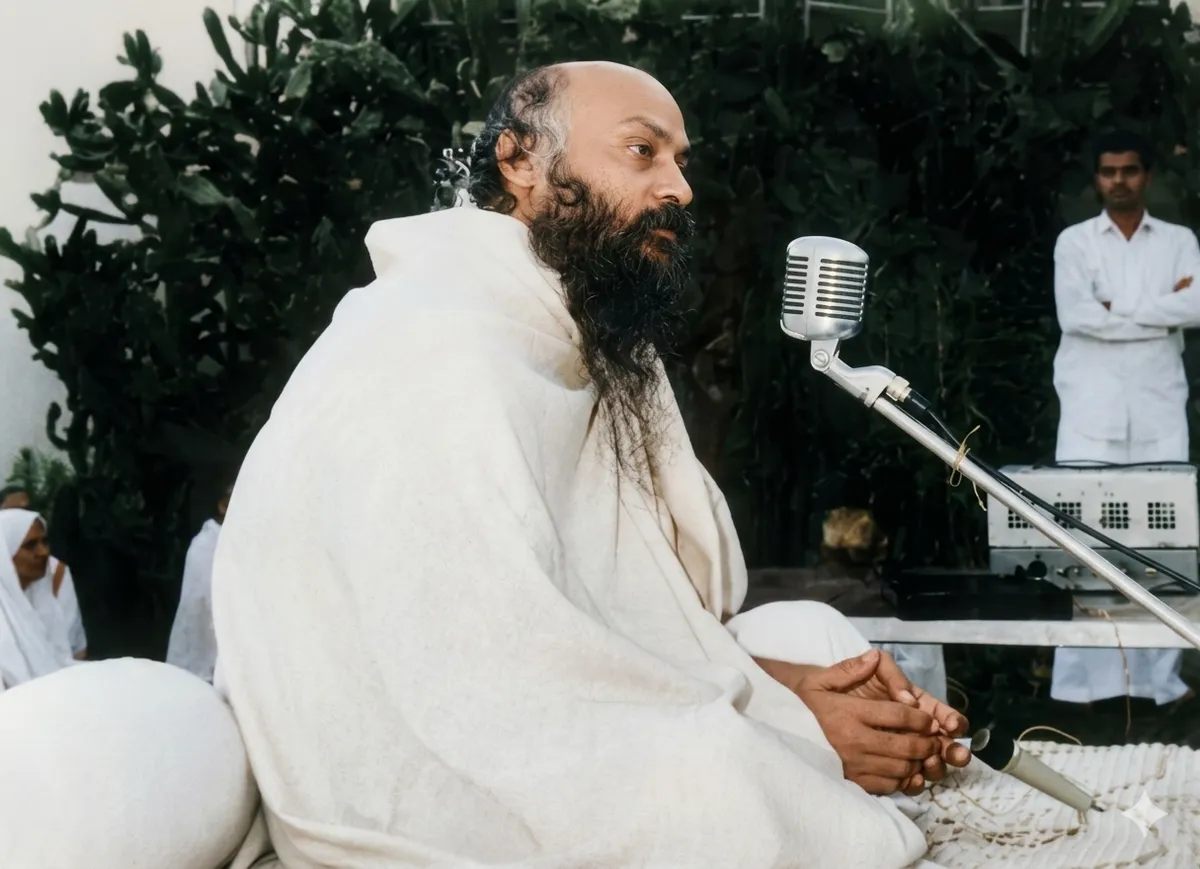
You’re ‘chosen’ only if you choose to drop your ego and be simply ordinary, with nothing special to gain.
From the Discourses
Passages where Osho speaks to this question — each links to the complete discourse.
Beloved Osho, if you are only a fallible, ordinary man, and not a great master, why are we called "the chosen few" who are going to be messengers of rajneeshism for the world at large? Doesn't this fulfill our egos?
Perspiration is a natural way to keep the heat from entering you. You perspire, and the sunrays are prevented by your perspiration. The sunrays become engaged -- they are foolish -- they become engaged in evaporating the perspiration. They forget you, they leave you alone, and your temperature remains the same. You have holes all over your body: seven million small holes, with glands ready to perspire any moment. If Mahavira never perspired, I can think only of one thing -- that we should forget the idea that we have invented plastic. Mahavira's body must have been a plastic body; only a plastic body cannot perspire. Plastic is very stubborn. Now the scientists of the whole world are worried: so much plastic is being thrown into the ocean, into the rivers, into the earth, and there is no way for plastic to dissolve into earth or into water. It is…
Beloved Osho, I don't really have a question to ask you -- everything is very good. Only one thing is confusing me a little. You have often spoken about the "chosen few." please, who is doing the choosing?
It is a very difficult question. In the beginning, God used to do it! But there are many hypotheses about what happened to God: some say he died a natural death, some say he committed suicide, some say he got into an accident. Some say he was murdered by man -- because without murdering him, man could not really be free. I will not go into what happened to God. One thing is certain: he is missing. In the beginning, he had chosen the Jews to be the chosen few -- "God's own people." But since then, he has had no opportunity. Although Jews have been praying continuously in every synagogue all over the world, "Now it is time for you to choose somebody else; we have suffered enough!" And it is true. If God had not chosen them they would have lived just like everybody else. But because he…
Osho, another discourse, another silly question. Why do you refer to your sannyasins as "the chosen few" when any lost soul who can make it to poona with a willingness to participate in some trendy gestalt-oriented therapy groups and do some meditating, can apparently take sannyas? Who ever gets refused sannyas and on what grounds? P.s.: bob dylan says, "I never got into any of them guru trips. I never felt that lost!"
Dick Blackburn, nobody is ever refused, no Tom, Harry or Dick. That does not mean that all are accepted. Nobody is ever refused, that's true, but that does not mean that all are accepted. Only those are accepted who surrender. Only those are accepted who are utterly committed, who have fallen in love with me, who can trust, and whose trust is unconditional and absolute. They are accepted. Sannyas is not denied to anybody, because sannyas is an opportunity. A few people surrender even before taking sannyas, a few surrender after taking sannyas, a few surrender after being sannyasins for months or for years. Hence sannyas is not denied; it creates a space, a context, for surrender. But as to who is really received, who is really accepted, it is a totally different matter. It is not declared; it remains esoteric. Only I know. And, slowly slowly, the person who…
One last question. A small, final question a friend has asked: Osho, can the capacity for egolessness be available to an ordinary person too?
From his question it sounds as if, poor fellow, how could an ordinary person ever get it? Whereas the truth is: for the extraordinary it is very difficult. Because “extraordinary” itself means egoistic. It can be attained only by the ordinary. But not by the merely ordinary—by the extraordinarily ordinary, one who is ordinary in an extraordinary way. Whom do I call “ordinary-ordinary”? I call him ordinary-ordinary whom everyone else calls ordinary, but who himself does not accept he is ordinary. And whom do I call extraordinarily ordinary? The one whom the world may call extraordinary, yet he knows himself to be ordinary. For twelve years I traveled across the country. I met hundreds of thousands of people. Hundreds came to me and said, “What you say—how will it ever be understood by the ordinary man?” I asked them, “Do you understand it?” They said, “I do understand; but how…
Another sannyasin friend said, ‘Osho is supremely compassionate,’ ‘Then why this distinction in the sharing of compassion—that only a chosen few receive the prasad of his ambrosial words?’ And hearing that very remark, I was reminded of my own unworthiness and backwardness. And I have begun to fear that perhaps for this very reason Osho may, in his own way, throw me out. Kindly be gracious enough to dispel our doubts and fears.
- “I am special; hence I was chosen.” Then you have gone astray. You miss at the very threshold. - “By grace alone I, unworthy, have been chosen.” Then you are on the right path. The Sufi mystic Junayd used to say in his daily prayer, “I am amazed—there is no worthiness in me, and yet I live. I have earned nothing, and this supremely blessed life has been given to me. I am amazed, for there is no reason why such peace should shower upon me. Where people burn in such restlessness, why does this peace rain on me?” There was a strange line in his prayer: “O God, I cannot believe You are just. You must be partial toward me—showering so much on one so unworthy.” And that was his worthiness. To see oneself as unworthy is worthiness on the path of the spirit. The day you take…