
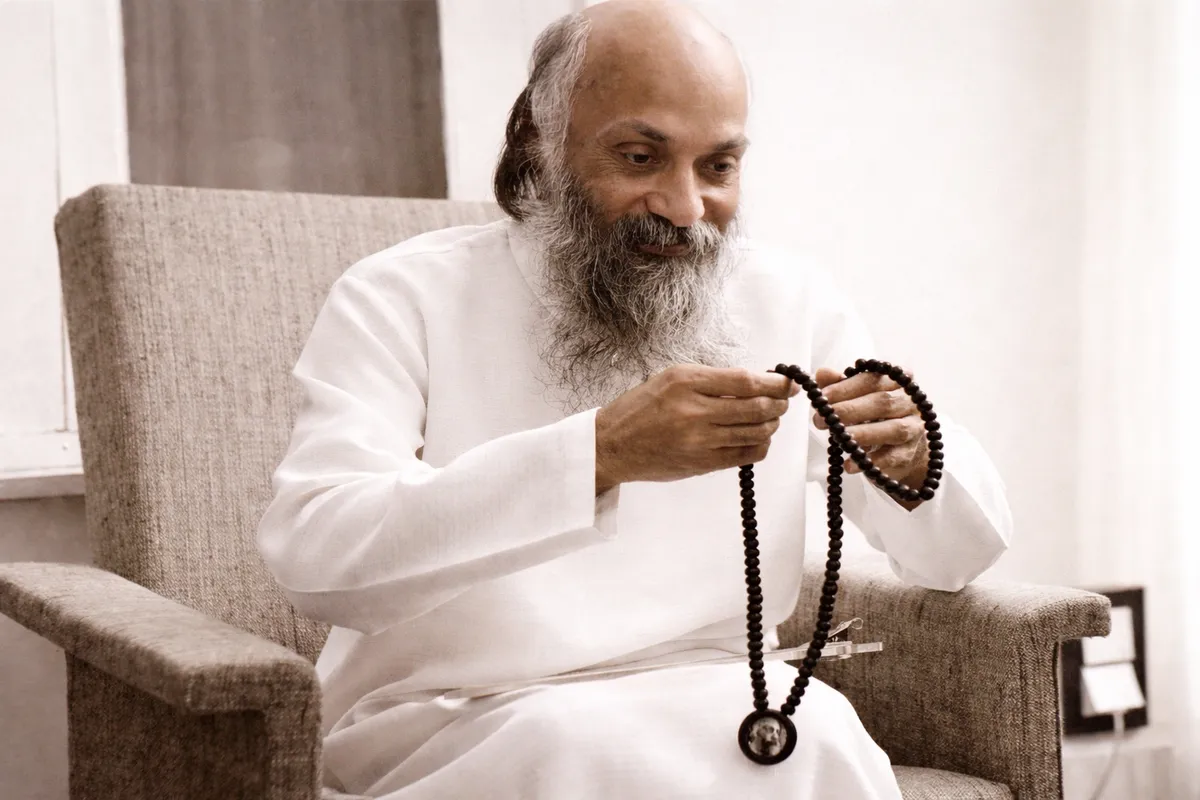
According to Osho, when love ripens, you stop seeing merely a person and begin to perceive the soul—the Divine dwelling in the other. Love flowers into reverence; personal attachment transforms into prayerful awareness. This mature love opens a new dimension beyond body and mind, turning relationship into a doorway to the sacred and initiating the path of prayer.
When love matures, you feel the divine soul in the other person, and love naturally turns into prayer.
From the Discourses
Passages where Osho speaks to this question — each links to the complete discourse.
Osho, when sex ripens, one’s interest in it begins to wane. What happens when love ripens?
In this country this mishap has happened often. The reason it happened is the good fortune of this land—that many saints arose here. We turned that good fortune into our misfortune. We heard the ambrosial words of the saints. Their words appealed to us. Not only was their reasoning powerful, the weight of their presence was powerful too. In their presence we felt that what they said must be right. “Must be right.” But “must be right” is not the same as our own experience bearing witness that it is right. The dignity of their being, their luminous aura, their stream of consciousness moved us, influenced us: we followed behind, and our mind kept wandering in the world. From this a great deterioration has occurred here. People call themselves religious, yet inside they are so worldly as you will hardly find anywhere. Here people abuse money, and yet the grip…
And that is the experience that gives you the proof of god's existence; when you have experienced it with one person you know that now you can melt with the whole. You know the art, you have learned it; you can now melt with the whole universe and become one with it. That is prayer. Not the Christians and Hindus praying in their temples -- that is not prayer. Prayer is the ultimate state of love, the fragrance of that ultimate state, the fragrance of the flower of divine love. [Then more on love to Satprem. Her name means true love, Osho told her. Our love is only so-called love, he began.] It has many other things in it which are far more predominant: jealousy, possessiveness, domination -- all kinds of ego numbers. And ego is the most poisonous thing for love. Love is very delicate.
Osho, you have titled this series of talks “Sahaj Yoga.” Do “sahaj” and “yoga” not seem mutually opposed?
Anand Maitreya! They don’t just seem opposed, they are opposed. But no ultimate truth of life can manifest without contradiction. Life is made of opposites—darkness and light, day and night, woman and man, negative electricity and positive electricity, birth and death. The very structure of life is woven of opposites. Hence the opposites are not only opposed; they are complementary to each other. If you have labored hard all day, you will be able to sleep deeply. Labor and rest are opposites, yet only the one who has worked can rest deeply—and the one who has not worked cannot. So the opposites are not only opposed, they complete each other. And only the one who has rested deeply at night can rise in the morning and engage in work again. One who has not rested through the night will not be able to work in the morning. Look closely at…
Osho, athato prema jijñasa—now, therefore, an inquiry into love. Does the very inquiry into love transform into the experience of egoless love? Please explain.
Athato jijñasa—athato prema jijñasa. With this we began Dariya’s sutras. Good to complete it here. Because love is the beginning and love is the end. Love is the seed and love is the fruit. Love is the start and the final expression. Athato prema jijñasa. We have searched for everything in life—wealth, position, respectability—yet we have not searched for love; hence we seem crippled, impoverished. The inquiry into love, the search for love, finally becomes the search for the divine. Why? Because in love the ego dissolves, melts. Love means your death—your disappearance. Where you are not, God is. Your presence is the obstacle; your absence becomes the door. Die, O yogi, die—dying is sweet. Die the death by which Gorakh was seen. Dissolve. Become zero. Let this identity go—this ego, this I-sense. The moment the I is gone, samadhi arrives. This I-sense is like ice; let it melt in…
Osho, what is the definition of God?
Words are very small. If you say God is light, then what of darkness? The scriptures have said that God is light. Suppose we accept this as a definition—then what about darkness? Where will darkness go? Darkness is too; in fact it is far more than light. Light sometimes is and sometimes is not; darkness is always, eternal. Where will you place darkness? If you say God is light, darkness is left out. If you say God is darkness, then light is left out. If you say God is both darkness and light, a contradiction arises: they cannot be together. Try to have both darkness and light in the same room. If you bring in light, darkness disappears; if you preserve darkness, you cannot have light. Then how can both be together? That becomes an impossibility. So you cannot say “both” either. Then the fourth device is to say: it…