
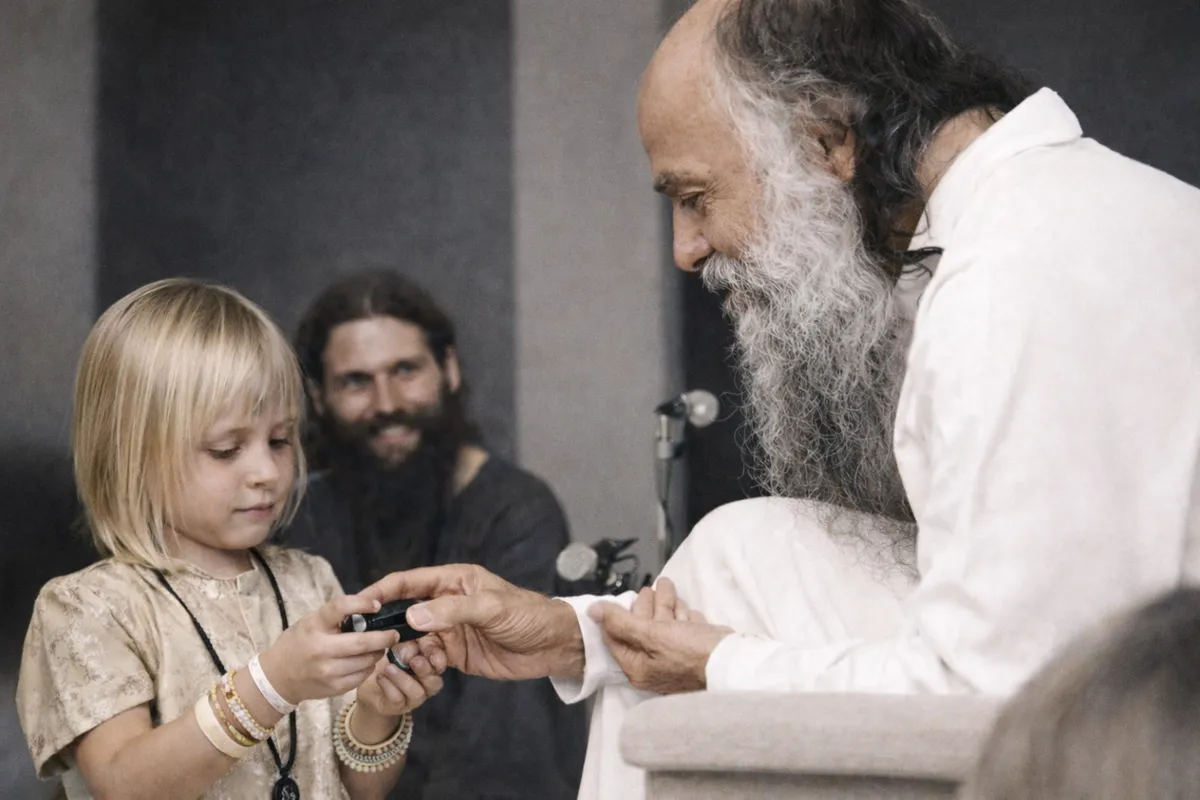
Take away all the clinging and fear, and the ‘me’ drops; then love shines by itself, as natural as breathing.
From the Discourses
Passages where Osho speaks to this question — each links to the complete discourse.
Beloved master, if the jealousies, the possessiveness, the attachment, the needs and expectations and desires and illusions drop, will anything be left of my love? Has all my poetry and passion been a lie? Have my love pains had more to do with pain than with love? Will I ever learn to love? Or is it not a learning but a gift, an outgrowth of something else? A grace descending?
Because you depend on the other, possessiveness arises -- out of fear. "Who knows? -- the other is with me today; tomorrow he may not be with me. Who knows about the next moment?" Your woman may have left you, your children may become grown up and will be gone, your husband can desert you. Who knows about the next moment? Out of that fear of the future you become very possessive. You create a bondage around the person you think you love. But love cannot create a prison -- and if love creates a prison, then nothing is left for hatred to do. Love brings freedom, love gives freedom. It is nonpossessiveness. But that is possible only if you have known a totally different quality of love: not of need but of sharing. Love is sharing of overflowing joy. You are too full of joy; you cannot contain it,…
Question: First question: Osho, why is there jealousy in love? If there is jealousy in love, then love is not love at all; something else is operating in love’s name. Jealousy indicates the absence of love. It is like this: the lamp is lit and yet there is darkness. If the lamp is lit, there should be no darkness. The disappearance of darkness is the proof that the lamp is burning. The disappearance of jealousy is the proof of love. Jealousy is like darkness; love is like light. Take this as the touchstone. As long as jealousy remains, understand that love is not yet love. Some other game is going on in the name of love; the ego is on a new trip—the pleasure of possessing the other in love’s name, exploiting the other in love’s name, using another person as a means.
Osho, isn’t love inherently laced with attachment and possessiveness?
Rabi‘a, a woman mystic, was sitting in her house. A fakir named Hasan was her guest. Morning came; the sun rose. Hasan went outside and called loudly, “Rabi‘a, what are you doing inside? Come out and see how beautiful the sun is—behold God’s creation!” Rabi‘a said, “Hasan! Better you come inside—for you are seeing God’s creation outside; within I am seeing the One Himself.” Creation is beautiful. But will you compare it with the Creator? A song is beautiful; it carries a slight hint of the singer’s soul. These carvings all around are beautiful, but they are a tiny work of the artist. The artist is not exhausted in the paintings, nor is the Creator finished in the creation. From that Creator infinite creations can arise, and still He remains as He is—unchanged. The Ishavasya says: “From the Full, the Full is taken, yet the Full remains.” From that God,…
The love to which ego is attached is a form of jealousy -- this is why nobody is as jealous as lovers are. The love which is attached to the ego is a conspiracy and a trick to possess the other. It is a conspiracy -- that is why nobody suffocates so many people as those who talk of love. This situation is created because of the 'love' which comes from the ego -- there can never be any relation between love and the ego. Jalaluddin used to sing a song, a very beautiful song. He used to go from town to town singing the song. Whenever people would ask him to tell them something about god, he would sing the song. The song was very wonderful. In that song he said that a lover went to the door of his beloved and knocked at the door.
When all I know of love is its attachments, how can I drop them? All I can see is the ego clinging to what it believes is love.
Remain alert, because if love becomes attachment you will never function in your totality. The energy has moved in a wrong way. Don't a]low love to become attachment, remain alert! Allow love absolute freedom, even if sometimes it is painful -- it is. But that pain is also beautiful. When you suffer for freedom, that suffering is good. When you are comfortable because of bondage, that comfortableness is bad. I have heard one story, that one man, a great priest, dreamed one night that he was in a beautiful place, sleeping under a tree, a cool breeze passing, subtle fragrance of flowers, birds singing; he couldn't imagine a more heavenly moment. He looked around -- it was really peaceful, beautiful. He thought in his mind he must be in paradise! But he was feeling hungry, so he thought: But where to get food? I am feeling hungry. Suddenly an angel…