
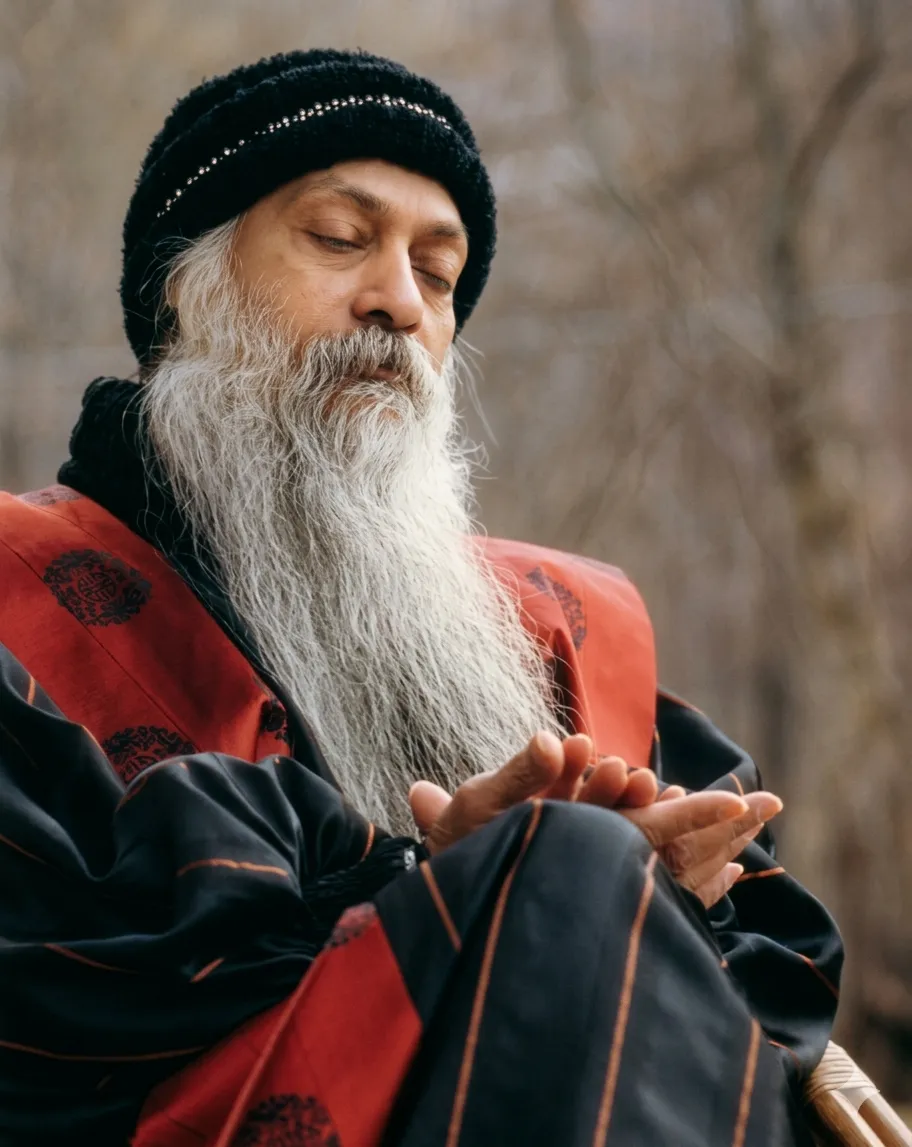
The judge is the learned voice saying good or bad; the witness is you just watching quietly without taking sides.
From the Discourses
Passages where Osho speaks to this question — each links to the complete discourse.
Beloved master, you talk so much about the witness, but what is the witness and what is the judge? How can we tell which is which -- the witness or the judge?
Out of that witnessing a response arises -- a response which is total because your whole heart is behind it, a response which is total because it is your own response, not a repetition of somebody else's teachings; a response which you will never regret, a response which will not make you feel guilty, that "I have done something wrong," which will not make you feel egoistic, that "I have done something great." A response is a simple response, it neither makes you feel inferior nor superior. It is simply the requirement of the moment. It comes out of your witnessing and it is finished. It leaves no trace behind. The witnessing soul is like the sky. The birds fly in the sky but they don't leave any footprints. That's what Buddha says, that the man who is awakened lives in such a way that he leaves no footprints. He…
Osho, it feels that to be a witness is also a kind of thought. So what is the difference between the witness and a thought of the witness?
The mystic laughed. He said, "Not underneath this tree, but within me there is a treasure and I am watching it. And the treasure is growing every day, it is becoming bigger and bigger, hence I have to be more and more alert." The mystic said to the king, "You can sleep, you have nothing to lose. I cannot, I have much to lose; and if I can remain awake I have much to gain." The king was very much impressed. He asked him to come to his palace, he invited him. The monk agreed. The king was a little puzzled: a monk agreeing so soon without even refusing once is not thought to be right. A monk should say, "No, I cannot come to the palace. I have renounced the world. It is all futile. It is all dream, illusion, maya I cannot come back to the world. I…
Drik swaroop awasthanam akshataha to be established in one's own witnessing nature is akshat -- the unpolished and unbroken rice used for the worship.
Breathe, be aware. And if you are trying to be aware of your breathing, you cannot think, because the mind cannot do two things simultaneously -- thinking and witnessing. The very phenomenon of witnessing is absolutely, diametrically opposite to thinking, so you cannot do both. Just as you cannot be both alive and dead, as you cannot be both asleep and awake, you cannot be both thinking and witnessing. Witness anything, and thinking will stop. Thinking comes in, and witnessing disappears. Witnessing is a passive awareness with no action inside. Awareness itself is not an action. One day Mulla Nasrudin was very much worried, in deep brooding. Anyone could look at his face and feel that he was lost somewhere in thoughts, very tense, in anguish. His wife became alarmed. She asked, "What are you doing, Nasrudin? What are you thinking? What is the problem? Why are you so worried?"…
By knowing oneself as the individual witnessing self of the intellect, and all its moods, and cultivating such feelings as "I am that," one should renounce any identification with all things except the self. After ceasing to follow others, one should create a distance with one's own body. Then one should stop following scriptures and give up one's identification with the self also.
WHEN A YOGI IS ROOTED IN THE SELF, HIS MIND IS DESTROYED BY FOLLOWING RIGHT METHOD, RIGHT LISTENING, AND HIS FIRST HAND EXPERIENCE, AND BY SEEING OTHERS AS HIS OWN SELF. HE THEN, CONTEMPLATES THE SELF, INSIDE THE HEART, WITHOUT GIVING AN EAR TO WHAT PEOPLE SAY, WITHDRAWING HIS ATTENTION FROM THE OBJECTS OF THE SENSES: SOUND, TOUCH, SIGHT, TASTE AND SMELL COLLECTIVELY; AND HE DOES NOT GIVE IN TO SLEEP OR FORGETFULNESS OF THE SELF. The word "witnessing" is one of the most significant words, particularly in Eastern spiritual alchemy. This word is a key word. So we must understand what witnessing means. We act, we do something, and the moment we do it we become the doer -- you walk, you become the walker. But there is one more possibility -- to remain a witnesser, to remain a witness. Walk, eat, or do whatsoever; don't be identified with…
Could one summarize the difference between a god-oriented religion and the quality of religiousness as the difference between a judge external to us, a projected conscience, and a witness within our consciousness?
A woman has to be out of the house just for one night. It does not matter whether she has made love to anybody or not. This is how Indian Mohammedans go on increasing their population. Obviously, one man with four wives, can give at least four children per year. The same is not possible for four husbands and one wife. They may not even give one child -- the four husbands may kill the child before it is born. So remember, your God-oriented religions are only conveniences for the society. They should not be called religions, they are only moral precepts to keep the society together, and in the least inconvenient way. It is not religiousness. Religiousness arises only as a blossoming of your own consciousness. God-oriented religions certainly create a conscience, but not consciousness. And many people have the false notion that conscience and consciousness are one. Their…