
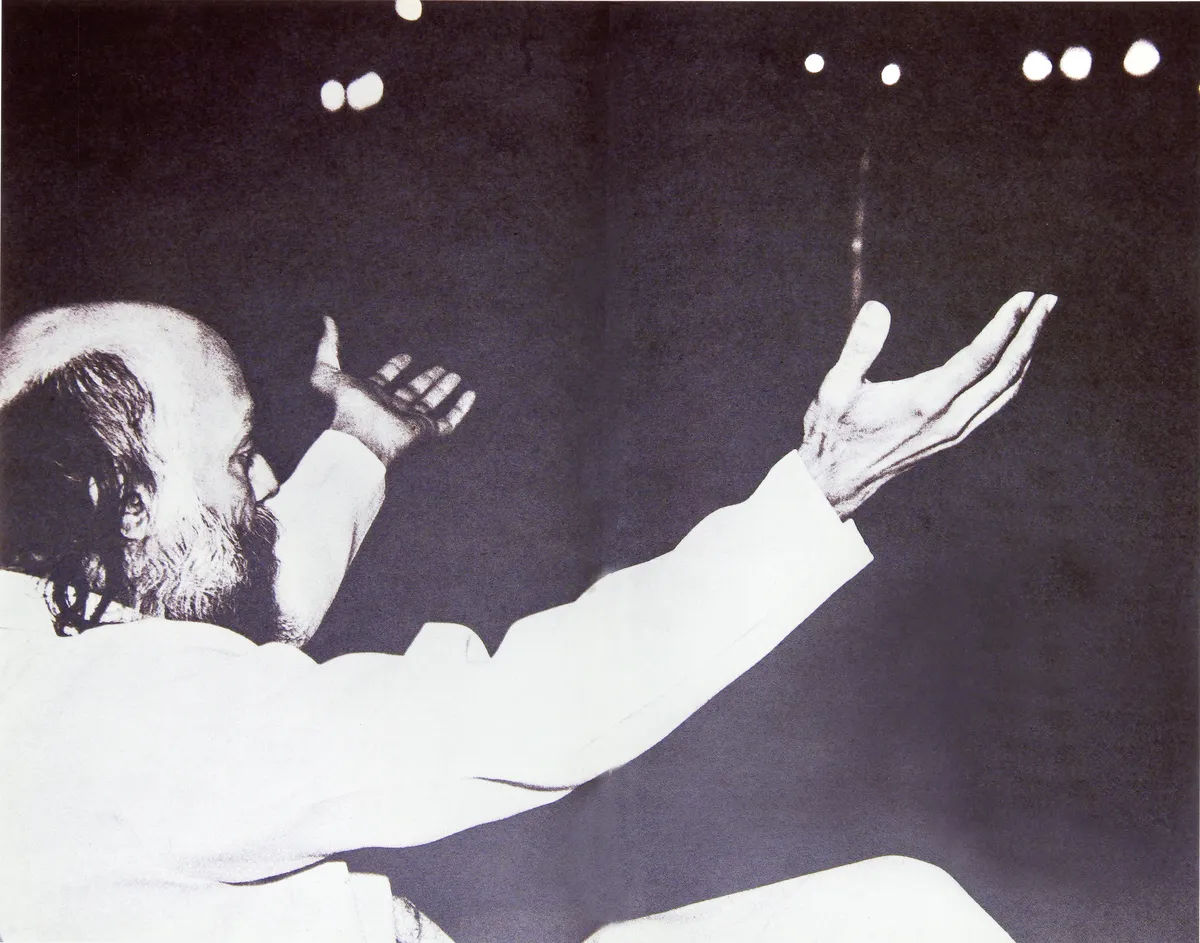
Just look without saying anything inside; the moment you think “I am watching,” it’s no longer real watching.
From the Discourses
Passages where Osho speaks to this question — each links to the complete discourse.
Osho, it feels that to be a witness is also a kind of thought. So what is the difference between the witness and a thought of the witness?
The mystic laughed. He said, "Not underneath this tree, but within me there is a treasure and I am watching it. And the treasure is growing every day, it is becoming bigger and bigger, hence I have to be more and more alert." The mystic said to the king, "You can sleep, you have nothing to lose. I cannot, I have much to lose; and if I can remain awake I have much to gain." The king was very much impressed. He asked him to come to his palace, he invited him. The monk agreed. The king was a little puzzled: a monk agreeing so soon without even refusing once is not thought to be right. A monk should say, "No, I cannot come to the palace. I have renounced the world. It is all futile. It is all dream, illusion, maya I cannot come back to the world. I…
Osho, last night you said that the mind cannot do two things together -- that is, thinking and witnessing. It seems then that witnessing is a mental faculty and an act of the mind. Is it so? Please explain. Is there anything like partial witnessing and total witnessing?
WITNESSING is not a mental activity; thinking is a mental activity. Rather, it would be better to say that thinking is mind. When the mind is not, when the mind is absent, when the mind has disappeared, only then do you have witnessing. It is something behind the mind. Zen Buddhism uses mind in two ways: the ordinary mind means thinking; then Mind with a capital "M" means the Mind behind thinking. Consciousness is behind the mind; consciousness comes through the mind. If mind is in a state of thinking, it becomes opaque, non-transparent, just like a clouded sky -- you cannot see the sky. When the clouds are not, you can see the sky. When thinking is not there, then you can feel the witnessing. It is the pure sky behind. So when I said that you cannot do two things, I meant either you can think or you…
And someone has asked: Osho, who is it that thinks when one is witnessing?
As it is now, whenever we know, three things are present: the one who knows—the knower; that which is known—the known; and the relationship between the two—knowledge. Knowledge is bound and burdened by the knower and the known. Keval-gyan means the known dissolves—the object disappears. And when the known dissolves, where will the knower be? He was bound to the known. When the known dissolves, the knower dissolves. What remains then? Only knowledge remains. In that moment of pure knowing there is the sense of liberation and of freedom. So keval-gyan means to experience pure knowledge. What I have called samadhi is the experience of pure knowing. These are different names in different traditions: what Patanjali called samadhi, the Jains called keval-gyan, and Buddha called prajna. Keval-gyan does not mean telling what is going on in your head. That is very easy—a simple thing. That is ordinary telepathy, thought-reading; it…
और पूछा है, ओशो, साक्षी होकर कौन विचार करता है?
अभी जब भी हम कुछ जानते हैं, तो जानने में तीन चीजें होती हैं--जानने वाला होता है, वह ज्ञाता होता है; जिसको जानते हैं, वह होता है, वह ज्ञेय होता है; और इन दोनों के बीच जो संबंध होता है, वह ज्ञान होता है। तो ज्ञान जो है, ज्ञाता और ज्ञेय से दबा रहता है, उनसे बंधा रहता है। केवल-ज्ञान का अर्थ है कि ज्ञेय विलीन हो जाए, आब्जेक्ट विलीन हो जाए। और अगर ज्ञेय विलीन हो जाएगा, तो फिर ज्ञाता कहां रहेगा! वह तो ज्ञेय से बंधा हुआ था। जब ज्ञेय विलीन हो जाएगा, तो ज्ञाता विलीन हो जाएगा। तब क्या शेष रह जाएगा? तब मात्र ज्ञान शेष रह जाएगा। उस ज्ञान की घड़ी में मुक्ति का बोध होता है और स्वतंत्रता का बोध होता है। तो केवल-ज्ञान का अर्थ है, शुद्ध ज्ञान को अनुभव कर लेना। जिसको मैंने समाधि कहा है, वह शुद्ध ज्ञान का अनुभव है। यह अलग-अलग संप्रदायों के अलग-अगल सत्य हैं। जिसे पतंजलि ने समाधि कहा है, उसे जैनों ने केवल-ज्ञान कहा है, उसे बुद्ध ने प्रज्ञा कहा है।
Osho said that there was no need to try to still the mind, to stop the thoughts. He said that just as the traffic goes by and one remains on the sidewalk, unaffected, just a watcher, so one should simply witness the thoughts as they went by. We are not our thoughts, and recognising that we are the witness is enough. The very acceptance of the thoughts makes one more relaxed. The relaxation helps to create a distance, to separate oneself. To evaluate a thought as good or bad means that you are attached to your thoughts -- so one should not put labels on them.] ... put yourself aside, sit under a tree, and just watch the traffic. Soon, one day, the traffic disappears and the road is empty. Suddenly there is an interval and in that interval is meditation. But that interval cannot be created or cultivated.
Question: what is the difference between awareness and witnessing?
Witnessing comes as a consequence of consciousness. You cannot practice witnessing; you can only practice consciousness. Witnessing comes as a consequence, as a shadow, as a result, as a byproduct. The more you become conscious, the more you go into witnessing, the more you come to be a witness. So consciousness is a method to achieve witnessing. And the second step is that witnessing will become a method to achieve awareness. So these are the three steps: consciousness, witnessing, awareness. But where we exist is the lowest rank: that is, in unconscious activity. Unconscious activity is the state of our minds. Through consciousness you can achieve witnessing, and through witnessing you can achieve awareness, and through awareness you can achieve "no achievement." Through awareness you can achieve all that is already achieved. After awareness there is nothing; awareness is the end. Awareness is the end of spiritual progress; unawareness is…