
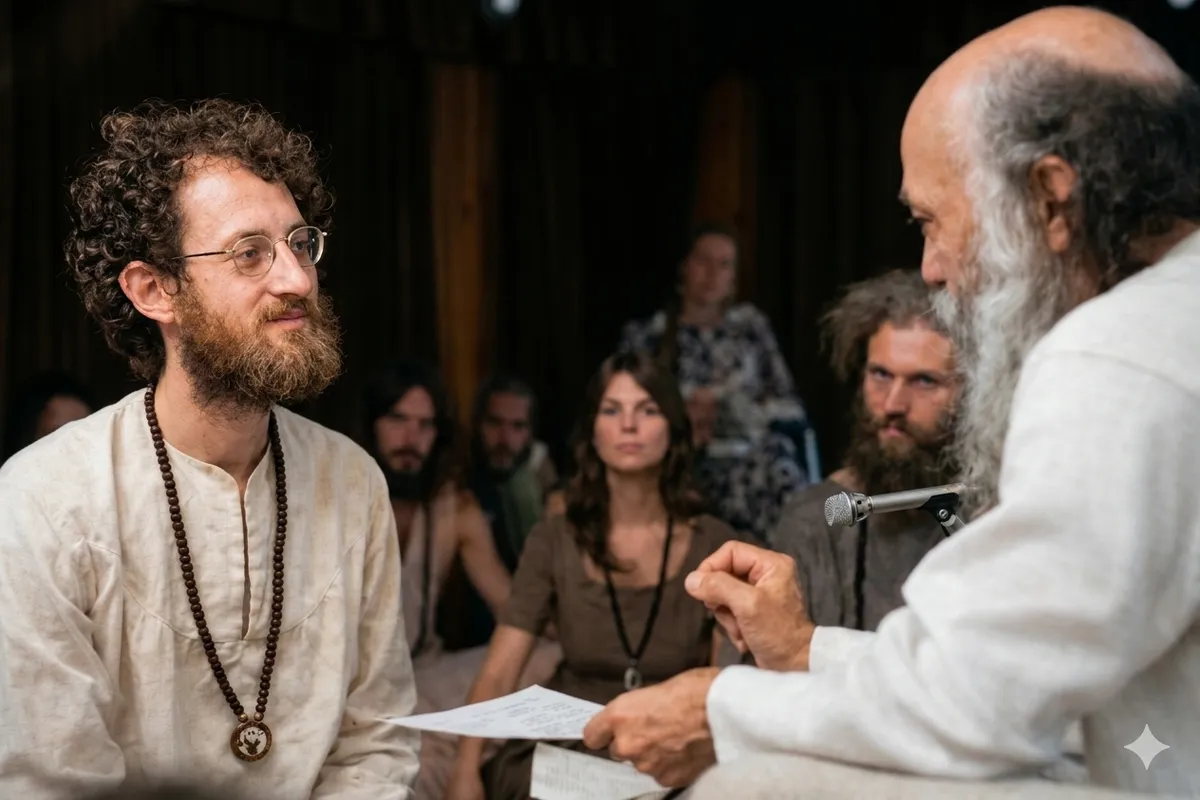
Watch yourself like a quiet observer so you don’t get lost, stay awake, and choose wisely instead of being driven by urges.
From the Discourses
Passages where Osho speaks to this question — each links to the complete discourse.
Where is the witness when the observer and the observed become one?
Anand Pravesh, the observer and the observed are two aspects of the witness. When they disappear into each other, when they melt into each other, when they are one, the witness for the first time arises in its totality. But this question arises in many people; the reason is that they think the witness is the observer. In their minds, the observer and the witness are synonymous. It is fallacious; the observer is not the witness, but only a part of it. And whenever the part thinks of itself as the whole, error arises. The observer means the subjective, and the observed means the objective. The observer means that which is outside the observed, and the observer also means that which is inside. The inside and the outside can't be separate; they are together, they can only be together. When this togetherness, or rather oneness, is experienced, the witness arises.…
Osho, if witnessing is possible through the knowledge-senses, is it also possible through the action-senses, or not?
One can be a witness to the body, because inside, consciousness is separate and distinct. I raise this hand—at that moment an action is occurring: I have raised the hand. Ordinarily we only know that I am the doer of the hand’s raising. But look within: while I am raising the hand there is a consciousness inside that is seeing the hand being raised. When you are walking on the road there is someone within who is seeing that you are walking. When you are doing anything there is someone within who is seeing that you are doing something. Twenty-four hours a day there is a seeing point within you. But you are not aware of it. Witnessing means: we gradually come to remember that point; its remembrance keeps returning; its awareness dawns. As awareness of that point grows, as awakening happens there, the coverings fall away; you will find…
पूछा है: ओशो, ज्ञान-इंद्रियों से साक्षीभाव शक्य है, ऐसा कर्म-इंद्रियों से शक्य है या नहीं?
शरीर के प्रति साक्षी हुआ जा सकता है; क्योंकि भीतर चेतना पृथक है, अलग है। यह हाथ मैं उठाता हूं--इस वक्त एक क्रिया हो रही है कि मैंने हाथ उठाया, तो हमें केवल एक ही बात का पता है कि मैं हाथ के उठाने का कर्ता हूं। लेकिन भीतर खयाल करें, जब हाथ को मैं उठा रहा हूं तो भीतर एक चेतना है जो देख रही है कि हाथ उठ रहा है। जब रास्ते पर आप चल रहे हैं तो आपके भीतर कोई देख रहा है कि आप चल रहे हैं। जब आप कुछ भी कर रहे हैं तो आपके भीतर कोई देख रहा है कि आप कुछ कर रहे हैं। चौबीस घंटे आपके भीतर कोई देखने वाला बिंदु है। लेकिन आपको उसका होश नहीं है।
By knowing oneself as the individual witnessing self of the intellect, and all its moods, and cultivating such feelings as "I am that," one should renounce any identification with all things except the self. After ceasing to follow others, one should create a distance with one's own body. Then one should stop following scriptures and give up one's identification with the self also.
WHEN A YOGI IS ROOTED IN THE SELF, HIS MIND IS DESTROYED BY FOLLOWING RIGHT METHOD, RIGHT LISTENING, AND HIS FIRST HAND EXPERIENCE, AND BY SEEING OTHERS AS HIS OWN SELF. HE THEN, CONTEMPLATES THE SELF, INSIDE THE HEART, WITHOUT GIVING AN EAR TO WHAT PEOPLE SAY, WITHDRAWING HIS ATTENTION FROM THE OBJECTS OF THE SENSES: SOUND, TOUCH, SIGHT, TASTE AND SMELL COLLECTIVELY; AND HE DOES NOT GIVE IN TO SLEEP OR FORGETFULNESS OF THE SELF. The word "witnessing" is one of the most significant words, particularly in Eastern spiritual alchemy. This word is a key word. So we must understand what witnessing means. We act, we do something, and the moment we do it we become the doer -- you walk, you become the walker. But there is one more possibility -- to remain a witnesser, to remain a witness. Walk, eat, or do whatsoever; don't be identified with…
Different from all that constitutes the experiencer, bhokta, the experienced -- bhogya, and the experiencing -- bhoga, in the of waking, dream, and deep sleep. I am the witness, the ever-auspicious, the pure consciousness.
I AM THE NON-DUAL BRAHMAN. IN ME ALONE IS EVERYTHING BORN; IN ME ALONE THAT EVERYTHING EXISTS. AND IN ME ALONE, THAT EVERYTHING DISSOLVES. ... Find this witness; try to find this witness in everything you are doing, knowing, feeling. You are walking on the street; be a witness to it . See it, feel it, that the body is walking and the mind knows that the body is walking. Then be a witness of both; then be a witness that the mind knows that the body is walking, and the body is walking. The mind is the subject; the walking the object. ... Who are you? ... You can witness both body and mind -- WITNESS. Then suddenly you become aware that "the body is walking in me, the mind is knowing in me. And this me is not an "I" -- this is just a pure consciousness, a mirror in which
Osho, it feels that to be a witness is also a kind of thought. So what is the difference between the witness and a thought of the witness?
The mystic laughed. He said, "Not underneath this tree, but within me there is a treasure and I am watching it. And the treasure is growing every day, it is becoming bigger and bigger, hence I have to be more and more alert." The mystic said to the king, "You can sleep, you have nothing to lose. I cannot, I have much to lose; and if I can remain awake I have much to gain." The king was very much impressed. He asked him to come to his palace, he invited him. The monk agreed. The king was a little puzzled: a monk agreeing so soon without even refusing once is not thought to be right. A monk should say, "No, I cannot come to the palace. I have renounced the world. It is all futile. It is all dream, illusion, maya I cannot come back to the world. I…