
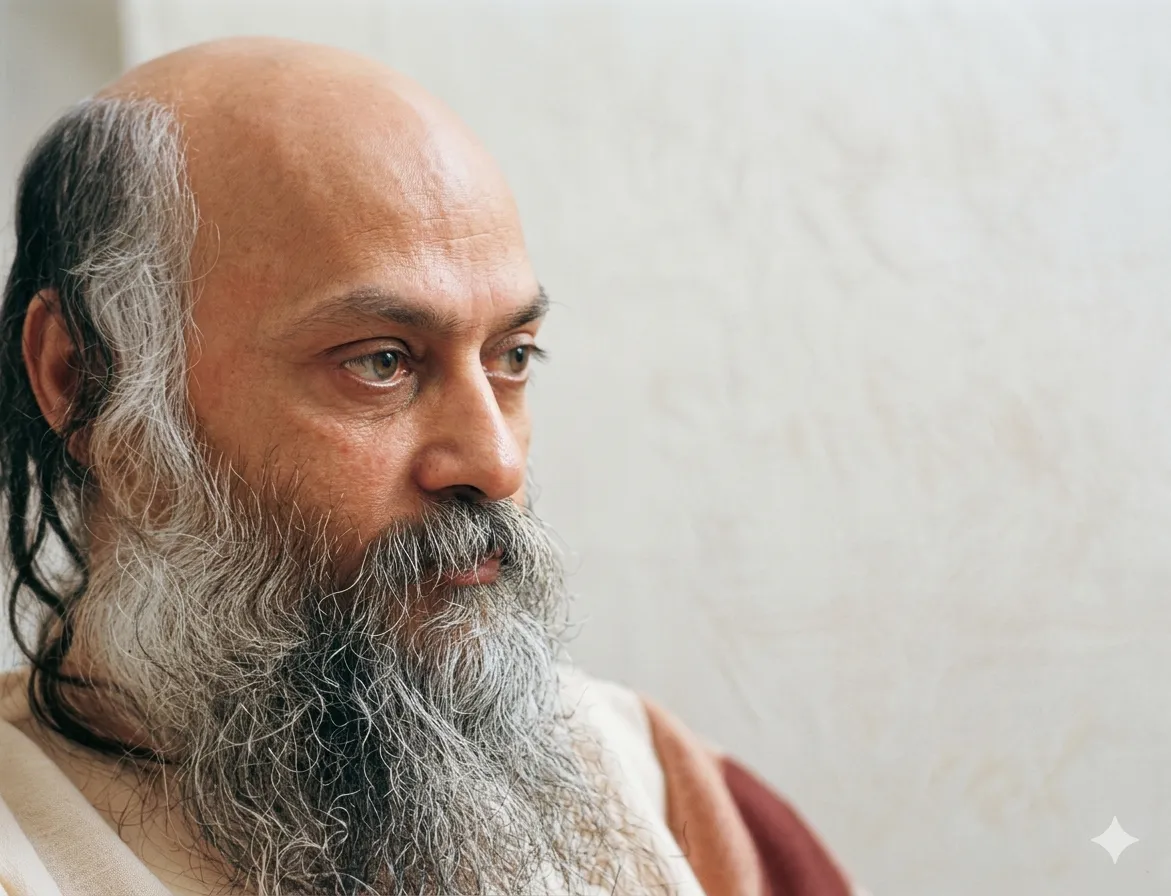
You’re like a leaf on a great river: stop trying to control the current and let it carry you, and the ride becomes easy and joyful.
From the Discourses
Passages where Osho speaks to this question — each links to the complete discourse.
Osho, there is a longing to disappear, to become a mere instrument, and let my life flow only according to His will. I have also had a few small glimpses of this. But on many occasions I fall into conflict and confusion: is it His will or my will?
“And let my life flow according to His will…” If it is His will, then what “life of yours” is left? Let His own life flow. His will, His life—why do you come in between? But no—then the fun evaporates. If it is all His will and His life, and you do not come in at all, the ego loses all its juice. “I have had a few small glimpses…” So long as the ego remains, even the “glimpses” will be imagination. And if a glimpse of That truly happens, will you still hold on to the ego? If diamonds and jewels appear before you, will you go on clutching pebbles? Will you then come and ask me, “How to drop the pebbles? How to empty the bag so I can fill it with diamonds?” You will drop them yourself. You won’t even come to ask; you won’t come to…
पांचवां प्रश्न: ओशो, अभीप्सा है कि मिट जाऊं, निमित्त-मात्र हो जाऊं और उसकी मर्जी के अनुसार ही मेरा जीवन बहे। कुछ छोटी-मोटी झलकें भी इसकी मिली हैं। लेकिन अनेक अवसरों पर मैं द्वंद्व और दुविधा में पड़ जाता हूं कि यह उसकी मर्जी है या मेरी मर्जी है!
और उसकी मर्जी के अनुसार ही मेरा जीवन बहे.। अब जब उसकी ही मर्जी है, तो तुम्हारा क्या खाक जीवन है! उसको ही बहने दो। उसकी ही मर्जी, उसका ही जीवन, तुम बीच में क्यों आते हो? लेकिन नहीं, तब तो मजा ही चला गया। अगर उसकी ही मर्जी और उसका ही जीवन है, और तुम बीच में बिलकुल न आए, तब तो अहंकार का सारा रस चला गया। कुछ छोटी-मोटी झलकें भी मिली हैं.। अहंकार के रहते हुए झलकें भी कल्पना ही होंगी। और अगर झलक मिल जाए उसकी, तो फिर भी तुम अहंकार को पकड़े रहोगे? हीरे-जवाहरात दिखाई पड़ जाएं, फिर तुम कंकड़-पत्थर हाथ में लिए रहोगे? फिर तुम मुझसे पूछने आओगे, कैसे छोड़ें कंकड़-पत्थर? कैसे झोली खाली करें, ताकि हीरे भर लें? तुम भर ही लोगे, तुम पूछने भी न आओगे, तुम बताने भी न आओगे। तुम हीरे भरकर अपने हीरों के भोग में लग जाओगे। कबीर ने कहा है, हीरा पाया गांठ गठियाया, फिर बाको बार-बार क्यों खोले। अब मिल गया हीरा, उसको जल्दी से आदमी गांठ में लपेट लेता है। फिर खोलकर भी नहीं देखता कि कोई और न देख ले। …
Duryodhana had never imagined that the divine would enter into war. Hence what he is saying is just an initial statement of the kind we all make in the early stages of our lives. Meanwhile, the unknown keeps intervening and the entire story changes. If we could see our lives in hindsight, we might say that whatever we intended went wrong. Where we expected success, we met failure; what we had our hearts set on was never attained. Happiness was expected by gaining something, which when we got it, led to sorrow; and that which we never dreamed of having, the mere glimpse of it burst open fountains of joy and happiness. Everything becomes topsy-turvy. There are very few intelligent people in this world who would take into consideration the outcome first. We pay attention to the beginning first.
How to see what is my will and god's will?
There is a Chinese saying: Man is a puppet when he acts, a poet when he describes. All that you think is your freedom is nothing but your poetry. An unconscious man cannot be free, cannot have any freedom. Freedom comes as a consequence of consciousness, freedom is the function of consciousness. An unconscious man exists like a machine, like a robot. You may not know, but you are continuously functioning as a robot. Somebody abuses you and anger arises. It is almost like when you push the button and the fan starts moving. Somebody pushes the button and you become angry. What kind of freedom is this? You don't have any choice, to be angry or not to be angry. If the choice is not there there is no freedom. Freedom means freedom to choose -- you can decide whether to be angry or not, then you are free.…
Whenever will succeeds, it simply shows it is a coincidence -- will never succeeds. The wind was blowing to the north and you were rushing to the north. The wind is not blowing to the north because you are going to the north. It is just coincidence that the wind is also going to the north; it is not following your will. Sometimes you will feel that the will succeeded -- it was coincidence -- then it creates ego and ego is a great problem, the greatest of them all... it is the essential madness. If you fail there is frustration. If you fail you feel very horrible about yourself -- you think you are not worthy, that you are worthless, that you don't even deserve to be alive -- and then you find a thousand and one faults with yourself and you start hating yourself.
What is divine will, and how does it act through the surrendered individual?
This is an intellectual question. Futile. Rot. It arises in the intellect because the intellect cannot understand. Remember always, intellect is not intelligence. You cannot find more stupid a thing than intellect. Intellect is not intelligence. Intelligence is existential, intellect is borrowed. You don't know what divine will is, you don't know what a surrendered individual is -- hence, the question. The question is like this: if you have not known what light is and you ask, "When we bring light in the room, does it have to fight with darkness to destroy it? " Or, "When we bring light into the room, how much time does it take for darkness to leave the room?" The question is absurd because you know, stupid because you know. The question looks stupid because you know that darkness has no existence of its own. When you bring light in, it is not that…