
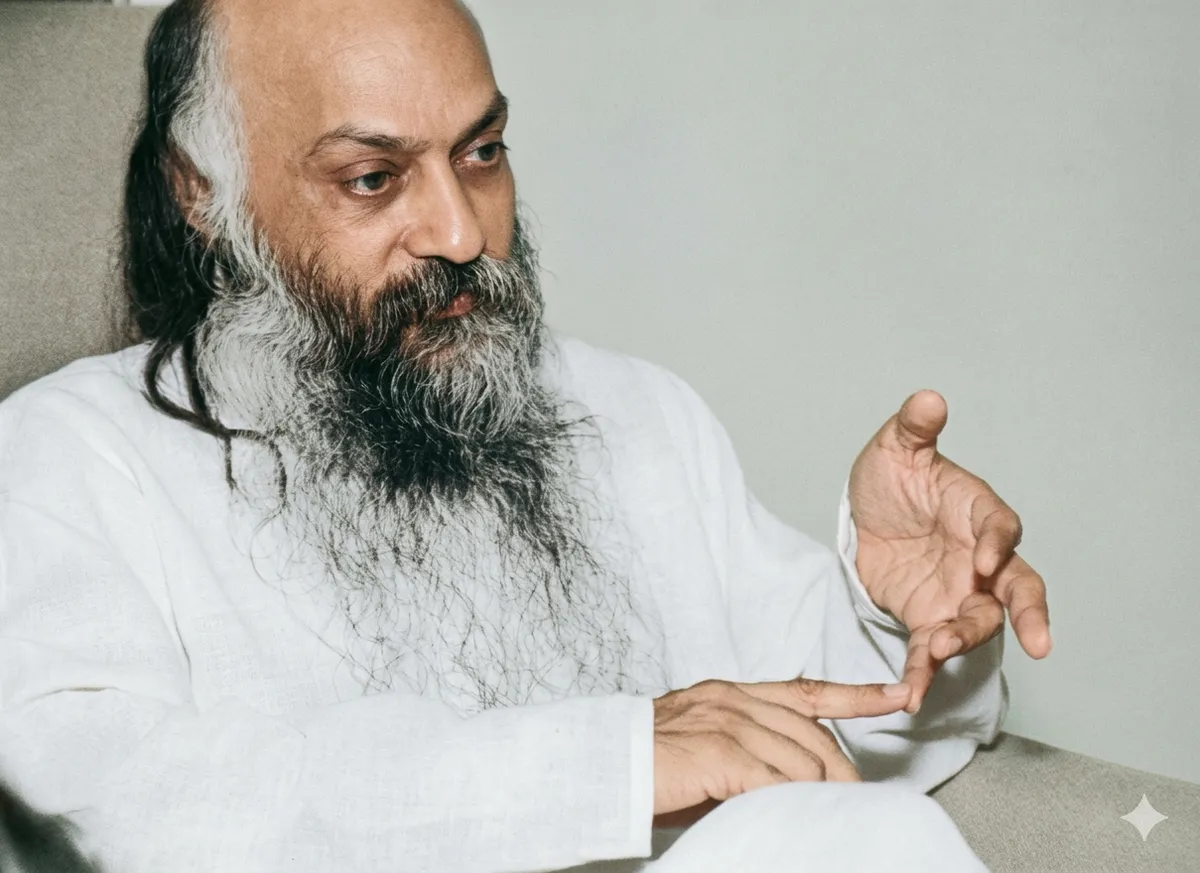
There isn’t a separate “me” choosing—trust the clear inner nudge and obvious signals life gives, and let both actions and outcomes belong to the Whole.
From the Discourses
Passages where Osho speaks to this question — each links to the complete discourse.
Osho, there is a longing to disappear, to become a mere instrument, and let my life flow only according to His will. I have also had a few small glimpses of this. But on many occasions I fall into conflict and confusion: is it His will or my will?
“And let my life flow according to His will…” If it is His will, then what “life of yours” is left? Let His own life flow. His will, His life—why do you come in between? But no—then the fun evaporates. If it is all His will and His life, and you do not come in at all, the ego loses all its juice. “I have had a few small glimpses…” So long as the ego remains, even the “glimpses” will be imagination. And if a glimpse of That truly happens, will you still hold on to the ego? If diamonds and jewels appear before you, will you go on clutching pebbles? Will you then come and ask me, “How to drop the pebbles? How to empty the bag so I can fill it with diamonds?” You will drop them yourself. You won’t even come to ask; you won’t come to…
पांचवां प्रश्न: ओशो, अभीप्सा है कि मिट जाऊं, निमित्त-मात्र हो जाऊं और उसकी मर्जी के अनुसार ही मेरा जीवन बहे। कुछ छोटी-मोटी झलकें भी इसकी मिली हैं। लेकिन अनेक अवसरों पर मैं द्वंद्व और दुविधा में पड़ जाता हूं कि यह उसकी मर्जी है या मेरी मर्जी है!
और उसकी मर्जी के अनुसार ही मेरा जीवन बहे.। अब जब उसकी ही मर्जी है, तो तुम्हारा क्या खाक जीवन है! उसको ही बहने दो। उसकी ही मर्जी, उसका ही जीवन, तुम बीच में क्यों आते हो? लेकिन नहीं, तब तो मजा ही चला गया। अगर उसकी ही मर्जी और उसका ही जीवन है, और तुम बीच में बिलकुल न आए, तब तो अहंकार का सारा रस चला गया। कुछ छोटी-मोटी झलकें भी मिली हैं.। अहंकार के रहते हुए झलकें भी कल्पना ही होंगी। और अगर झलक मिल जाए उसकी, तो फिर भी तुम अहंकार को पकड़े रहोगे? हीरे-जवाहरात दिखाई पड़ जाएं, फिर तुम कंकड़-पत्थर हाथ में लिए रहोगे? फिर तुम मुझसे पूछने आओगे, कैसे छोड़ें कंकड़-पत्थर? कैसे झोली खाली करें, ताकि हीरे भर लें? तुम भर ही लोगे, तुम पूछने भी न आओगे, तुम बताने भी न आओगे। तुम हीरे भरकर अपने हीरों के भोग में लग जाओगे। कबीर ने कहा है, हीरा पाया गांठ गठियाया, फिर बाको बार-बार क्यों खोले। अब मिल गया हीरा, उसको जल्दी से आदमी गांठ में लपेट लेता है। फिर खोलकर भी नहीं देखता कि कोई और न देख ले। …
Swami Arun has asked: you say, “Leave everything to His will.” But how are we to know which is our will and which is His will?
The magistrate will punish. But the one who has left everything to Him accepts even the punishment—His punishment. He made the theft happen. The wealth that was stolen was His. He is there in the magistrate too. To leave everything to Him means there is no such thing as “my will” anymore. Now whatever happens, however it happens. This is a very deep state. You keep calculating: where is my will in this, and where is His? As if there could be two wills. Does a wave have a will of its own? All the will is the ocean’s. For a moment a wave rises, dances, sings, makes a great commotion, then dissolves. But even when the wave soars high, converses with the winds, longs to touch the clouds, it is still only the ocean’s will. One who knows this becomes thought-free. Then the questions do not arise: Why is…
स्वामी अरुण ने पूछा है कि आप कहते हैं सब उसकी मर्जी पर छोड़ दें। मगर यह कैसे पता चले कि कौन-सी हमारी मर्जी है और कौन-सी उसकी मर्जी है?
मजिस्टे्रट सजा देगा। लेकिन तब जिसने सब उस पर छोड़ दिया है, वह सजा भी स्वीकार करेगा--उसी की सजा है। उसी ने चोरी करवाई। उसी ने चोरी की। उसी का धन था, जिसकी चोरी की गई। वही मजिस्ट्रेट में है। जिसने सब उस पर छोड़ा, उसका अर्थ यह होता है कि अब मेरी मर्जी जैसी कोई चीज ही नहीं है। अब जो होगा, जैसा होगा। यह बड़ी गहन अवस्था की बात है। तुम हिसाब लगाते हो कि इसमें मेरी मर्जी कहां है, उसकी मर्जी कहां है? जैसे कि दो मर्जी हो सकती हैं। लहर की कोई मर्जी होती है? मर्जी तो सब सागर की होती है। क्षण-भर को लहर उठती है, नाचती है, गीत गा लेती है, शोरगुल मचा लेती है, फिर खो जाती है। मगर जब लहर नाचती है उत्तुंग, हवाओं से बात करती है, बादलों को छूने की आकांक्षा रखती है, तब भी सागर की ही मर्जी है।
How to see what is my will and god's will?
There is a Chinese saying: Man is a puppet when he acts, a poet when he describes. All that you think is your freedom is nothing but your poetry. An unconscious man cannot be free, cannot have any freedom. Freedom comes as a consequence of consciousness, freedom is the function of consciousness. An unconscious man exists like a machine, like a robot. You may not know, but you are continuously functioning as a robot. Somebody abuses you and anger arises. It is almost like when you push the button and the fan starts moving. Somebody pushes the button and you become angry. What kind of freedom is this? You don't have any choice, to be angry or not to be angry. If the choice is not there there is no freedom. Freedom means freedom to choose -- you can decide whether to be angry or not, then you are free.…
Osho, in reference to the subject of offering to the divine, please explain what is the significance of will and surrender? What are the similarities and differences between will and surrender?
THE END is always the same, but the beginning differs, and all the differences belong always to the beginning. The nearer you reach, the less is the difference between paths. In the beginning will and surrender are diametrically opposed. Surrender means absolute will-lessness. You have no will of your own, you feel helpless, you feel you cannot do anything. You are so totally helpless that you cannot even say that will exists; the very concept of will is illusory. You have no will. Rather, on the contrary, you have destiny, not will, so you can only surrender. It is not that you surrender: rather, it is that you cannot do anything else. So surrender is not an act. Rather, it is a recognition. It is not an act! How can surrender be an act? How can you surrender? If you surrender, then how will you call it surrender when you…
Beloved master, gurdjieff said that in order to attain to real will one would have to surrender one's false will first. Is this also true here?
Peter Markee, it is true everywhere. It is true forever. Truth is universal: time makes no difference, place makes no difference. And this is one of the most fundamental truths of spiritual growth: the false has to be given up because the false is the barrier. You remain deluded by the false; hence the search for the true never starts. You believe the false to be the true. Then why should you endeavor to realize the true? If you think that darkness is light, then where is the necessity to search for light? If you think this life is all, then there is no question of seeking and inquiring about another life. If time is your total reality, then eternity never becomes a quest for you. The false will means the ego; the true will means egolessness. The false will is yours; the true will is God's. The false will…