
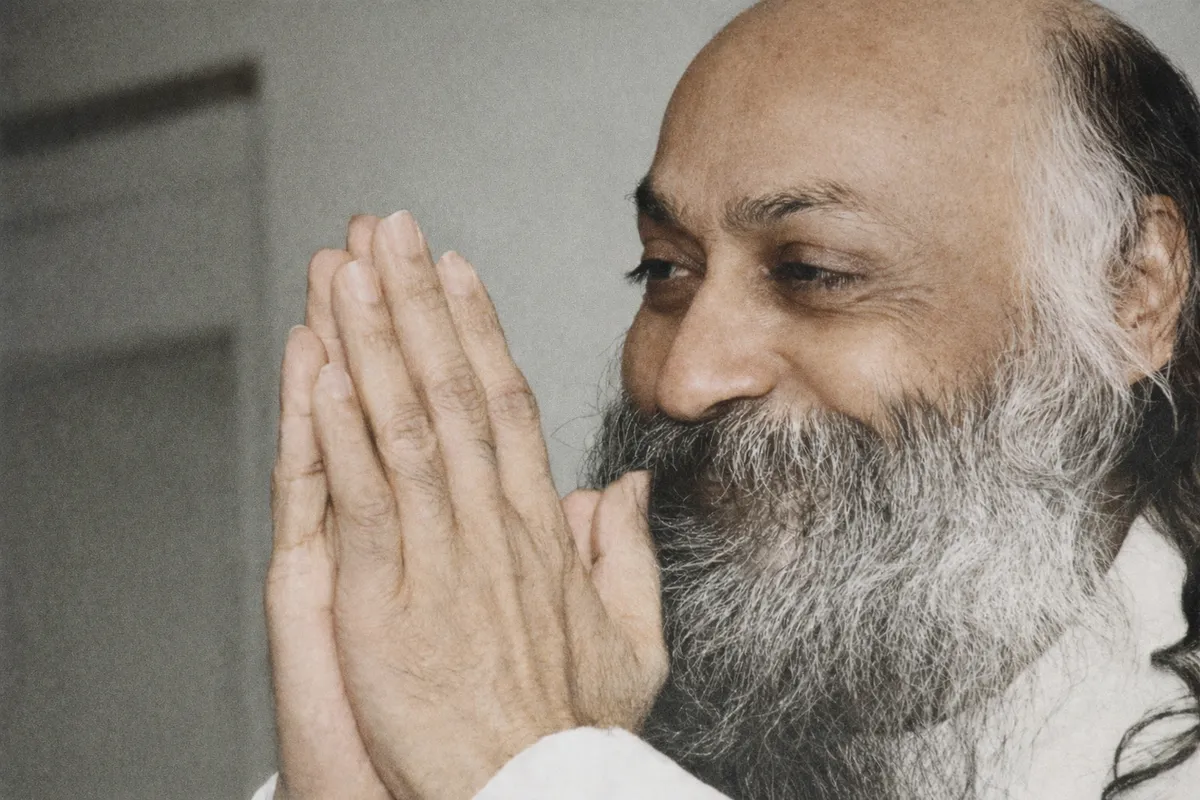
It’s when you feel one with everything, so thinking stops and there’s just clear, direct knowing.
From the Discourses
Passages where Osho speaks to this question — each links to the complete discourse.
And in the sixth body? In the sixth body even contemplation is no longer needed. Up to the fourth body there is need of thought; on the fifth body there is contemplation, thinking, prajna; on the sixth body even that ends. Because in the sixth body you are where no need remains at all—you become cosmic; you become one with Brahman; there is no other left.
In truth, all thinking is a relating with the other. The thinking before the fourth body is an unconscious relating—with the other. On the fifth body, thought is a conscious relating, but still with the other. After all, why is thought needed? Thought is needed because one has to relate to the other. Up to the fourth there is unconscious relating; on the fifth there is wakeful relating; on the sixth there is no one left to relate to—no related ones remain. You have become cosmic; you and I are one. So no question remains now; there is no place left where thought can stand. In the sixth body only knowledge remains Therefore the sixth is the Brahman body; there is no thought there. In Brahman there is no thought. So, to be precise, we can say: in Brahman there is knowing. In fact, thought—as it is up to the…
प्रश्न: और छठवें शरीर में? छठवें शरीर में विचारणा की भी कोई जरूरत नहीं रह जाती है। चौथे शरीर तक विचार की जरूरत है; पांचवें शरीर पर विचारणा, थिंकिंग, प्रज्ञा; छठवें शरीर पर वह भी समाप्त हो जाती है। क्योंकि छठवें शरीर पर तुम वहां होते हो जहां कोई जरूरत ही नहीं होती, तुम कास्मिक हो जाते हो; तुम ब्रह्म के साथ एक हो जाते हो; अब कोई दूसरा बचता नहीं।
असल में, सब विचार दूसरे के साथ संबंध है। चौथे शरीर के पहले का जो विचार है, वह मूर्च्छित संबंध है--दूसरे के साथ। पांचवें शरीर पर जो विचार है वह अमूर्च्छित संबंध है, लेकिन दूसरे के ही साथ। आखिर विचार की जरूरत क्या है? विचार की जरूरत है क्योंकि दूसरे से संबंधित होना है। चौथे तक मूर्च्छित संबंध है, पांचवें पर जाग्रत संबंध है, छठवें पर संबंध के लिए कोई नहीं बचता--रिलेटेड नहीं बचते, कास्मिक हो गए, तुम और मैं एक ही हो गए। तो अब तो कोई सवाल नहीं बचता, विचार की अब कोई जगह नहीं बचती जहां विचार खड़ा हो। छठवें शरीर में केवल ज्ञान शेष इसलिए ब्रह्म शरीर है छठवां, वहां कोई विचार नहीं है। ब्रह्म में विचार नहीं है। इसलिए अगर ठीक से कहें तो हम इसको ऐसा कह सकते हैं कि ब्रह्म में ज्ञान है। असल में, विचार जो है--चौथे शरीर तक मूर्च्छित विचार--गहन अज्ञान है; क्योंकि वह इस बात की खबर है कि हमें विचार की जरूरत है अज्ञान से लड़ने के लिए। …
Question: what is prana and how is it manifested in each of the seven bodies?
When the magnetic force is in you, when it is coming into you, you are great; when it has gone from you, you are just a nobody. And this is changing back and forth, just like day and night; the circle revolves, the wheel revolves. So even a person like Napoleon had his impotent moments and even a very cowardly person has his moments of bravery. In judo there is a technique to know when a person is powerless. That is the moment to attack him. When he is powerful you are bound to be defeated, so you have to know the moment when his magnetic power is going out and attack him then, and you should incite him to attack you when your magnetic force is coming in. This coming in and going out of the magnetic force corresponds to your breathing. That is why, when you have to…
When the self -- living inside the food body -- and the vital body thinks through the instrumentality of the fourteen organs like mind, et cetera, about objects like sound, smell, touch, et cetera it is called the manomaya koshu or the mental body.
WHEN THE SELF, UNITED WITH THESE THREE BODIES, KNOWS THROUGH INTELLIGENCE, IT IS CALLED THE VIGYANMAYA KOSHA OR THE KNOWING BODY. WHEN THE SELF, IN UNION WITH THESE FOUR BODIES -- FOOD BODY, VITAL BODY, MENTAL BODY AND THE KNOWING BODY -- DWELLS IN ITS PRIMEVAL AND CAUSATIVE IGNORANCE IT IS CALLED THE ANANDAMAYA KOSH OR THE BLISS BODY. ... And when there is no experience, only the experiencer remains. When there is no known object, only the knower remains. When there is nothing to be witnessed, but only the witness is, then you are centered in yourself -- then you ARE; otherwise, you belong to this body or that. This is not a body. This is the original nature. This is the existential source of all being. Two or three things more. When you transcend the bliss-body, you transcend individuality also. When you transcend the bliss-body, you transcend life and
You said we have seven bodies: an etheric body, a mental body and so on. Sometimes it is difficult to adjust the indian language to the terms of western psychology. We have no theory for this in the west, so how can we translate these different bodies into our language? The spiritual is no problem, but the etheric? The astral?
Begin from the physical. Then every other step opens for you. The moment you work on the first body, you have glimpses of the second. So begin from the physical. Be aware of it moment to moment. And not only outwardly aware. You can become aware of your body from the inside also. I can become aware of my hand as I have seen it from the outside, but there is an inner feeling to it too. When I close my eyes the hand is not seen, but there is still an inner feeling of something being there. So do not be aware of your body as seen from the outside. This cannot lead you inward. The inner feeling is quite different. When you feel the body from within, you will know for the first time what it is to be inside the body. When you see it only from…
Osho, in yesterday’s talk you said that a seeker should first be concerned with becoming a vessel, and should not go about begging from place to place. But the very meaning of a seeker is that he has obstacles in practice. He doesn’t know how to become a vessel, how to prepare. So if he does not go asking, what should he do? How difficult it is to meet the right guide!
But searching and begging are two different things. In fact, the one who does not want to search is the one who begs. Searching and begging are not the same; they are opposites. He who wants to avoid searching begs; a seeker never begs. And the processes of searching and begging are entirely different. In begging you have to keep your attention on the other—the one who will give. In searching you have to keep your attention on yourself—the one who is to receive. It is true that there are obstacles on the path of the seeker. But if we understand rightly, saying there are obstacles on the path of the seeker means the obstacles are within the seeker; the path too is within. And to understand one’s obstacles is not very difficult. So we will have to speak a little more extensively on what the obstacles are and how…
प्रश्न: ओशो, कल की चर्चा में आपने कहा कि साधक को पात्र बनने की पहले फिकर करनी चाहिए, जगह-जगह मांगने नहीं जाना चाहिए। लेकिन साधक अर्थात खोजी का अर्थ ही है कि उसे साधना में बाधाएं हैं। उसे पता नहीं है कि कैसे पात्र बने, कैसे तैयारी करे। तो वह मांगने न जाए तो क्या करे? सही मार्गदर्शक से मिलना कितना मुश्किल से हो पाता है!
लेकिन खोजना और मांगना दो अलग बातें हैं। असल में, जो खोजना नहीं चाहता वही मांगता है। खोजना और मांगना एक तो हैं ही नहीं, विपरीत बातें हैं। खोजने से जो बचना चाहता है वह मांगता है, खोजी कभी नहीं मांगता। और खोज और मांगने की प्रक्रिया बिलकुल अलग है। मांगने में दूसरे पर ध्यान रखना पड़ेगा--जिससे मिलेगा। और खोजने में अपने पर ध्यान रखना पड़ेगा--जिसको मिलेगा। यह तो ठीक है कि साधक के मार्ग पर बाधाएं हैं। लेकिन साधक के मार्ग पर बाधाएं हैं, अगर हम ठीक से समझें तो इसका मतलब होता है कि साधक के भीतर बाधाएं हैं; मार्ग भी भीतर है। और अपनी बाधाओं को समझ लेना बहुत कठिन नहीं है। तो इस संबंध में थोड़ी सी विस्तीर्ण बात करनी पड़ेगी कि बाधाएं क्या हैं और साधक उन्हें कैसे दूर कर सकेगा।