
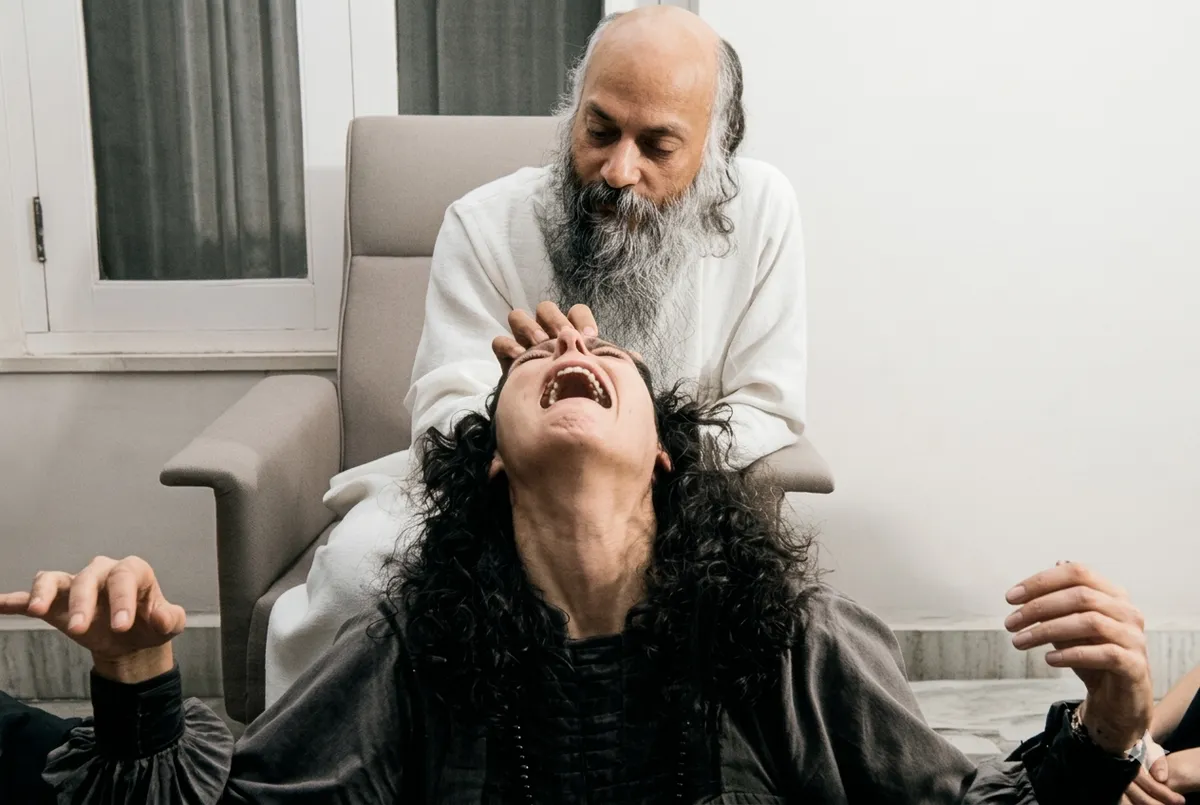
If your head is packed with ideas, nothing new fits—drop even the ‘cup’ (your ego) so life’s truth can pour in.
From the Discourses
Passages where Osho speaks to this question — each links to the complete discourse.
The japanese master nan-in gave audience to a professor of philosophy. Serving tea, nan-in filled his visitor's cup, and kept pouring. The professor watched the overflow until he could restrain himself no longer: stop! The cup is overfull, no more will go in. Nan-in said: like this cup, you are full of your own opinions and speculations. How can I show you zen unless you first empty your cup?
In the night, just the opposite of the morning -- be completely unconscious; don't bother at all. The night has come, the sun has set, now everything is moving into unconsciousness. Move into unconsciousness. This whirling, Sufi whirling, is one of the most ancient techniques, one of the most forceful. It is so deep that even a single experience can make you totally different. You have to whirl with open eyes, just like small children go on twirling, as if your inner being has become a center and your whole body has become like a wheel, moving- a potter's wheel, moving. You are in the center, but the whole body is moving. Start slowly, clockwise. If somebody feels it is very difficult to move clockwise then anti-clockwise, but the rule is to move clockwise. If a few people are left-handed then they may feel it difficult; they can move anti-clockwise.…
A monk asked nansen: 'is there a teaching no master ever preached before?' nansen said: 'yes there is.' 'what is it?' asked the monk. Nansen replied: 'it is not mind, it is not buddha, it is not things.'
People, ninety-eight percent of them, are asleep in things. Try to find out where you are asleep, because the work has to start there. If you are asleep with things, then you have to start from there. Drop that sleep with things. Why do people go on thinking about things? I used to stay in a house in Calcutta. The woman there must have had at least one thousand saris, and every day it was a problem.... When I was there her husband and I would be sitting in the car and her husband would go on honking and she would say, 'I am coming!' -- and it was difficult for her to decide which sari to wear. So I asked, 'Why is this a problem every day?' So she took me and showed me, and she said, 'You would also be puzzled. I have got one thousand saris and…
Someone asks, Osho, the mind itself is the obstacle; because of it one cannot realize the Self. How can this mind be emptied?
Be alert about this. Be alert about the filling. Drop the worry about emptying. You will not be able to empty it. No one has ever emptied it. Just drop the preoccupation with filling. And one day you will suddenly find that the filling has stopped and, from below, the flour has stopped coming out of the mill; it lies empty. Keep watch over the filling—where and how you are filling! First be aware; do not hurry to stop. First be aware of all the ways you fill and all the channels through which you fill! And man is such that till his last breath he goes on filling. Mulla Nasruddin was bitten by a mad dog. For two or three days he paid no attention. People said, “It’s a mad dog; go to a doctor.” When he went, the poison had already spread. The physicians met and decided they…
Question: OUR BELOVED MASTER, BUKKO SAID: TAKING THINGS EASILY AND WITHOUT FORCING, AFTER SOME TIME THE RUSH OF THOUGHT, OUTWARD AND INWARD, SUBSIDES NATURALLY, AND THE TRUE FACE SHOWS ITSELF. ... NOW BODY AND MIND, FREE FROM ALL MOTIVATIONS, ALWAYS APPEAR AS VOID AND ABSOLUTE SAMENESS, SHINING LIKE THE BRIGHTNESS OF HEAVEN, AT THE CENTER OF THE VAST EXPANSE OF PHENOMENAL THINGS, AND NEEDING NO POLISHING OR CLEANING. THIS IS BEYOND ALL CONCEPTS, BEYOND BEING AND NON-BEING. LEAVE YOUR INNUMERABLE KNOWINGS AND SEEINGS AND UNDERSTANDINGS, AND GO TO THAT GREATNESS OF SPACE. WHEN YOU COME TO THAT VASTNESS, THERE IS NO SPECK OF BUDDHISM IN YOUR HEART, AND WHEN THERE IS NO SPECK OF KNOWLEDGE ABOUT YOU, YOU WILL HAVE THE TRUE SIGHT OF BUDDHAS AND PATRIARCHS. THE TRUE NATURE IS LIKE THE IMMENSITY OF SPACE WHICH CONTAINS ALL THINGS.
A certain man decided that he would seek the perfect master.
HE READ MANY BOOKS, VISITED SAGE AFTER SAGE, LISTENED, DISCUSSED AND PRACTISED, BUT HE ALWAYS FOUND HIMSELF DOUBTING OR UNSURE. AFTER TWENTY YEARS HE MET A MAN WHOSE EVERY WORD AND ACTION CORRESPONDED WITH HIS IDEA OF THE TOTALLY REALIZED MAN. THE TRAVELER LOST NO TIME. "YOU," HE SAID, "SEEM TO ME TO BE THE PERFECT MASTER. IF YOU ARE, MY JOURNEY IS AT AN END." "I AM, INDEED, DESCRIBED BY THAT NAME," SAID THE MASTER. "THEN, I BEG OF YOU, ACCEPT ME AS A DISCIPLE." "THAT," SAID THE MASTER, "I CANNOT DO FOR WHILE YOU MAY DESIRE THE PERFECT MASTER, HE, IN TURN, REQUIRES ONLY THE PERFECT PUPIL." One man came to me and he said, "I used to think that Krishnamurti must be like a Buddha, but today I saw him in his discourse -- he became so angry. And for no reason at all!" I said, "You…