
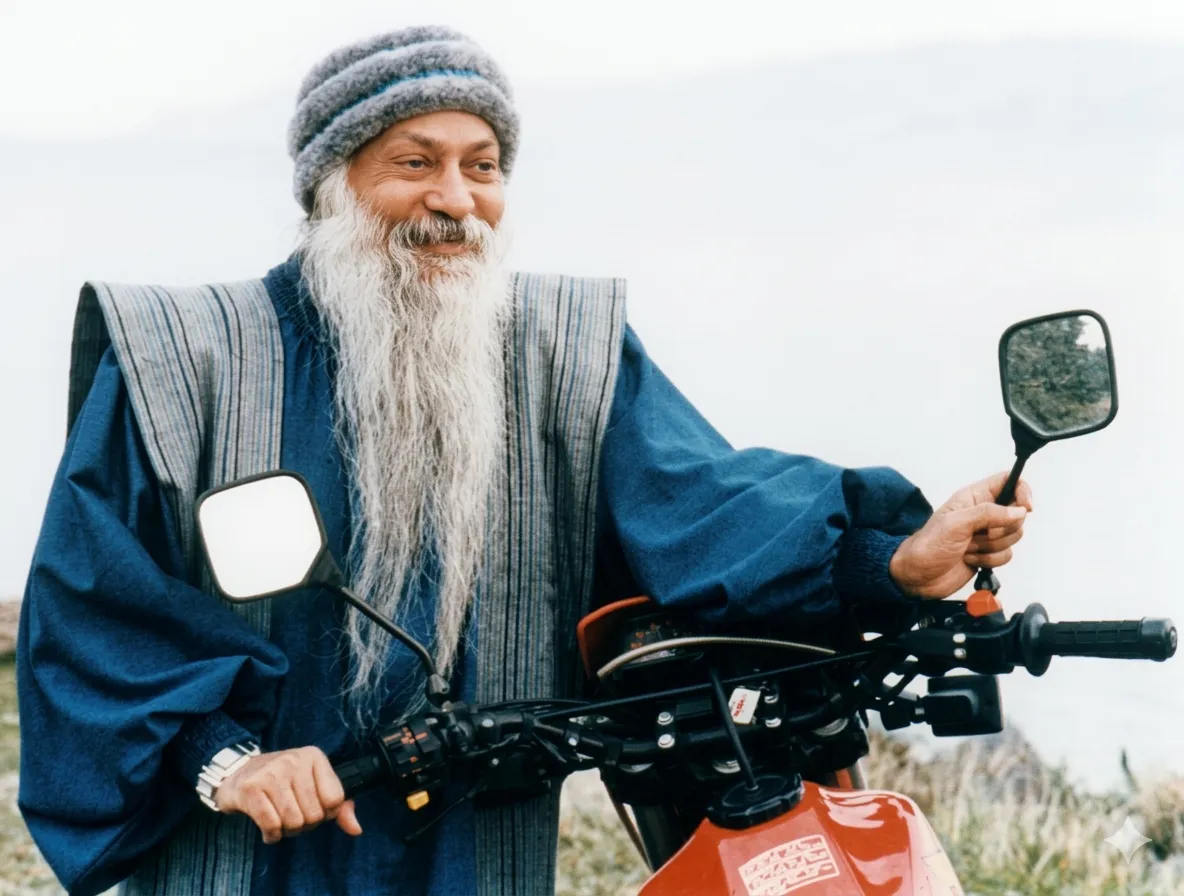
Osho says old God-based religions don’t help anymore; let them go and discover your own joyful, loving awareness through meditation and celebration.
From the Discourses
Passages where Osho speaks to this question — each links to the complete discourse.
It seems that never has any god-oriented religion been more anachronistic than it is today; yet curiously, christianity at least seems to be blooming. Born-again christians, jesus freaks, and fundamentalist christians are rife. Are we seeing the phenomenon you have described when something is about to die? You have compared it to a candle going out, having a last, final spurt of energy before it splutters into extinction.
I am ready for any argument with anybody, because I know their whole religious belief is absolutely unfounded. They cannot prove God, they cannot prove heaven, they cannot prove hell. They cannot prove that God created the world, because there is no witness. How have you found it? Who told you? Obviously there cannot have been any witness when God created the world. If there was a witness, the world was already there. It is intrinsically rational to accept that there cannot be any witness -- because there was no world. From where will the witness come? So God cannot have a witness; then how have these people come to know? From whom? Their whole idea is based on the lie of God. And I always strike at the very foundation, I don't bother about the branches and the leaves. I cut the very roots. And they cannot defend, because…
Could one summarize the difference between a god-oriented religion and the quality of religiousness as the difference between a judge external to us, a projected conscience, and a witness within our consciousness?
A woman has to be out of the house just for one night. It does not matter whether she has made love to anybody or not. This is how Indian Mohammedans go on increasing their population. Obviously, one man with four wives, can give at least four children per year. The same is not possible for four husbands and one wife. They may not even give one child -- the four husbands may kill the child before it is born. So remember, your God-oriented religions are only conveniences for the society. They should not be called religions, they are only moral precepts to keep the society together, and in the least inconvenient way. It is not religiousness. Religiousness arises only as a blossoming of your own consciousness. God-oriented religions certainly create a conscience, but not consciousness. And many people have the false notion that conscience and consciousness are one. Their…
Osho, I was shocked to hear you say that god does not exist. Then the question arose in me: how can there be any religion without god? Isn't god the center and religion the circumference?
These are the three phases of the Hindu God: Brahma is the creative phase, he creates the world; Vishnu, the second phase, he maintains the world, and Shiva -- he destroys the world when the time comes to destroy it. In a way it is perfectly balanced; there are all the three functions that existence needs: creation, maintenance, and one day, de-creation. But if you look into the inner life of these three persons, you cannot believe it. One day, Vishnu and Brahma are quarreling about something. In the first place, the idea of a quarrel between two parts of God makes Him schizophrenic. If both your hands start fighting each other... and that's what you are doing in the mind -- one part fighting against the other part. Sometimes you become so split that you are already two persons, and sometimes you are many persons. God is already three…
Question: Second question: Osho, why has the man of this century become irreligious? Understand this: religion lives from the future. The pandit-priest lives off the past. Therefore the pandit-priest and religion never truly meet. In my view, the pandit-priest is the most irreligious person in the world. He has only one concern—that his shop keep running. He drags in the old by any excuse. There is unrest in the world—he says, “Perform a yajna—a great Shatachandi—for world peace!” What has your fire sacrifice to do with world peace? How many have you performed already—has world peace come? Leave the world; bring peace to a single neighborhood and show us! Leave the neighborhood—those five hundred Brahmins who gather to burn up ten million rupees in a ritual, there is such turmoil among them—constant quarrels over who grabs how much.
Osho, what is the definition of God?
Words are very small. If you say God is light, then what of darkness? The scriptures have said that God is light. Suppose we accept this as a definition—then what about darkness? Where will darkness go? Darkness is too; in fact it is far more than light. Light sometimes is and sometimes is not; darkness is always, eternal. Where will you place darkness? If you say God is light, darkness is left out. If you say God is darkness, then light is left out. If you say God is both darkness and light, a contradiction arises: they cannot be together. Try to have both darkness and light in the same room. If you bring in light, darkness disappears; if you preserve darkness, you cannot have light. Then how can both be together? That becomes an impossibility. So you cannot say “both” either. Then the fourth device is to say: it…