
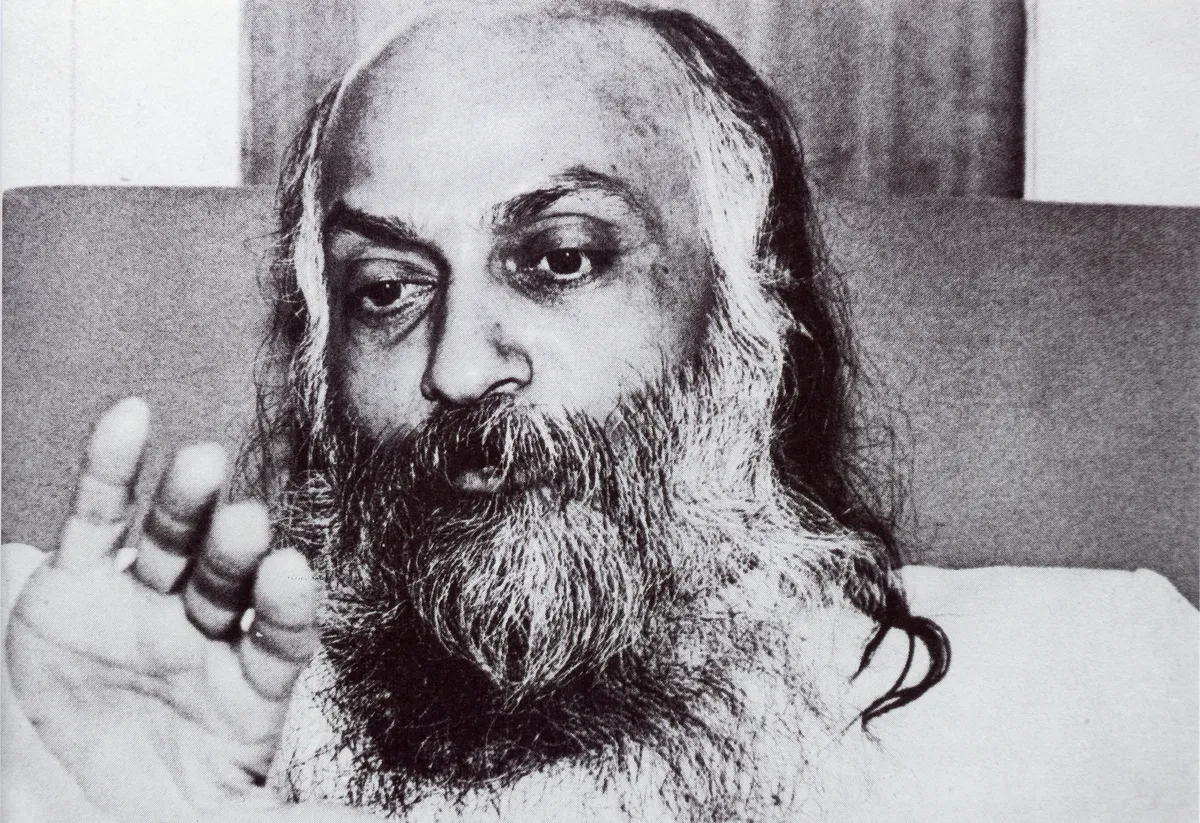
According to Osho, the ego is a flimsy structure built from thoughts and identifications—the “house” of mind. Thoughts nourish, adorn and defend the ego; matching ideas only strengthens it. When thoughts are seen as bubbles and dropped, brick by brick, the ego collapses, and what remains is empty, sky-like awareness—your true nature (tat tvam asi).
Your ego is like a house made of thoughts; stop clinging to thoughts and the house falls, revealing the open sky that you really are.
From the Discourses
Passages where Osho speaks to this question — each links to the complete discourse.
Osho, what is the fundamental anguish of human life?
There is only one anguish: that a human being cannot become what he was born to be. There is only one anguish: that the seed remains a seed and does not bloom like a flower; that it cannot scatter its fragrance to the infinite winds; cannot converse with the moon and stars; cannot offer its colors to the sky; cannot be expressed. If the poem within the poet cannot be revealed—anguish. If the painter cannot paint—anguish. If the dancer cannot dance—if chains lie on his feet—anguish. Anguish means only this: that what we are meant to be—our innate nature and destiny—does not come to fruition, and we are forced to be something else. Then anguish is born. Then melancholy gathers over life. And all those countless people you see burdened with sorrow, living in a kind of hell—the reason is only this: each has come carrying the seed of becoming…
Osho, is there any practical process for being in the realm of existence beyond thoughts, in the void?
The way to thin them out is non-cooperation. Right now we are their makers—that is, we are the ones maintaining them. When we sit idle, some thought or other is running, because without our cooperation they cannot run. Withdraw your cooperation from whatever thoughts are running, and do nothing else; regard just this as samayik, as meditation. If all thoughts dissolve, you will feel no ego and no person within. You will know only being—only being will be known, in which the distinction “I am an individual” or “I am the whole” will not be felt. Only pure being will remain—pure existence. In truth, because of the thoughts accumulated upon that pure existence, we appear to be a person. This sense that I am “A,” you are “B,” you are “C”—the A, B, C we have pasted on—is our thought-power. We commonly say, “I will become liberated”—this is not quite…
Osho, whenever someone tells you that such-and-such is happening in meditation and you say, “Good, that is auspicious,” the ego grows even more. And at all other times the ego keeps raising its head. Even while writing this question the ego thought a lot about it, and still...?
And I tell you: only the shadow remains with you; you have lost the soul. Imagine what your plight must be! Losing a shadow caused such trouble; you have lost the soul and kept only the shadow. But perhaps you don’t notice much trouble because those among whom you live have also lost their souls. The truth is, if you gain your soul, the trouble begins—those without souls become your enemies. Otherwise, why would people stone Mahavira, insult Buddha, crucify Mansoor, poison Socrates, kill Jesus? The crowd is without soul. Whenever a soul-full person stands among them, they become very uneasy. What foolishness! They should learn from the soulful how to become soulful. But seeing a soulful person, they get anxious. They say, “His presence proves we failed to become what we should have become. We lost.” Anxiety arises: “Our life is wasted. Remove this man; his presence is a…
Question: FOCUS ON FIRE RISING THROUGH YOUR FORM FROM THE TOES UP UNTIL THE BODY BURNS TO ASHES BUT NOT YOU. MEDITATE ON THE MAKE-BELIEVE WORLD AS BURNING TO ASHES AND BECOME BEING ABOVE HUMANAS, AS SUBJECTIVELY, LETTERS FLOW INTO WORDS AND WORDS INTO SENTENCES, AND AS, OBJECTIVELY, CIRCLES FLOW INTO WORLDS AND WORLDS INTO PRINCIPLES, FIND AT LAST THESE CONVERGING IN OUR BEING When you are silent, the ego is not. And when you are not silent, the ego is. So ego is the disease, all diseases combined together, hence the emphasis to surrender the ego. The emphasis is to surrender the disease. Secondly: if in silence, for even a single moment you have the glimpse of your existence as egoless, then you can analyze it, and then you can enter the phenomenon of ego, of what it is. Thew mind is accumulated past.
The ego we nurture through life—at the end we find it lying in the dust and people’s feet falling upon it. That ego which we guard our whole life—where is it? Turned to dust, turned to ash, blown by the wind—no trace to be found. Smoke in the fire, earth in the earth—where is it? How many have lived upon this earth! Even where we sit, who knows how many lie buried beneath. There is no patch of earth where crores upon crores have not been interred. There is no piece of earth that is not a cremation ground. And how many egos they had! For their egos how much pain they suffered, how they struggled, how they were violent, how they hated, how they dreamt of sorrow and pain, how they lost nights, lost sleep, lost their lives. Where are those people? Where are those egos?