
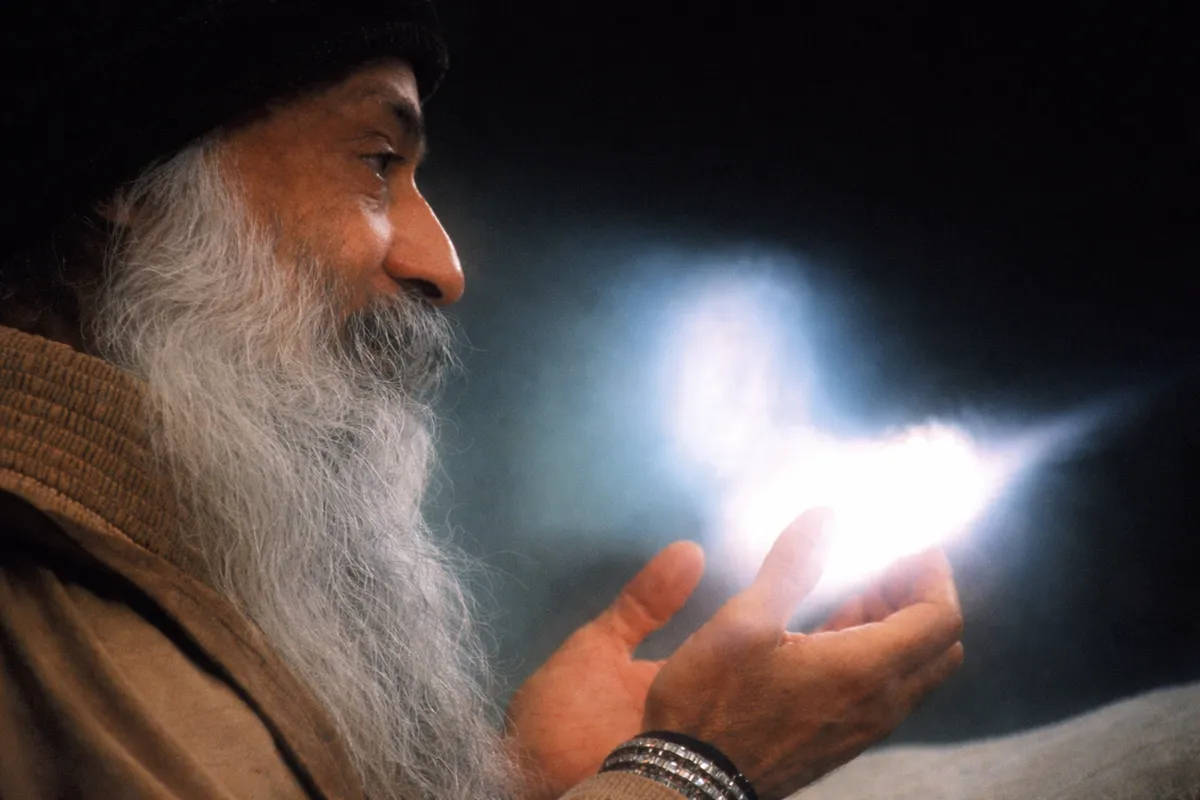
Perfection happens when emptiness is not forced by dropping things, but is your natural state that freely plays as everything without clinging.
From the Discourses
Passages where Osho speaks to this question — each links to the complete discourse.
Osho, there was a question about perfection. In the morning you said you regard emptiness as the fundamental hallmark of perfection. Then Buddha too was the ultimate void. So can he not be called complete? And along with that, is emptiness itself not multidimensional?
A few points. First, Buddha arrived at emptiness—as I was just saying, Buddha arrived at emptiness. That was his achievement; he attained it. He became empty. The emptiness that is attained becomes one-dimensional. It acquires a direction. It becomes dependent on the attainer. Understand it this way. In fact, whatever I negate within myself, whatever I cut off and set aside, will be finished, removed from within me. A certain kind of emptiness will be available. But that emptiness will come as the absence of something. There is another emptiness that we do not bring about; it is born in the very awareness of our being. We are emptiness—we do not become empty. Emptiness is our nature. That is how we are. The day emptiness is our nature—no discipline, no practice, no attainment—on that day emptiness becomes multidimensional. We have not emptied out anything to become empty; we have simply…
ओशो, पूर्णता के संबंध में एक प्रश्र्न था। आपने सुबह कहा कि पूर्णता का मूल लक्षण आप शून्यता मानते हैं। तो बुद्ध भी तो परम शून्य थे। तो क्या उन्हें पूर्ण नहीं कहा जा सकता? और उसी के साथ क्या शून्यता स्वयं में बहुआयामी नहीं है?
एक तो, बुद्ध शून्यता पर पहुंचे, जैसा मैं अभी कह रहा था, बुद्ध शून्यता पर पहुंचे। वह उनका अचीवमेंट है। वह उन्होंने पाया। वे शून्य हुए। जो शून्यता पाई जाएगी, वह वन डायमेंशनल हो जाती है। उसकी एक दिशा हो जाती है। वह पाने वाले पर निर्भर हो जाती है। इसको ऐसा समझें। असल में मैं अपने भीतर से जिस चीज को शून्य कर दूंगा, जिस चीज को काट डालूंगा, अलग कर दूंगा, वह समाप्त हो जाएगी, मेरे भीतर से हट जाएगी। एक तरह का शून्य उपलब्ध होगा। लेकिन वह शून्यता किसी चीज का अभाव होकर आएगी। एक और शून्यता है, जो हम लाते नहीं, जो हमारे होने के बोध में ही जन्मती है। हम हैं ही शून्य, हम होते नहीं शून्य। शून्यता हमारा स्वभाव है। ऐसे हम हैं ही। …
A friend has asked: Osho, you said about a wayward son that one should let him pass through his experiences, and he will learn on his own. But even after experiencing, he still prefers the same thing—someone is asking about his wayward son—no matter how much suffering he has to endure, even if death itself should come, still he does the same. After stumbling again and again, he repeats it. What can be done? How to reform him?
You will not be able to reform him. If life cannot reform him, if even death cannot reform him, what will you be able to do? If what you say is true—that again and again, even after suffering, he does the same thing; even if death comes, he will still do the same thing, and he does not change—then take your hands off. You will not be able to reform him. You cannot be stronger than death. And one who does not learn from suffering—what will he learn from you? Do not call him a wayward son. You have found yourself a Jadabharata. Because those whom suffering does not reform, whom even death does not reform—these are great, arrived masters; they are in the ultimate state. Do not even try to reform such a one. And why are you so eager to reform another? It is enough to reform yourself.…
एक मित्र ने पूछा है कि ओशो, आपने कुपुत्र के बारे में बताया कि उसको अनुभवों में से गुजरने देना चाहिए, तो वह खुद सीख जाएगा। लेकिन अनुभव लेने के बाद भी वह वही पसंद करता है--कोई अपने कुपुत्र के संबंध में पूछ रहे हैं--चाहे कितना ही दुख झेलना पड़े, चाहे मौत भी क्यों न आ जाए, फिर भी वह वही करता है। बार-बार ठोकर खाकर भी वही दोहराता है। उसका क्या उपाय किया जाए? उसको सुधारने का क्या तरीका है?
आप न सुधार पाएंगे। जिसको जिंदगी नहीं सुधार पा रही, मौत नहीं सुधार पा रही, उसको आप क्या सुधार पाएंगे? अगर आपकी बात सच है कि बार-बार दुख पाकर भी वह वही करता है, मौत भी आ जाए तो भी वही करता है, और सुधरता नहीं, तो आप हाथ अलग कर लें। आपसे नहीं सुधर पाएगा। आप मौत से ज्यादा मजबूत नहीं हो सकते। और जो दुख से नहीं सीख पा रहा है, वह आपसे क्या सीख पाएगा? कुपुत्र मत कहिए उसको। आपको कोई जड़भरत मिल गया है। क्योंकि जिसको दुख नहीं सुधारते, मौत नहीं सुधारती, वे तो बड़े पहुंचे हुए महात्मा हैं, वे तो परम अवस्था में हैं। उनको आप सुधारने की कोशिश ही मत करिए।
Questioner. I have a question in regard to wholeness. You say that emptiness is the basic characteristic of wholeness. Buddha had attained to absolute emptiness. Should he not be called whole? And why is emptiness not multidimensional in itself?
In the meantime the Master went his own way. He bathed himself in the morning, dug holes in the garden and watered the plants, ate his meals and went to bed at night. In two days' time the visitor was annoyed and again he said, "I am here to learn meditation. I have nothing to do with what you do from morning to night." The Master smiled and said, "I don't teach doing, I teach being. If you see me digging holes, then know it is how meditation digs. When you see me eating, then know it is how meditation eats. I don't do meditation, I am meditation itself." Now the visitor became worried and said, "It seems I came to a madman. I was always told that meditation is doing, I had never heard someone can be meditation itself." To this the Master simply said, "It is difficult to…
Here, o sariputra, form is emptiness and the very emptiness is form; emptiness does not differ from form, form does not differ from emptiness; whatever is form, that is emptiness, whatever is emptiness, that is form; the same is true of feelings, perceptions, impulses, and consciousness. Here, o sariputra, all dharmas are marked with emptiness;
Buddha says nothing is ever defiled and nothing is ever immaculate. Purity, impurity, are mind attitudes. Can you tell about a tree whether it is moral or immoral? Can you say about an animal that he's a sinner or a saint? Try to see this ultimate vision: there is no sinner, no saint, nothing moral, nothing immoral. In this acceptance, where is the possibility of worrying? There is nothing to improve either! And there is no goal, because there is no value. This journey is a journey without any goal. It is a pure journey; it is a play, a leela. And there is nobody behind it, doing it. All is happening, and there is nobody doing it. If the doer is there then the problem arises -- then pray to the doer, then persuade the doer, then become friends with the doer. Then you will be benefitted, and those…
One friend has asked, "you say nothing is complete, then how can the void be complete?"
If you had to attain the perfection of the void, you would never have attained it. The void is complete -- it is, it is! You have just to stop filling yourself and you will suddenly realise that you are empty! There can be no completeness in this world of anything. Nothing is attained by man s actions. Once the Sultan in whose service Nasruddin was, was displeased with him. He told him, "You are a perfect dolt!" Mulla replied, "Do not flatter me. Nobody is perfect." However, if Emptiness too, had to be brought in, it would not be perfect. But the fact is, Emptiness is your nature. You have not to bring it about. It is. All you can do is to cover up what is, hide it, forget it. You cannot destroy it. You have not to attain the perfection of Emptiness. You have only to give…