
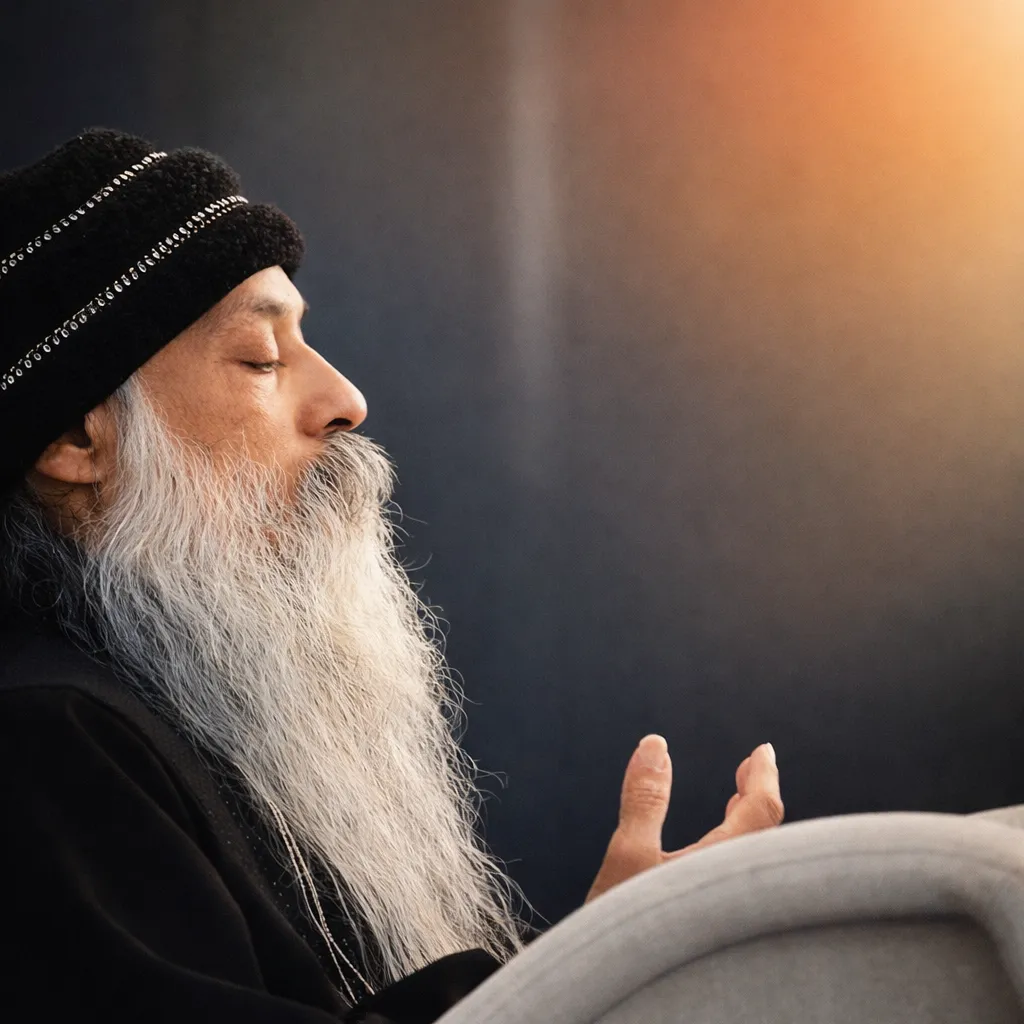
Wanting pain to prove you’re ready is ego; when the ego quiets, real change happens and hurt turns into freshness.
From the Discourses
Passages where Osho speaks to this question — each links to the complete discourse.
Osho, to remain awake even in death—or to successfully orchestrate a conscious death in meditation—what preparations should a seeker make concerning the body-system, the breath-system, the state of the breath, the state of prana, celibacy, willpower, etc.? Kindly shed detailed light on this.
But even in a cinema hall, where it is easier because it is all shadows, we do not remain witnesses. If we inspected the handkerchiefs of those exiting, we would know how many cried. We all know nothing is on the screen—only light and shadow. Yet everything “happens” there, and we become participants. Do not be mistaken that while watching a film you are merely a viewer—you become a participant. Someone pleases you, someone repels you; you identify. If we cannot be witnesses even to a film, how will we be witnesses in life? Life, too, is not much more than a film. At depth, like the play of rays on the screen, life is the play of electrical particles. If you reduce the body or a wall to its ultimate component, you find only electric particles. The difference between the screen and this is not great—two-dimensional there, three-dimensional here.…
A friend has asked: Osho, if events happen in nature and feelings in man, then when one attains siddhi and experiences one’s separateness, do bodily pain and mental anguish stop?
This needs a little understanding. First, understand the difference between pain and suffering. If a thorn pricks your foot, two things happen. One is pain. Pain means you experience that there is hurt in the foot. I know there is hurt in the foot. You are the knower. The pain happens in the foot; you are the seer of it. You are the witness. This does not mean that if you are a witness and someone pricks your foot you will feel no pain. Do not fall into that illusion. There will be pain, because the prick of a thorn is an event. But there will be no suffering. Keep this distinction in mind. Suffering happens when I become one with the pain. When I say, “A thorn is pricking me,” then suffering happens. When I say, “A thorn is pricking the foot—and I am seeing it,” then there is…
एक मित्र ने पूछा है कि ओशो, यदि प्रकृति में घटनाएं होती हैं और पुरुष में भाव, तो क्या जब कोई सिद्धि को प्राप्त हो जाता है और अनुभव कर लेता है अपनी पृथकता को, तो उसके शरीर में दुख और मन में पीड़ा बंद हो जाती है?
पहली तो बात यह समझनी पड़े कि दुख और कष्ट का फर्क। अगर आपके पैर में कोई कांटा चुभाए, तो दो घटनाएं घटती हैं। एक घटना है, कष्ट। कष्ट का अर्थ है कि आप अनुभव करते हैं कि पैर में पीड़ा हो रही है। मैं जान रहा हूं कि पैर में पीड़ा हो रही है। आप जानने वाले होते हैं। पीड़ा पैर में घटित होती है, आप देखने वाले होते हैं। आप साक्षी होते हैं। इसका यह मतलब नहीं कि आप साक्षी होंगे, तो कोई आपके पैर में कांटा चुभाए तो आपको पीड़ा नहीं होगी। इस भ्रांति में आप मत पड़ना। पीड़ा होगी। कष्ट होगा। क्योंकि कांटे का चुभना एक घटना है। लेकिन दुख नहीं होगा। इस फर्क को खयाल में ले लें। …
Osho, why is growth painful?
Man is unique among creatures in his knowledge of death and in his laughter. Wonderfully then, he can even make of death a new thing: he can die laughing. It is only man who knows laughter; no other animal laughs. It is only man who knows death; no other animal knows death -- animals simply die, they are not conscious of the phenomenon of death. Man is aware of two things which no animal is: one is laughter, another is death. Then a new synthesis is possible. It is only man who can die laughing -- he can join the consciousness of death and the capacity to laugh. And if you can die laughing, only then will you give a valid proof that you must have lived laughing. Death is the final statement of your whole life -- the conclusion, the concluding remark. How you have lived will be shown…
When the doctor cuts your body you may be thinking that you have pain but that you are not feeling it because of the injection. Wrong! -- because pain is in the feeling. If you are not feeling pain, then pain is not there. It cannot exist without your feeling; there is no way for it to exist. The doctor has made your body numb. The nervous system has gone insensitive so it can be cut. It is just as when a person is paralysed and a mosquito goes on biting his foot. He will not feel it because he is paralysed. That part of the body is no more alive. Whether a mosquito or a scorpion or a beautiful flower is there, it will make no difference to him. Numbness means that you have somehow learned not to feel pain and not to feel pleasure.
Understand it: when your stomach aches, you become aware of the stomach. When it does not, you never know you have one. When your head aches, you know you have a head; without pain, you never notice it. Wherever there is pain, that limb is felt. The wise have said: when there is pain in your consciousness you feel “I am.” When all pain is gone, there is no sense of “I.” That not‑knowing frightens—“I am not! Better keep hold of sorrow; at least the bank remains. Otherwise I’ll drown midstream!” Only when someone sees sorrow so thoroughly that he realizes “sorrow is me, my ‘I’ is woven of sorrow; without sorrow there is no ‘I’”—after such deep seeing, when such a one comes to a Sadguru, then “by even slight upadesha” a revolution happens.
… जब दर्द नहीं होता तो सिर का पता नहीं चलता। शरीर में कहीं भी पीड़ा हो तो उस अंग का पता चलता है। ज्ञानियों ने कहा है: जब तुम्हारी चेतना में पीड़ा होती है तो तुम्हें पता चलता है कि मैं हूं। और जब सब संताप मिट जाता है, कोई पीड़ा नहीं रह जाती, तो पता ही नहीं चलता कि मैं हूं। वह जो न पता चलना है, वह घबराता है--‘मैं नहीं हूं! तो इससे तो दुख को ही पकड़े रहो; दुख के किनारे को ही पकड़े रहो। …