
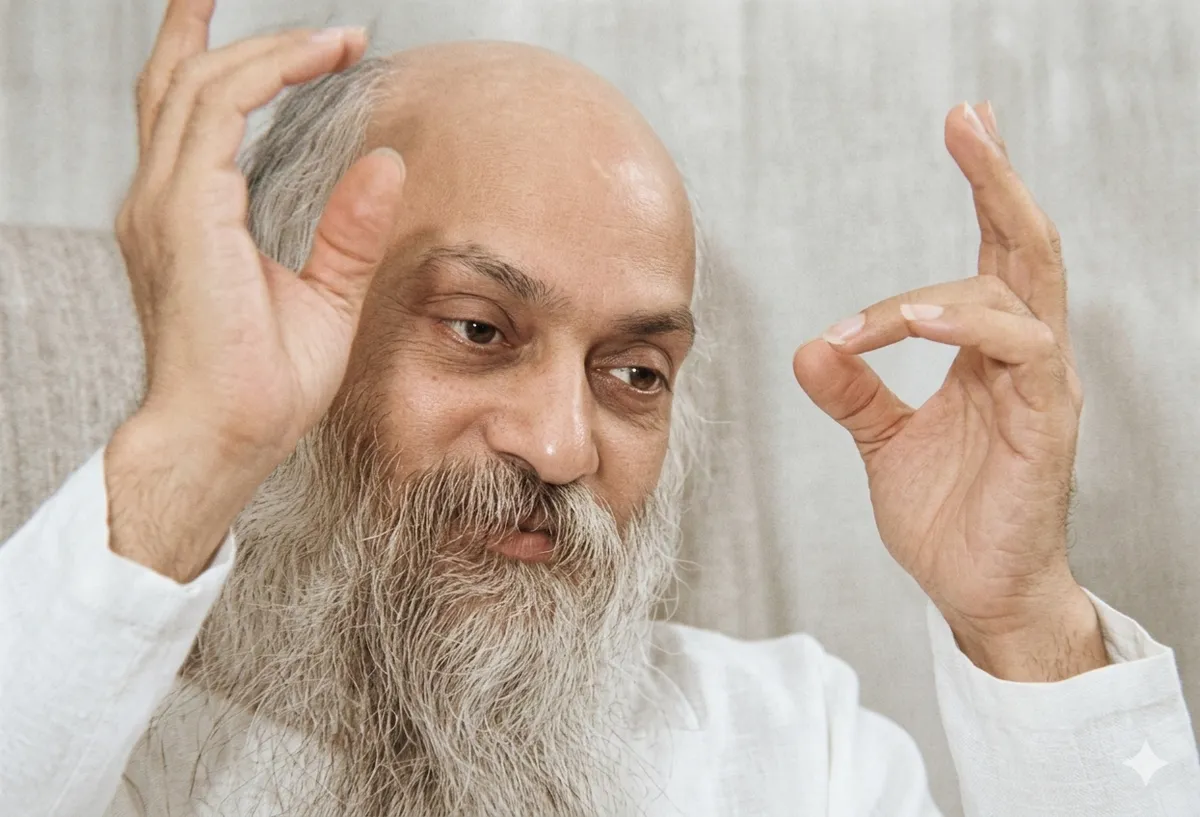
When you stop keeping busy and feel lonely and scared inside, staying with that feeling gently can turn it into a peaceful okay-ness of being by yourself.
From the Discourses
Passages where Osho speaks to this question — each links to the complete discourse.
A friend has asked: Osho, if events happen in nature and feelings in man, then when one attains siddhi and experiences one’s separateness, do bodily pain and mental anguish stop?
This needs a little understanding. First, understand the difference between pain and suffering. If a thorn pricks your foot, two things happen. One is pain. Pain means you experience that there is hurt in the foot. I know there is hurt in the foot. You are the knower. The pain happens in the foot; you are the seer of it. You are the witness. This does not mean that if you are a witness and someone pricks your foot you will feel no pain. Do not fall into that illusion. There will be pain, because the prick of a thorn is an event. But there will be no suffering. Keep this distinction in mind. Suffering happens when I become one with the pain. When I say, “A thorn is pricking me,” then suffering happens. When I say, “A thorn is pricking the foot—and I am seeing it,” then there is…
एक मित्र ने पूछा है कि ओशो, यदि प्रकृति में घटनाएं होती हैं और पुरुष में भाव, तो क्या जब कोई सिद्धि को प्राप्त हो जाता है और अनुभव कर लेता है अपनी पृथकता को, तो उसके शरीर में दुख और मन में पीड़ा बंद हो जाती है?
पहली तो बात यह समझनी पड़े कि दुख और कष्ट का फर्क। अगर आपके पैर में कोई कांटा चुभाए, तो दो घटनाएं घटती हैं। एक घटना है, कष्ट। कष्ट का अर्थ है कि आप अनुभव करते हैं कि पैर में पीड़ा हो रही है। मैं जान रहा हूं कि पैर में पीड़ा हो रही है। आप जानने वाले होते हैं। पीड़ा पैर में घटित होती है, आप देखने वाले होते हैं। आप साक्षी होते हैं। इसका यह मतलब नहीं कि आप साक्षी होंगे, तो कोई आपके पैर में कांटा चुभाए तो आपको पीड़ा नहीं होगी। इस भ्रांति में आप मत पड़ना। पीड़ा होगी। कष्ट होगा। क्योंकि कांटे का चुभना एक घटना है। लेकिन दुख नहीं होगा। इस फर्क को खयाल में ले लें। …
In the context of pleasure and pain, the desire for pleasurable things is called the sense of pleasure, and aversion to painful things is called the sense of pain. And because of what one does to gain pleasure and shun pain, one is called a doer.
SOUND, TOUCH, FORM, TASTE, AND SMELL -- THESE FIVE OBJECTS ARE CAUSES OF PLEASURE AND PAIN. WHEN THE SELF, IN PURSUIT OF VIRTUOUS AND SINFUL ACTS, IDENTIFIES ITSELF WITH THE BODY, WHICH IT IS NOT, THEN IT IS CALLED THE DISEASED BEING. ... The moment you succeed, you know nothing has been achieved. It was just a dream, and now you are disillusioned. So go back in this life, even this life is enough; go back and feel. Really we always go to the future, never to the past; we always go for the tomorrow, never for the yesterday. Go back and feel, go back. You have lived with the same desires, with the same longing, with the same dreams. Now take account of your past -- what have you achieved? What have you gained? Was any hope ever fulfilled, or has every hope just proved hopeless? ... -- go back. ... Don't
Osho, why is growth painful?
Man is unique among creatures in his knowledge of death and in his laughter. Wonderfully then, he can even make of death a new thing: he can die laughing. It is only man who knows laughter; no other animal laughs. It is only man who knows death; no other animal knows death -- animals simply die, they are not conscious of the phenomenon of death. Man is aware of two things which no animal is: one is laughter, another is death. Then a new synthesis is possible. It is only man who can die laughing -- he can join the consciousness of death and the capacity to laugh. And if you can die laughing, only then will you give a valid proof that you must have lived laughing. Death is the final statement of your whole life -- the conclusion, the concluding remark. How you have lived will be shown…
Osho, inside me there seems to be a kind of stunned stillness, a hush. It feels empty, as if a void has spread over everything. And at the same time, the assault of good and bad thoughts keeps overpowering me. What should I do? I feel as if I’ve gone a bit mad. I find myself very helpless, alone, and insecure. I am afraid.
It is Saroj’s question. This happens. It is natural. Because the moment we turn within, we become alone. That is why people are afraid to go inside. Outside there are others; inside there is no one. Inside it is you, and only you. Outside are countless people, bustle and stir; inside, silence. Outside there is so much fullness; inside, the void. And for lifetimes we have lived outside—lived in relationships, with others, in the crowd and the marketplace, the house and household—thousands of occupations! So when you begin to move within, you suddenly start to feel: all that is left far behind, and into this inner space not even your nearest and dearest can come. This is your utterly solitary space. It is so private that you cannot invite even your lover into it. Here there is only you—simply you. In the beginning this great stillness, this hush, this emptiness…
दूसरा प्रश्न: ओशो, मेरे भीतर जैसे स्तब्धता, सन्नाटा-सा लग रहा है। खाली-खाली, शून्यता जैसे छा गई हो। और साथ ही अच्छे-बुरे विचारों का आक्रमण भी हावी होता रहता है। मैं क्या करूं? मैं बावरी-सी हो गई हूं। मैं अपने को बहुत असहाय, अकेली और असुरक्षित पा रही हूं। भय लगता है।
‘सरोज’ का प्रश्न है। ऐसा होता है। ऐसा होना स्वाभाविक है। क्योंकि जैसे ही हम भीतर जाते हैं, हम अकेले हो जाते हैं। इसीलिए तो लोग भीतर जाने से डरते हैं। बाहर हैं और लोग, भीतर तो कोई भी नहीं। भीतर तो तुम हो और बस तुम हो। बाहर अनंत लोग हैं, चहल-पहल है। भीतर तो सन्नाटा है। बाहर बहुत भरावट है, भीतर तो शून्य है। और जन्मों-जन्मों तक हम बाहर जीए, संबंधों में जीए, औरों के साथ जीए, भीड़-बाजार, घर-गृहस्थी--हजार व्यस्तताएं! तो जब भीतर चलना शुरू करोगे तो अचानक अनुभव में आना शुरू हो गया, वह सब तो दूर छूट गया और इस भीतर तो तुम्हारा निकटतम प्रियजन भी नहीं आ सकता। यह तो तुम्हारा नितांत एकांत है। यह तो इतना निजी है, इतना प्राइवेट है कि तुम अपने प्रेमी को भी इसमें निमंत्रित न कर सकोगे। यहां तो बस तुम हो और तुम हो। …
Osho, to remain awake even in death—or to successfully orchestrate a conscious death in meditation—what preparations should a seeker make concerning the body-system, the breath-system, the state of the breath, the state of prana, celibacy, willpower, etc.? Kindly shed detailed light on this.
But even in a cinema hall, where it is easier because it is all shadows, we do not remain witnesses. If we inspected the handkerchiefs of those exiting, we would know how many cried. We all know nothing is on the screen—only light and shadow. Yet everything “happens” there, and we become participants. Do not be mistaken that while watching a film you are merely a viewer—you become a participant. Someone pleases you, someone repels you; you identify. If we cannot be witnesses even to a film, how will we be witnesses in life? Life, too, is not much more than a film. At depth, like the play of rays on the screen, life is the play of electrical particles. If you reduce the body or a wall to its ultimate component, you find only electric particles. The difference between the screen and this is not great—two-dimensional there, three-dimensional here.…