
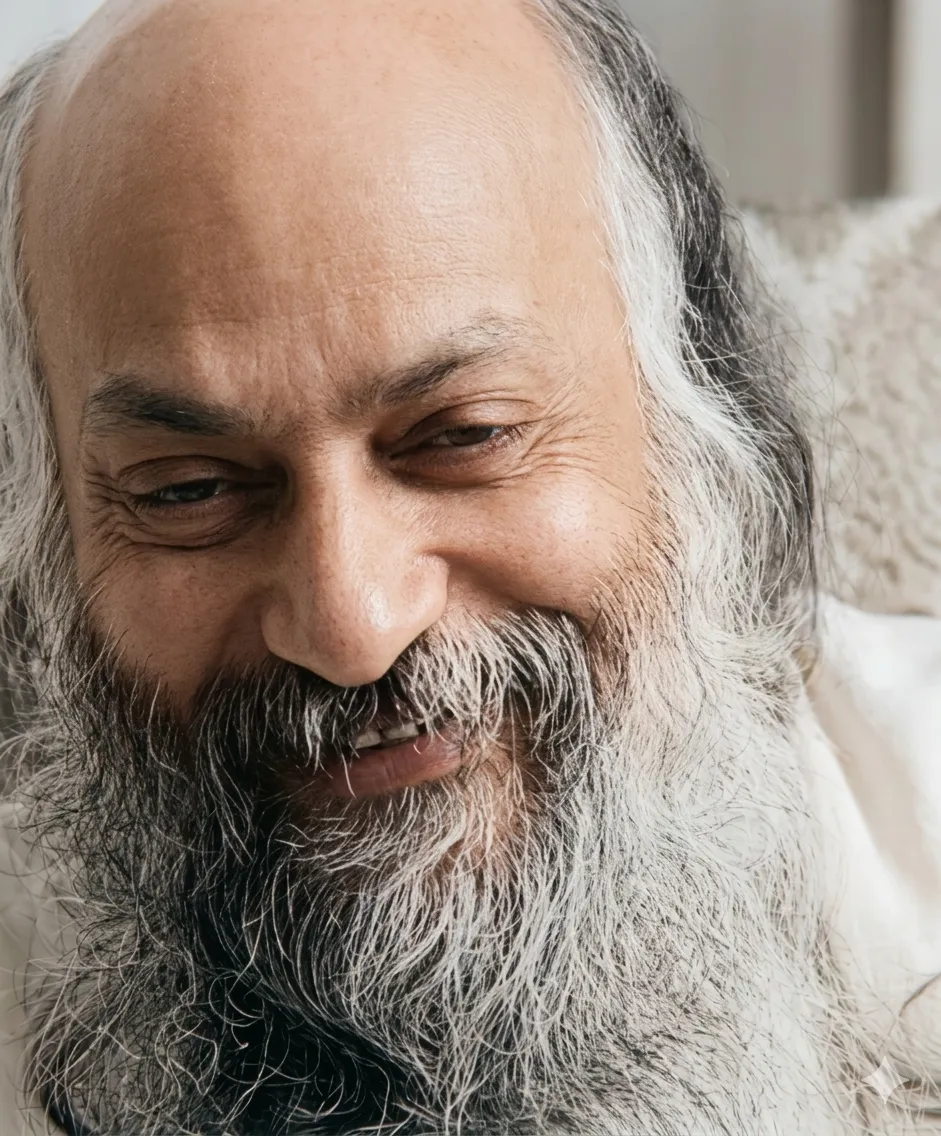
You feel others’ feelings because the ‘me’ is melting and one shared life is flowing through you.
From the Discourses
Passages where Osho speaks to this question — each links to the complete discourse.
Osho! While listening to you I start to weep. Now, even in the celebration of active meditation, tears burst forth. What is this? In the midst of meditation a feeling arises that this body is a hindrance now; how can it be shed—the feeling keeps growing more intense. Why? Please explain out of compassion.
Akshay Vivek! Human beings have been given such wrong conditioning that they have neither ever cried to their heart’s content nor laughed to their heart’s content. They have never really lived to their heart’s content. In no aspect, in no dimension, have they ever done anything totally; everything remains half-done! So many things hang inside, suspended like Trishanku. I say meditation is a celebration, but what is happening to you happens to others as well. While celebrating, suddenly tears arise from some unknown corner! They must have been suppressed somewhere—perhaps for lifetimes. Especially in men. Because from childhood we tell boys: Don’t cry! Girls cry. You are a man; crying is not for you. This is false. It is utterly false. Nature has made the tear glands in the eyes of men and women just the same. Men’s tear glands are not smaller than women’s. So one thing is certain—nature…
Osho, when I listen to you, every word sinks to the depths of my heart and stirs me. But when I read you, it remains a mental game. Please tell me why this happens.
It’s plain. The arithmetic is simple. When you read, only you are there; I am not. What you read is nothing but you. It becomes a game of the mind. When you listen to me, then sometimes—knowingly or unknowingly—I also slip into you. You seldom give such a chance, but now and then a lapse happens on your side. Unaware, you leave the door a little open—and I come in. So when you are hearing me, it’s a different matter. That is why truth has always been spoken, not written. It cannot be written. Even speaking it is very difficult, yet it can still be said—at least a little can be said, a little news can be given. Because in speaking, many elements are involved that are lost in writing. When you read a book, the book is dead. A book cannot create an atmosphere around you. A book has…
Osho, “Apna sa dukh sabka manai, tahi milai avinashi.” This condition of Baba Malukdas for meeting the Imperishable actually feels like an impossibility. A Krishna, a Christ, a Buddha, an Osho might pass this test—but is it really possible that an ordinary person can take everyone else’s suffering as his own?
First, Maluk’s saying has not been understood correctly. “Apna sa dukh sabka manai, tahi milai avinashi.” There can be two meanings. One is the ordinary: consider another’s suffering as your own. That is the straight meaning. If that is the meaning, then your question is exactly right: it is impossible. How will you take another’s pain as your own? If someone else has a headache, how will you take it as your own headache? And if you yourself have never had cracked heels, you cannot really know the pain of someone whose heels are split. If a thorn pierces you, you know it; if it pierces another, he knows it. How will you make another’s pain your own? And even if you force yourself to do so, it will have no real consequences. Has anyone found the Imperishable like that? If that were the meaning, the matter would become impossible.…
Osho, while listening to yesterday’s discourse I felt I was not on this earth, but a particle of light in the free and boundless sky. Even after the discourse a sense of lightness and emptiness continued; I kept wanting to roam in that same sky. I do not know knowledge, action, or devotion; but when I am alone I feel like sinking into this state. Yet sometimes a thought also arises: perhaps this is my madness; perhaps it’s just another play of my ego! Kindly guide me.
It is the fear of losing control. The ego can live very well with sorrow, because in sorrow it does not lose control. Cry as much as you like in sorrow, yet you remain your own master. Control is lost in joy; boundaries break in joy. In sorrow no boundary ever breaks. In hell, too, boundaries do not break. You can be in hell and remain inwardly strong. Boundaries break in heaven. There control is lost. Where control is lost, the ego is lost. Where control is lost, the grip of intellect is lost, the net of logic is lost. That is what is happening. Do not be afraid. The moment to cross is near. But without the head turning, no one has ever crossed. I seek a tune That is not on the lips— It quivers in the veins, Burning like lava— So that I may melt. I seek…
Osho, the moment I arrived here, intellect turned into heart and words into silence. While listening to you, my heart sometimes begins to flow as tears. I am doubtful whether this state will remain when I return home. Kindly explain how this state can be stabilized.
First thing: a human being has nothing more sacred than tears. There is no prayer greater than tears. People have known only one form of tears—tears of sorrow. But there is another form—tears of joy. Very few have known it; very few ever come to know it. When you see someone crying, you think he must be unhappy, in pain, wounded, burning. Not necessarily. Tears flow whenever any feeling becomes so intense that you cannot contain it—any feeling. If sorrow grows too much, it overflows as tears. If happiness grows too much, it too overflows as tears. Great pain flows out and lightens the heart through tears; great bliss also flows out as tears. So first, do not tie tears inextricably to sorrow. Deep down our minds have been conditioned to think tears come because of suffering. So we hide them, we hold them back. We try hard that tears…