
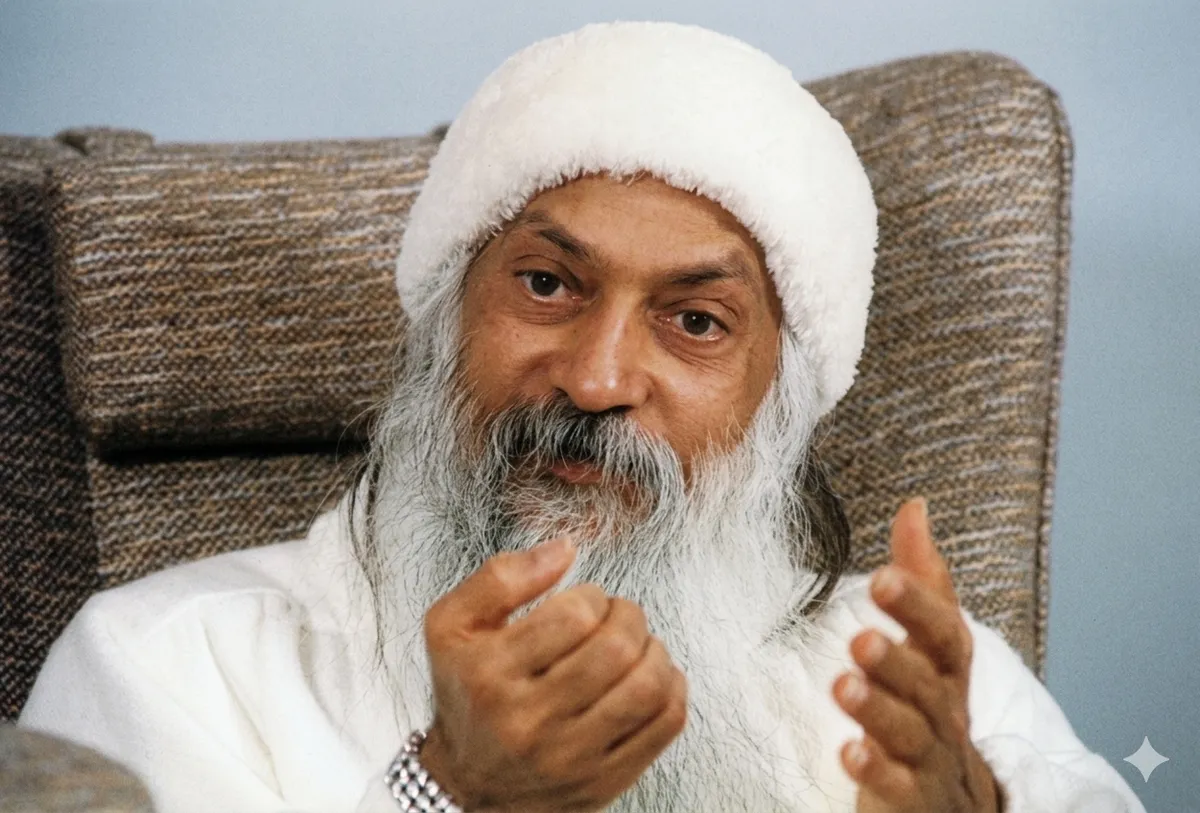
If we only chase sex and don’t let it grow into real love, we stay sad; love is the flower that should grow from sex.
From the Discourses
Passages where Osho speaks to this question — each links to the complete discourse.
A scholarly young korean buddhist monk told me the story about a woman who made love to every man who came to her for sex, but her cheek was always wet from tears. I was deeply moved by this story and it comes to my mind often. I can simply identify with her. Could you comment on this?
This question is from Prem Vartya. She is a dancer from Korea. She is my first korean sannyasin and has much potential. I can understand what she means. The story is really beautiful. A very small story, nothing much in it, and yet tremendous is its content. A WOMAN WHO MADE LOVE TO EVERY MAN WHO CAME TO HER FOR SEX BUT HER CHEEK WAS ALWAYS WET FROM TEARS. Just a one sentence story, but the story can be the story of the whole humanity. This is what is happening. Love is possible, but it never rises above sex. Hence all the cheeks are full of tears... wet. I can see your cheeks full of tears, tears rolling down. One of the greatest miseries in human life is that one remains with sexuality and never moves beyond it and never achieves a moment of love. Love is born in sexuality…
A friend has asked, Osho, in bhakti-yoga you have given love a fundamental place. I don’t know whether we ordinary people are familiar with love or only with lust! What is the difference between the two? And can lust become love?
It is worth asking, and worth understanding. Because we take lust to be love. And lust is not love; it can become love. In lust there is the possibility of love. But lust itself is not love; it is only a seed. If rightly used, it can sprout—but a seed is not a tree. So the one who becomes satisfied with lust, or concludes, “This is the end,” will never even come to know what love is. Lust can become love. Lust means attraction between two bodies—between bodies. Love means attraction between two minds. And devotion means attraction between two souls. They are all attractions, but on three planes. When one body is drawn to another body, that is kama, sex. When one mind is drawn to another mind, that is prem, love. And when one soul is drawn to another soul, that is bhakti, devotion. We live on the…
One can seek bodily pleasures. That's what millions of people go on doing. Nothing is wrong in it, but it is a little stupid. Not a sin, but it is as if you have been given a big palace to live in and you go on living on the porch. You never enter into the palace, so you have completely forgotten about it. You have made the porch your whole life. And the palace is waiting for you, and it is yours, you just have to explore a little bit deeper. Very few people enter into human love. Those are the people who are sensitive, alert, intelligent, who have some sense of poetry in life, some aesthetic values, for whom sex in itself is not of much value unless it is rooted in love, for whom to be under the influence of chemistry and hormones looks like slavery.
So then sex and love are the same.
No, I didn’t say that. That’s the hurry you get into! If I say that a tree is related to a seed, you don’t take it to mean that the seed is the tree. You don’t sit under a seed to take shade. Nor do you chop wood from a seed and take it home. What do you do with a seed? When I say, “From the seed comes the tree,” I mean the seed is the first possibility from which the tree can develop. It may, it may not. If you lock the seed away in a safe, nothing will happen; it will remain a seed. Yes, sow it in the soil, water it, fence it, and it will become a tree. And the day it becomes a tree, it won’t even occur to us that this very tree was once a seed. And if someone points to a…
Osho, what is the definition of God?
Words are very small. If you say God is light, then what of darkness? The scriptures have said that God is light. Suppose we accept this as a definition—then what about darkness? Where will darkness go? Darkness is too; in fact it is far more than light. Light sometimes is and sometimes is not; darkness is always, eternal. Where will you place darkness? If you say God is light, darkness is left out. If you say God is darkness, then light is left out. If you say God is both darkness and light, a contradiction arises: they cannot be together. Try to have both darkness and light in the same room. If you bring in light, darkness disappears; if you preserve darkness, you cannot have light. Then how can both be together? That becomes an impossibility. So you cannot say “both” either. Then the fourth device is to say: it…