
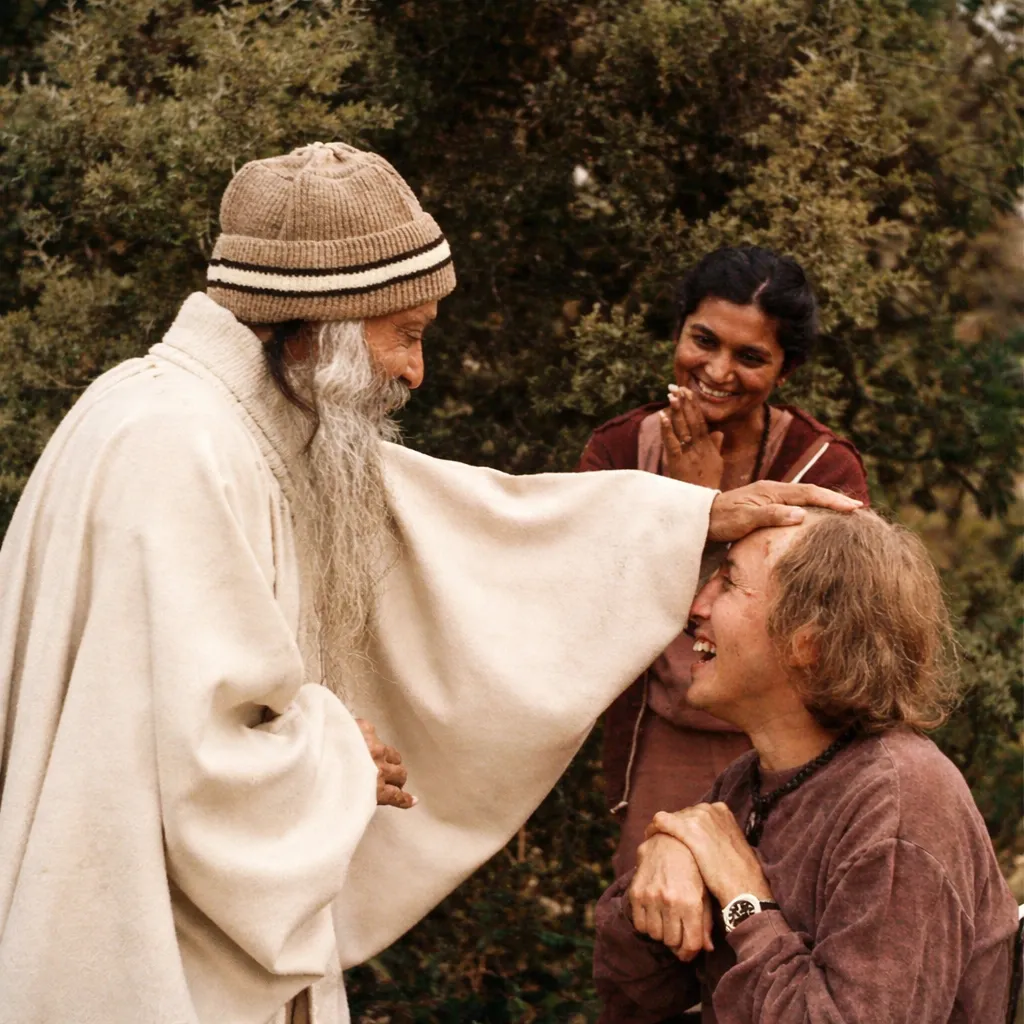
Become fully who you truly are, like a flower becoming itself, and offer that to the divine—don’t try to be someone else.
From the Discourses
Passages where Osho speaks to this question — each links to the complete discourse.
Osho, in the twenty-eighth verse the phrase svadhyāya-jñāna-yajñāś ca has been translated as “those who perform the knowledge-yajna in the form of chanting God’s name and studying scriptures related to God-realization.” Please explain the swadhyaya-yajna.
Swadhyaya-yajna is a process of the deepest self-transformation. When Krishna gave this sutra, swadhyaya-yajna was perhaps not as prevalent as it is today. Today, the most widespread process of self-transformation on earth is swadhyaya-yajna. So it is worth understanding it clearly—indeed, more than clearly. For the modern mind, the closest process is swadhyaya-yajna. Krishna only mentioned it in passing; in his time it was neither central nor common, used only occasionally by rare seekers. But Freud, Jung, Adler, Sullivan, Fromm—practically the entire lineage of Western psychologists—have given immense value to swadhyaya-yajna. Swadhyaya contains two parts: sva and adhyaya—study of oneself. The very foundation of psychoanalysis rests here. It is a profound acquaintance with what is within—not through someone else, but by oneself. Not through another, because in the abysmal depths of oneself no one else can enter. We can know another only at the periphery. There is no doorway into…
You can fast much—but your fasting should go to fill someone’s belly. You can become utterly poor—but that has no value. Your poverty should become a means to enrich someone; then the circle is complete. And then the tumult of the senses quiets as it never can through mere suppression. Sacrifice, self-study, austerity, and simplicity of heart along with purity of body and senses. Yajna (sacrifice) is the name of a scientific process. We know its outer form; but the outer is symbolic. Through outer symbol something inner is being conveyed. Yajna is a technique, a method—how to kindle the inner fire and how to burn myself to ashes in that fire. Life is a play of fire. You too are a form of fire. Food is digested, blood formed, blood runs, the heart beats, breath moves—fire’s play. If the body loses fire, everything is lost.
आप खूब उपवास कर सकते हैं, लेकिन आपका उपवास किसी के पेट भरने का हिस्सा होना चाहिए। आप बिलकुल दरिद्र हो सकते हैं, उसका कोई मूल्य नहीं है। आपकी दरिद्रता किसी को समृद्ध करने का हिस्सा होना चाहिए, तब बात पूरी होती है। और तब जीवन में इंद्रियों का उत्पात जिस भांति शांत होता है, उस भांति कोई भी दमन करके कभी उन्हें शांत नहीं कर पाया।
Osho, in the world of sadhana there is much mention of yajnas and rituals. There are many methods of yajna; people speak of homa-type yajnas. But in the Gita, japa-yajna and jnana-yajna are given special importance. And while speaking on japa you also spoke of ajapa-japa. So please shed light on the Gita’s japa-yajna, jnana-yajna, and on ajapa-japa as well.
Third: we see the flames of fire rising; we can only see them a little way, then they vanish. Fire is visible only a short distance; beyond that it becomes invisible. Knowledge too is visible only a little—or say: for a short distance its relation remains with the visible; beyond that its relation is with the invisible. Then the visible is lost; only the invisible remains. For all these reasons fire became a potent symbol of knowledge, and Krishna could use the word jnana-yajna. If these symbols are in our awareness, jnana-yajna will continue forever. The other rituals and yajnas built around fire will disappear, because they arise from circumstances; but jnana-yajna will continue. Thus Krishna, for the first time, freed yajna from circumstance and gave it an eternal meaning. The yajna of the Vedas was bound to particular conditions, tied to an event. Krishna freed it from that event…
ओशो, साधना-जगत में यज्ञों और रिचुअल्स का बहुत उल्लेख है। यज्ञ की बहुत सी विधियां भी हैं। होमात्मक यज्ञ की बात आती है। लेकिन गीता में जपयज्ञ और ज्ञानयज्ञ को विशेष स्थान दिया गया है। साथ ही आपने जप पर बात करते हुए अजपा-जप के बारे में कहा था। तो गीता के जपयज्ञ, ज्ञानयज्ञ और अजपा-जप पर भी प्रकाश डालने की कृपा करें।
तीसरी बात। अग्नि की लपटें हमने उठते देखी हैं, थोड़ी दूर तक ही दिखाई पड़ती हैं, फिर खो जाती हैं। अग्नि बहुत थोड़े दूर तक दृश्य है, इसके बाद अदृश्य हो जाती है। ज्ञान भी बहुत थोड़े दूर तक दिखाई पड़ता है, या ऐसा कहें कि थोड़े दूर तक ज्ञान का संबंध दिखाई पड़ने वाले से रहता है, दृश्य से रहता है, और इसके बाद उसका संबंध अदृश्य से हो जाता है। फिर दृश्य खो जाता है और अदृश्य ही रह जाता है। इन सारे कारणों से अग्नि बड़ा ही समर्थ प्रतीक ज्ञान का बन गया और कृष्ण ज्ञान-यज्ञ शब्द का उपयोग कर सके। ये प्रतीक अगर हमारे खयाल में हों, तो ज्ञान-यज्ञ सदा जारी रहेगा। अग्नि के आस-पास निर्मित हुए दूसरे रिचुअल और यज्ञ तो खो जाएंगे, क्योंकि वे परिस्थिति से पैदा होते हैं, लेकिन ज्ञान-यज्ञ सदा जारी रहेगा। इसलिए कृष्ण ने यज्ञ को पहली दफा परिस्थिति से मुक्त करके शाश्र्वत अर्थ दे दिया। वेद जिस यज्ञ की बात करते थे वह परिस्थिति से बंधा था, एक घटना से जुड़ा था। कृष्ण ने उसे उस घटना से मुक्त कर दिया और एक शाश्र्वत अर्थ दे दिया। …
Questioner: yajnas or rituals have an important place in spiritual discipline, and there are many forms of yajnas or sacrificial rituals mentioned in the scriptures. But the geeta attaches special importance to japa-yajna and jnana-yajna -- the rituals of chanting and knowledge. Talking about the significance of japa or chanting, you mentioned ajapa or wordless chanting. So please explain to us the significance of japa-yajna, jnana-yajna and ajapa as envisioned by the geeta.
Japa can be used with the awareness that it is a means which helps one to be free of his thoughts. But if someone takes japa to be an end in itself, of course he will be free of other thoughts but he will be a prisoner of this japa which is as good as a thought. His mind will remain as burdened and tense as ever. There is no difference between a mind teeming with thoughts and another filled with the chanting of Rama or Ave Maria. They are equally tense and restless. It is possible a thought-filled mind can achieve something worthwhile in the workaday world; a few of his thoughts may be found useful. But as far as the chanting-filled mind is concerned, it is completely a waste. But this man will say what helped to free him from wasteful thoughts is something valuable, and he is…