
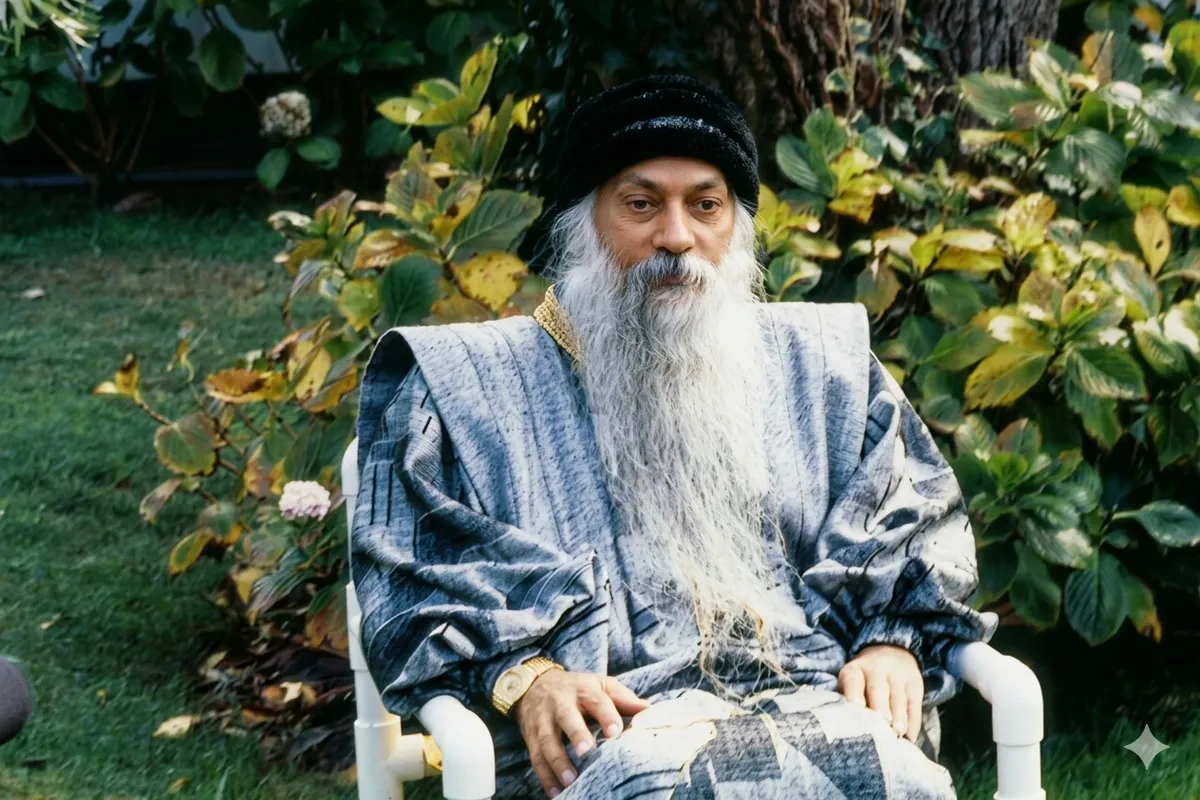
According to Osho, saying 'I am God' does not exalt the person; it announces the disappearance of the person. The egoic 'I' has dissolved, and with it the separate man—only God, pure being, remains. It is sheer transcendence, not a claim of superiority or supermanhood. When the 'I' becomes God, nothing personal survives; there is just the divine presence without a separate doer.
It means the little ‘me’ is gone, and only the bigness of life (God) remains—no one is personally claiming anything.
From the Discourses
Passages where Osho speaks to this question — each links to the complete discourse.
Osho, you said that it is ego, isn’t it, when someone takes oneself to be an avatar?
Yes, that is the ultimate, extreme form of ego. Otherwise, there is no reason for it. The moment a person attains perfect samadhi, he will not even know “I am,” let alone that I am separate from you. He will not even know that he is separate from you. But things are like this. Claims are very strange. Rama Tirtha went to America—a sadhu from Punjab. He became very renowned; his writings became very renowned; his lectures were quite remarkable, and he spoke on Vedanta there with great passion. He returned to India and stayed in Kashi. There, a pandit remarked, “He keeps harping on Vedanta, and he can’t even speak two words of Sanskrit!” He certainly did not know Sanskrit; he had been educated in Persian. At just this remark he became so enraged...! For fifteen years no one had seen anger in Rama Tirtha. People believed he had…
Knowing oneself as sakshi pratyagatma, the inner witnessing soul, of one's intellect and all its dispositions, and acquiring the disposition that "that am I," giving up the claim of 'mine' over all things.
GIVING UP FOLLOWING LOK, THE SOCIETY, HE GIVES UP FOLLOWING THE BODY ALSO. GIVING UP FOLLOWING THE SCRIPTURES, HE GIVES UP THE ILLUSION OF THE SOUL ALSO. BEING ROOTED IN HIS OWN SOUL, AND THROUGH TECHNIQUES, THROUGH LISTENING AND THROUGH SELF-EXPERIENCING, THE YOGIN COMES TO KNOW HIMSELF AS THE SOUL OF ALL AND HIS MIND IS ANNIHILATED. WITHOUT GIVING OPPORTUNITY TO SLEEP, TO SOCIETY'S TALKS, TO SOUND, TOUCH, FORM, TASTE, AND SMELL -- THE OBJECTS OF THE SENSES -- AND TO FORGETFULNESS OF THE SOUL, CONTEMPLATE THE SOUL WITHIN YOU. <q>GIVING UP FOLLOWING LOK, THE SOCIETY, HE GIVES UP FOLLOWING THE BODY ALSO.</q> Not only does he stop following others, as the realization of the witness deepens he drops the slavery of the body too. Then he does not do things because the body is saying so, now he does what he wants to and the body follows him like…
Question: The second question: Osho, what did you do that made you God? No one becomes God by doing; godhood is our nature. When you drop all doing and look within, you discover—God is what we are! It has nothing to do with doing. You probably imagine: how many fasts were undertaken, how many push-ups and squats (dand-baithak), how many headstands, how many asanas and exercises, how much bhajan and kirtan—perhaps you are asking in that sense: what did you do by which you became God? It is precisely through doing that you miss. By doing and doing, you miss. Because godhood is our very being; nothing needs to be done for it—you are God. Try a hundred thousand methods, you will not become anything else. Every method will fail. That is why you are weeping in life—because every method is failing. Whatever you do does not succeed; it cannot.
A friend has said: Osho, why do you call yourself Bhagwan? And he is a very bold man, because he also wrote: If you are really bold, you must reply to my question.
You ask, “Why do you call yourself God?” I have never said it. But now that you say it, I will say: I am God. And I say this because there is no way to be anything other than God. You are God too. In this whole existence there is nothing but God. So if someone claims, “I am God and you are not,” then that claim is criminal. I have never made any claim. I have never even said it. But I cannot say the opposite either—that I am not God—because that would be downright untrue. I can only say there is nothing but God. And what can I do, since there is nothing but God? You too are God. It may be you don’t know it; it may be you do. One who doesn’t know should try to know. God means: existence—purest existence. That which we are in…
All the systems of theology only prove that the person has not known yet, because when you know, no proof is needed; knowledge is always self-evident. That's why the poet never gives any argument, his statements are non-argumentative. They are pure statements -- he simply declares 'God is.' And that is the difference between the western religion and the eastern religion: the western religion is too much in the hands of the theologian, hence they have killed it. God has been killed by the argumentative minds. They may be for him, that makes no difference -- god is always killed by arguments; whether for or against it does not matter. In fact the man who argues against god may not be able to kill him, but the man who argues for him is certain to kill him!