
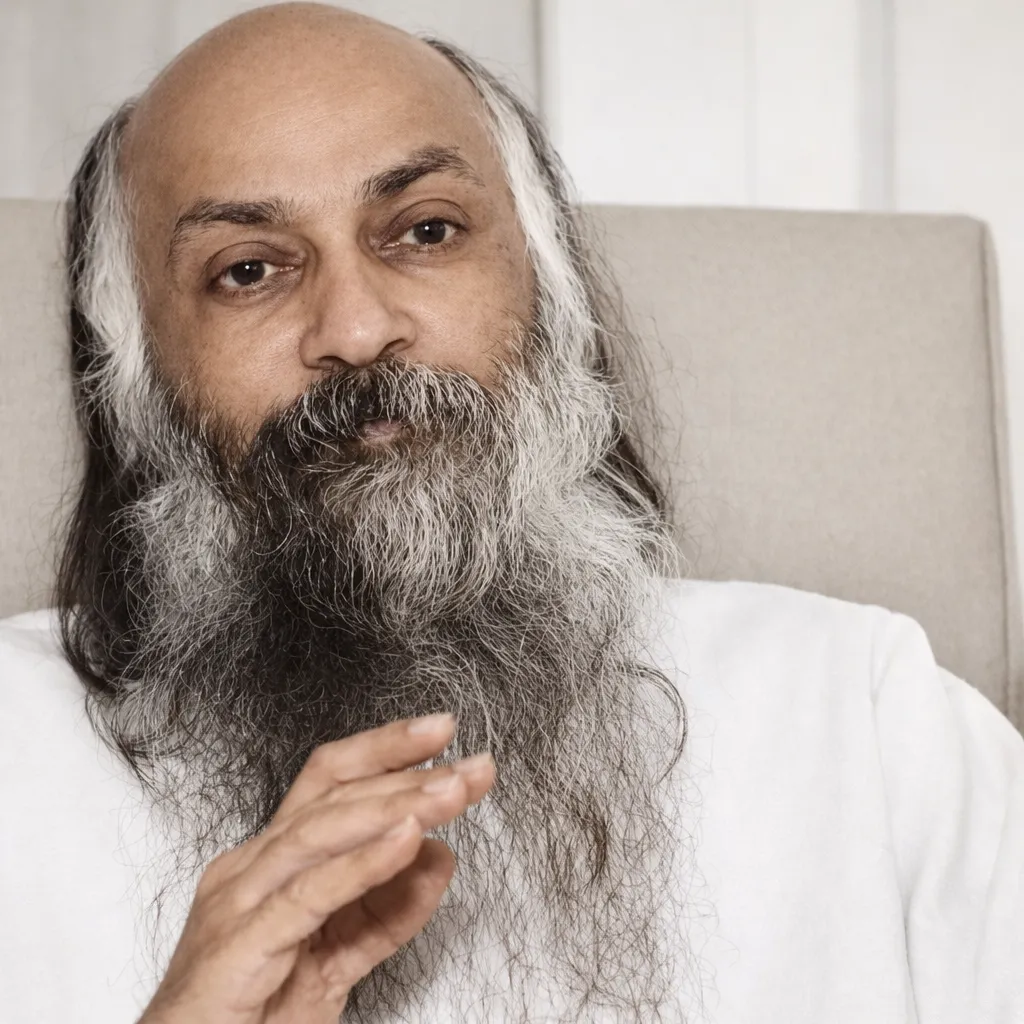
According to Osho, to 'fight the enemies of your soul' is a misunderstanding; there is only one inner enemy: moorcha (stupor, unconsciousness), and one friend: awakening. Lust, anger, greed, and attachment are just its armies, branches of the same trunk. Real fighting means waking up—cultivating awareness; when consciousness dawns, those symptoms disappear naturally, without repressive struggle against each one.
Don’t fight many bad habits; wake up inside with awareness, and the bad habits fade by themselves.
From the Discourses
Passages where Osho speaks to this question — each links to the complete discourse.
Osho, there is a sentence in the Acharang whose meaning is: “Why do you fight with outer enemies? Fight only with the enemies of your own soul.” In your view, is this in any way interpretable, or is it simply incorrect?
I don’t bother about sutras, the Acharang and so on. I don’t bother at all. Because the people who compile them are not particularly understanding people. I don’t bother about them. There is no question of adjusting myself to them. If something happens to fit, that’s accidental; if it doesn’t, there is no need that it should. “Fight the inner enemies”—somewhere a basic mistake has crept in here, because “enemies” is in the plural. “Fight the inner enemy”—that would have been right, because “enemy” is singular. The inner enemy is only moorcha—stupor, unconsciousness. Mahavira has said this a thousand times over. So there are not many enemies within; the enemy is one. And the friend too is one, not many friends within—awakening is the friend and stupor is the enemy. So the listener has made a mistake somewhere. In saying “fight the inner enemies,” he has again descended into the…
Within live many enemies. Birth after birth, who knows how many ailments you have nurtured. Who knows what diseases you have befriended. Who knows how many diseases have become part of your habit. So, “Many enemies dwell within the vessel—you conquer none.” And that ‘you’ which is within—that alone is the one friend. That inner consciousness, that awareness, is the only friend. And that conscious one is surrounded by countless enemies. Lust, anger, greed, attachment, jealousy, pride, envy—who knows what all. Surrounded on all sides. Your one friend is the witness—consciousness, awareness. But the witness is besieged by many diseases. Wherever identification happens, there the witness is lost; there the disease takes hold. A wave of anger arises. You are not anger. You can never be anger. You are the knower, the seer before whom anger arises, before whom the smoke of anger spreads.
Who ever finished enemies outside! Finish the outer enemies and new ones are born. Even if you triumph over external foes, the triumph does not last. He who wins today will lose tomorrow; who loses today will win tomorrow. Outside life changes every moment. Nothing is eternal there—just a flow. But inside there is a war—and one must become the inner warrior! There are enemies, the real enemies—anger, lust, greed, delusion… a thousand enemies. He who conquers them becomes their master, and is entitled to meet the Great Master. Become a small master, and you can meet the great Master. Earn that much worthiness. To meet the Master, become a little like him. To meet the Lord, have a little lordliness within—then there will be welcome at his door. He establishes Ram’s reign; a teeming city is raised. Establish Ram’s reign within. Right now lust rules within you.
See this on a deeper plane. When the Buddha says, I wander without enmity, your mind may think he bears no hostility to others. But there is a deeper meaning—he does not hold hostility, period. Leave aside others—he does not hold hostility even toward himself. Often, a man leaves hostility toward others but keeps fighting himself. He says, I have no enmity with anyone; I won’t go to court with anyone—but the fight within continues: There is anger; I must fight it. There is attachment; I must fight it. There is greed; I must fight it. There is ego; I must fight it. So enmity continues—the enemy has changed. The Buddha does not say, I have no enemies outside. He says, I abide without enmity—understand—“I have become free of enmity.” Enmity with others has fallen—and with oneself too it has fallen. Enmity itself has fallen.
Why do so many persons on the path of yoga adopt an attitude of fight, struggle, over-concern with keeping strict rules, and warrior-like ways? Is this necessary in order to really be a yogi?
And trust, shraddha, faith, was easier in a world which was non-technological. A technological world needs cunning, calculation, mathematics, cleverness -- not innocence. In a technological world, if you are innocent you will look foolish; if you are cunning you will look clever, intelligent. Our universities are doing nothing but this: they make you clever, cunning, calculating. The more calculating, the more cunning, the more successful you will be in the world. Quite the reverse was the case in the East in the past. If you were cunning it was impossible for you to succeed even in the outside world. Only innocence was accepted. Technique was not valued too much, but inner quality was valued too much. If a person is cunning and he makes a better shoe nobody will go to him in the East in the past. They will go to the person who is innocent. He may…