
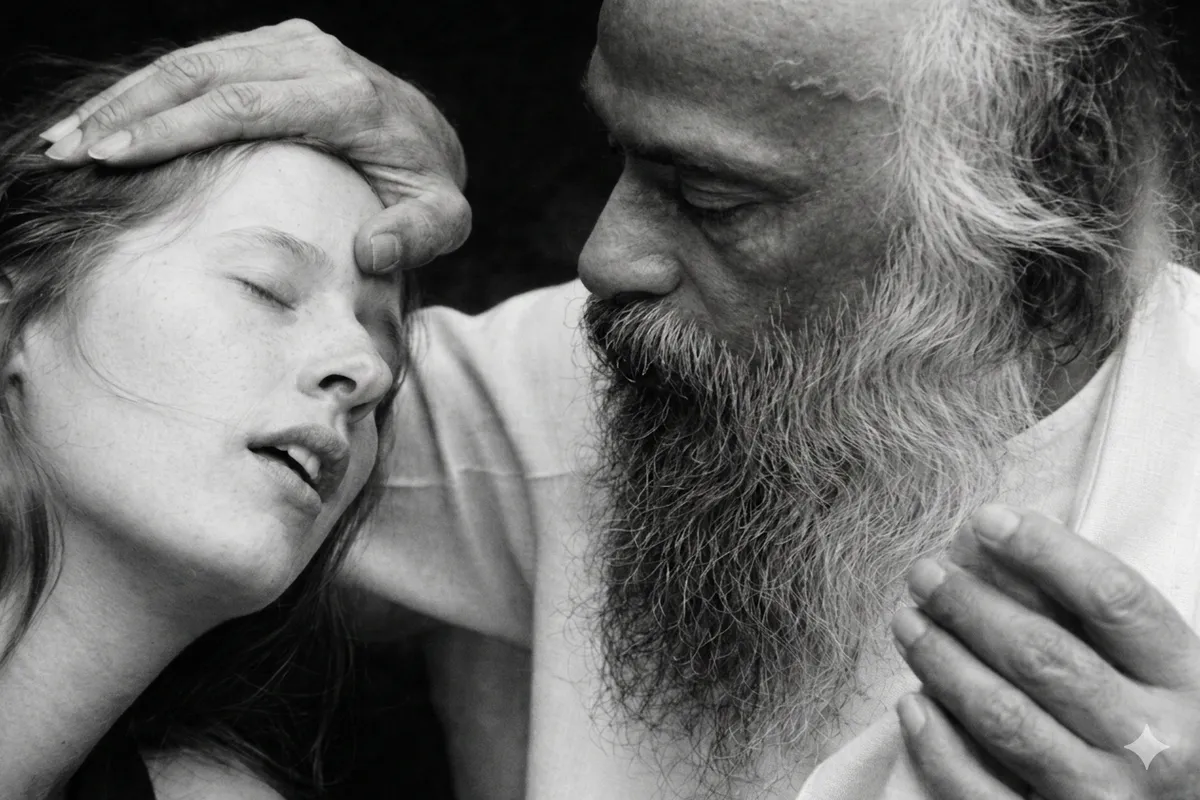
When you die, you drop the body and rest in a timeless space until the right parents are found; if you were very good you feel bliss, if very cruel you feel your own pain, and then you’re born again.
From the Discourses
Passages where Osho speaks to this question — each links to the complete discourse.
Osho, when the soul leaves the body and has not yet assumed another one, is it possible to describe what happens in that timeless interval, and the kind of environment in which it moves? And, along with this, since you have spoken of the soul’s freedom to take birth by its own will, does it also have the freedom to leave the body whenever it wishes—or not to leave it?
If you look at descriptions of hell’s fire, you’ll find this: people are burned in the fire, yet they do not burn up. The inconsistency doesn’t occur to you at that time—that you are being burned, the fire is terrible, the heat unbearable, yet you are not actually burning! That inconsistency may occur later, not in the midst of it. In the interval between two bodies there are two kinds of souls. First, those very bad souls for whom finding a womb will take time; I call them pretas. Second, the good souls for whom finding a suitable womb will also take time; they need a worthy womb—I call them devas. There is no fundamental difference in species—only differences of personality, character, quality of mind. Their experiences are different. The bad souls come back from this interval with such painful memories that the memory itself is the fruit called hell.…
Osho, in that timeless interval you have described what happens to the soul. But what is the soul’s disembodied form? Is it still or does it wander? How does it recognize other familiar souls? And is there any possibility of dialogue in that state?
Ask: in a dream are you still or moving? It is hard to say. Waking, you find you lay still in bed; yet within the dream there was great movement. Strictly speaking, even movement in dreams is not real. If you understand precisely, in dreams you are not a participant but only a witness. You can see yourself dying in a dream; you can see your own corpse. Even when you see yourself walking, what you see walking is only the dream; you remain the seer. Properly understood, in dream you are only the witness. Hence religion devised a maxim: one who comes to see the world as dream-like attains the supreme realization. Philosophies calling the world maya or dream arose for this reason: if we can see the world as a dream, we become the witness. In dreams there is never a participant; there is always a witness. You…
Osho, you have told us what happens to the soul during that timeless interval between two births. But some points remain unresolved, regarding the bodiless soul: in that bodiless state, does the soul remain stationary or can it move about? And how does it recognize other souls? In that state, is there any possibility of a dialogue between souls?
Sometimes different types of events may also happen, but these kinds of experiences will differ. Occasionally, it may so happen that souls which are neither stationary nor in movement will enter other bodies. But to say that the souls will enter is a linguistic fallacy. It would be better to say that some body may behave in such a way that it will cause a soul to enter into it. The world of such souls is not different from ours. That world exists also beside us, close by. We are all residing in the same world. Every inch of space that is here is filled with souls. The space right here which appears empty to us is also full. There are two types of bodies which are in a state of deep receptivity. One is of those that are in great fear. Those who are in great fear cause their…
A friend has asked after the morning talk: Osho, do some souls keep wandering after leaving the body?
Some souls certainly do not at once take another body after leaving the old one. The reason? There is a reason—and perhaps it is not one you would ever have imagined. If we divide all souls, all personalities in the world, they will appear in three kinds. First, those of very low, degraded consciousness; second, those of very high, noble, utterly pure quality; and third, the great crowd in between that is a mixture of both, that goes along combining the bad and the good. Look at a damaru, the little hourglass drum: it is broad at both ends and narrow in the middle. Now invert the picture—thin at both ends and wide in the middle—and you will understand the state of the world: small at the extremes, thick in the middle, the damaru reversed. On these two ends are only a few souls. The very lowliest souls find it…
A friend has asked: Osho, if in the mother’s womb man and woman create the opportunity for a soul to be born, does that mean souls are separate and there is no all-pervading Soul? He also asked: I have said many times that truth is one, God is one, the soul is one—then don’t these two statements seem contradictory, opposed?
These two statements are not opposed. The Divine is one; in truth the soul is one. But bodies are of two kinds. One is what we call the gross body, which we can see; the other is the subtle body, which we cannot see. When death happens, the gross body falls away, but the subtle body does not die. The soul abides within two bodies, a subtle body and a gross body. At death the gross body drops. This body made of earth and water, of bone, flesh and marrow, falls. What remains is an extremely subtle body—of thoughts, subtle sensations, subtle vibrations, subtle filaments. That filament-woven body begins the journey again with the soul and takes birth anew by entering a new gross body. When a new soul enters a mother’s womb, it means the subtle body has entered. At ordinary death only the gross body falls, not the…