
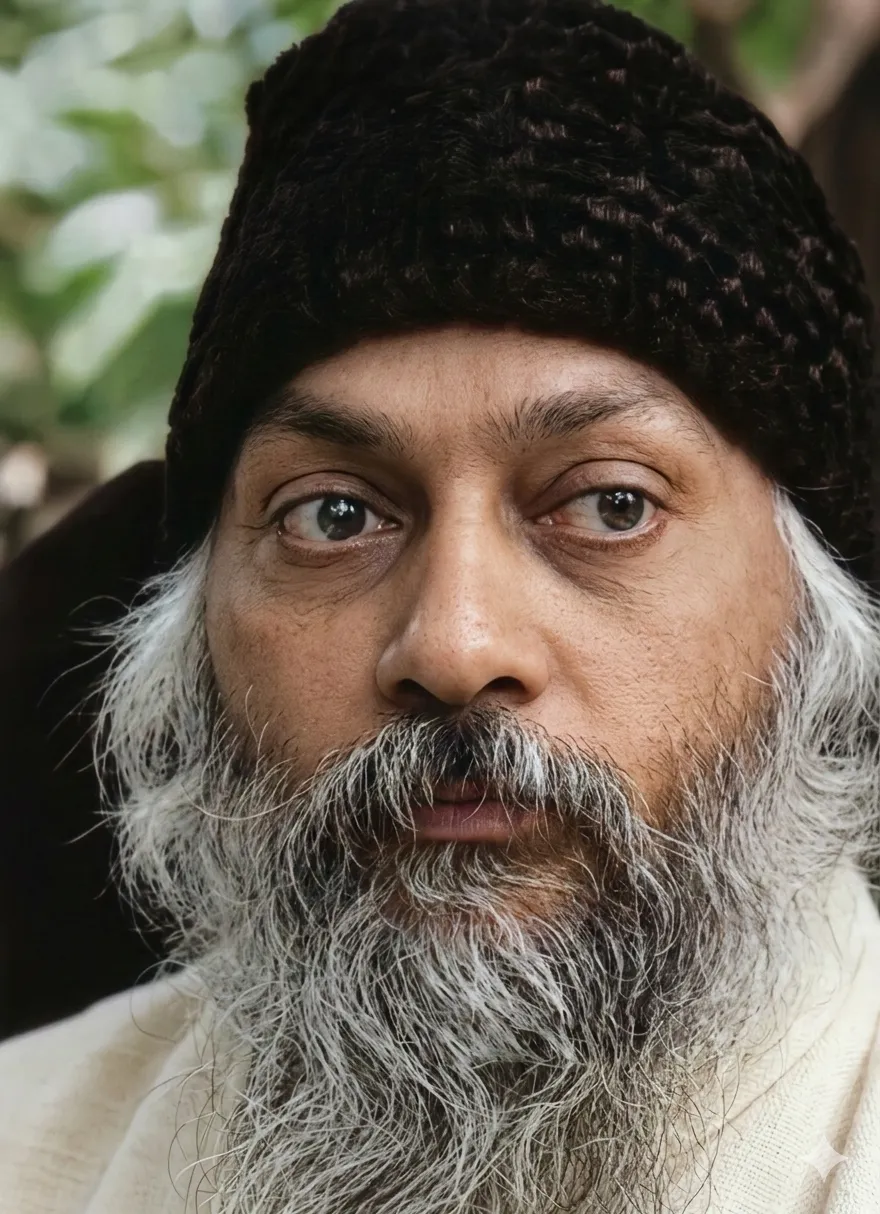
He talked to a made-up someone in the sky and nothing replied; quietly knowing himself would have helped more.
From the Discourses
Passages where Osho speaks to this question — each links to the complete discourse.
Beloved Osho, the forty days and forty nights that jesus spent in the wilderness -- did he meditate? -- he never mentions meditation if he had known of it. Just what did he get up to out there?
There are a few sects in Hinduism which have meditated, but they are in a minority. For example, yoga. The founder of yoga, Patanjali, was really a daring man. Five thousand years ago, in his yoga sutras, he says something which even the contemporary man has not the guts to say. He says, "God is a hypothesis. It is not a reality. If you enjoy prayer, then the hypothesis of God is needed; otherwise to whom are you going to address it?" People like Patanjali are also under the same umbrella. They should be taken out. They belong really to Taoism, Jainism, Buddhism -- the religions of meditation. Taoism, Buddhism, Jainism -- they don't believe in any god. They don't believe in anything. They believe only in one thing -- and that, too, hypothetically. You know you are. You feel you are. You cannot deny it because even your denial…
Osho, one night you said that christianity has remained incomplete because for christians jesus died at the age of thirty-three when he was fiery, rebellious and active, with sun-like consciousness as his inner center. Does it mean that jesus could not achieve total spiritual growth, inner silence, inner peace and an inner full-moon stage of consciousness like buddha and mahavir? Please enlighten us on this point.
There is a story: Vivekananda achieved his first satori, his first glimpse of Samadhi, and Ramakrishna said, "Now I will keep this key with me; I am not going to give it to you. It will be given to you only three days before your death. Before you die, only three days before, this key will be given back to you. Now no more glimpses of Samadhi." Vivekananda began to weep and he said, "Why? I do not want anything. I do not want the whole kingdom of the world. Give me only my Samadhi. The one glimpse was so beautiful. I do not want anything more." Ramakrishna said, "The world needs you and something has to be done. And if you move into Samadhi, then you will not be able to do anything. So do not be in a hurry. Samadhi will wait for you. Move into the world;…
A single session of your dynamic meditation has left within me a greater bliss and sense of being than twenty years of having had to listen to the stories of the new testament and to pray to an almighty and distant god who stayed an unexperienceable godot to me. Is it possible that the teachings of jesus just might not be helpful to all seekers -- yes, might even be poisonous to them, or to some?
Have you watched sometimes? You see a beautiful flower. You may appreciate it, it has an aesthetic quality. You appreciate it and you move ahead. You may see a beautiful face -- even the face of a Cleopatra: the lines, the proportion, the marble-like body -- but that too is aesthetic. And sometimes you come across a few things or a few beings that inspire not only aesthetic appreciation, but awe. What is awe? Facing some thing or some being, thinking stops. Your mind cannot cope with it. You can cope with a Cleopatra, you can even cope with an Einstein -- howsoever abstruse, abstract, difficult, you can cope with it. Just a little more training of the mind may be needed. But when you come across a Jesus or a Buddha the mind falls flat, it bogs down. SOMETHING is too much for it. You cannot think about anything,…
Osho, I have heard you say not to ask for anything in our prayers. Then why does jesus say to us, "when you pray, say: give us our daily bread. Forgive us our trespasses. Lead us not into temptation, but deliver us from evil"? And also jesus himself asked, "my father, if it is possible, let this cup pass me by, yet not as I will, but as thou wilt." please explain.
From where does this "if" come -- "if it is possible"? This desire is there that "if you can manage, please... but if you cannot manage then it is okay, then whatsoever happens I will accept." But there is reluctance, there is contradiction. His own desire is that this cup should pass by -- this agony, this crucifixion, this death, should pass by. He was really deep down waiting for a miracle, he was hoping for a miracle. He was not very different from the crowd that had gathered there to observe the crucifixion. He was not very different from the rabbis and the priests and the government who were all conspiring to kill him; their philosophical background was the same. The rabbis and the high priest of the temple of Jerusalem were trying to prove that this man was a fake. And he was trying to prove that "No,…
If jesus was still in a rebellious and active stage at the time of the crucifixion, does that mean that he had not achieved the total spiritual growth and inner silence of buddha?
When Jesus remained silent after Pilate asked him, "What is truth?" he was behaving like a Zen master. If you look at the previous life of Jesus, if you look at his whole previous life, this silence was not like Jesus at all. What happened? Why did he not speak? Why was he at a loss? He was one of the greatest orators the world has ever produced; we may even say, without hesitation, the greatest. His words were so penetrating. He was a man of words, not a man of silence. Why did he suddenly remain silent? He was moving toward the cross. Pilate asked him, "What is truth?" Jesus had spent his whole life talking about truth; he was defining only that, that is why Pilate asked him. But he remained silent. What happened in Jesus' inner world has never been reported because it is difficult to report.…