
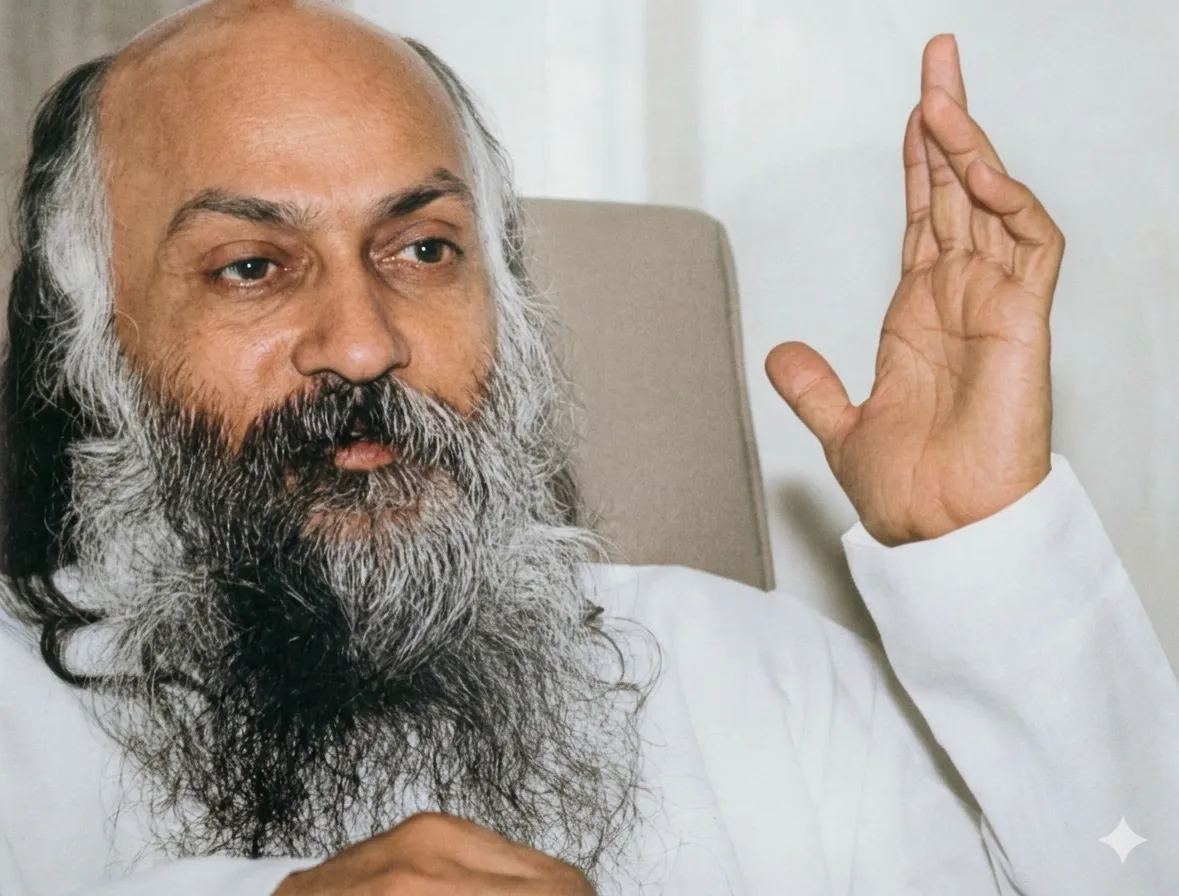
According to Osho, yes: the urge to understand is the soul's homesickness for unity - a return from separation to oneness with the cosmos. He aligns with Freud that this longing echoes the womb's primal unity. Through deep meditation we touch our center, where life from existence continually flows in, dissolving fear, masks, and even birth-and-death into inexhaustible, evolving wholeness.
We want to understand because we want to feel at home and one with everything again, and meditation helps us do that.
From the Discourses
Passages where Osho speaks to this question — each links to the complete discourse.
Osho, through study, reflection, and listening one does gain an intellectual understanding, but my life keeps being tormented and driven by the impulses and shocks rising from the unconscious cellars. I am helpless; I have no access to those unconscious basements. Please be gracious and give a method, a way of life, a formula and direction.
What comes through study, thinking, and contemplation is not even the intellect’s understanding; it is only the illusion of understanding. Just as if we tried to explain light to a blind man—he listens; and there is a system by which the blind can read, so he studies; and on what he has heard and read he also reflects and contemplates within—do you think he will gain any understanding of light? Yes, one thing can be gained: the illusion that “I understand light.” And that illusion is more dangerous than blindness itself. Because if a blind man understands that he does not understand, he might search for the remedy by which eyes can be found. But if the blind man concludes that he understands, then even that door is closed. Your question has two parts. You are calling study, listening, and contemplation the intellect’s understanding. The intellect has never truly understood…
Question: ONCE UPON A TIME THERE WAS A MAN STANDING ON A HIGH HILL. THREE TRAVELLERS, PASSING IN THE DISTANCE, NOTICED HIM AND BEGAN TO ARGUE ABOUT HIM. ONE SAID, 'HE HAS PROBABLY LOST HIS FAVOURITE ANIMAL.' ANOTHER SAID, 'NO, HE IS PROBABLY LOOKING FOR HIS FRIEND.' THE THIRD SAID, 'HE IS UP THERE ONLY IN ORDER TO ENJOY THE FRESH AIR.' THE THREE TRAVELLERS COULD NOT AGREE AND CONTINUED TO ARGUE RIGHT UP TO THE MOMENT WHEN THEY ARRIVED AT THE TOP OF THE HILL. ONE OF THEM ASKED: 'O FRIEND, STANDING ON THIS HILL, HAVE YOU NOT LOST YOUR FAVOURITE ANIMAL?' 'NO, SIR, I HAVE NOT LOST HIM.' THE OTHER ASKED: 'HAVE YOU NOT LOST YOUR FRIEND?' 'NO, SIR, I HAVE NOT LOST MY FRIEND EITHER.' THE THIRD TRAVELLER ASKED: 'ARE YOU NOT HERE IN ORDER TO ENJOY THE FRESH AIR?' 'NO, SIR.
Osho, what, in truth, is the ultimate quest of a human being?
Or when you drink alcohol—what are you doing? You are saying, “This little awareness I have, O Lord, take it away from me. I cannot bear this awareness. Make me unconscious; take me back.” The old shore is pulling you. But whatever you do, you cannot become an animal again. There is no possibility of returning to the past. Travel backward does not happen. No matter how much the young man wishes to be a child again—he cannot. No matter how much the old man wishes to be young again—he cannot. No matter how much the dead wish to live again—now it cannot be. Where we have passed, we have passed. We will never go there again. Yet the longing persists. That is why people, though they become young and then old, still sing songs of childhood: “Ah, how lovely were those days!” This is foolishness. If childhood was beautiful,…
Question: First question: Osho, The city grows deserted as awareness turns back upon itself; the highway becomes a footpath; the flame trembles, then steadies; unknown, and yet some humming seems familiar. Words-thoughts fall like leaves; the net of logic—once the mind’s glory—is fraying, torn moment by moment. Honey fills the hour, the day, the night, the month; childhood hides and reappears; the earth is cooled by the cascade of the inner stream. Upon the lofty peak of consciousness, adorned with a hundred-thousand sun-rays—O resplendent white radiance! O Great Life-Breath, source of energy for hundreds upon hundreds of lotuses! Accept at your feet all my righted and inverted beats and notes; O ocean that pours out heaps upon heaps of gems! I bow my head, O divine gateway of the whole cosmos—salutations, Lord, salutations!
This foundation has to be found. It is there, waiting for us. It has always been there, we have just been roaming around and around in circles. A few people are attached to the body. They are the farthest, they are living only like animals. A few people are attached to the mind. They are a little closer, but still far away; they are living like human beings -- thinkers, philosophers, poets -- but their world consists only of thoughts and thoughts are just soap-bubbles, the same stuff as dreams are made of. And a very few have reached to the heart, very few.