
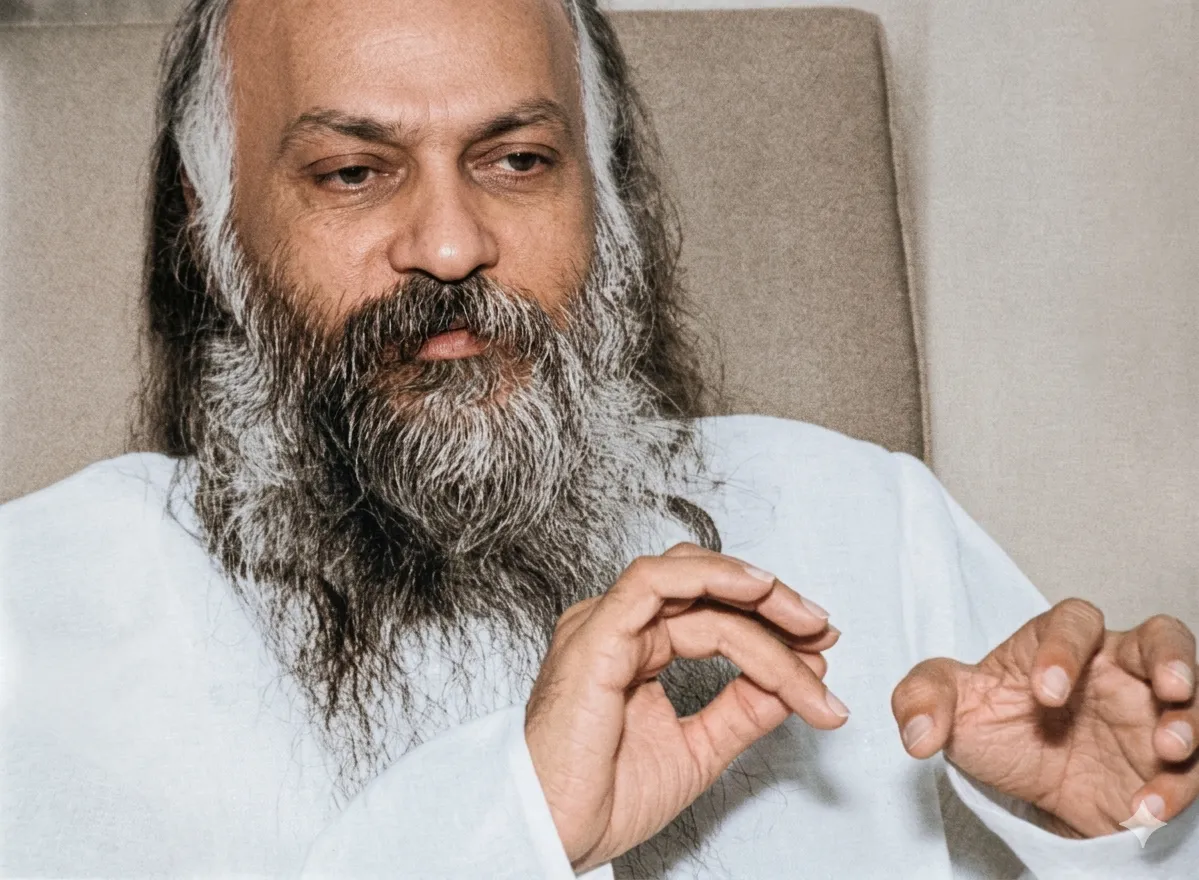
You’re not passing out; you’re deeply and peacefully absorbed so the small “me” quiets and a bigger, divine presence is felt.
From the Discourses
Passages where Osho speaks to this question — each links to the complete discourse.
Osho, during discourse when I look at you, when I behold you, I hear your voice; but I don’t remain aware of what you are saying. So is this my swooning, unconsciousness? Please guide me.
No, Samadhi! It is not unconsciousness. Now for the first time you have begun to listen to me as one should. What I am saying is only a pretext—to keep you engaged, to keep you sitting here. It is with what I am that you have to connect. What is said in the words is nothing; what flows between the words is everything. The gap between two words—when sometimes I fall silent for a moment—then you will hear; only then is it heard. Forget what I say; don’t bother about that. Don’t forget what I am. It is not stupor. It is like stupor, but it is not stupor. It will feel like stupor. It is ecstasy, self-absorption. But self-absorption, too, seems like faintness; an intoxication descends. “The goblet slips, O saqi, the hands begin to tremble; Seeing your eyes, I fall into intoxication.” Let the intoxication grow. Let the…
Osho, while listening to your discourse my eyes start closing, my ears begin to go deaf, and even if I try I can’t manage the situation. My heart longs that, when the Divine is before me, I keep gazing at you and drink the nectar of your words. But it just doesn’t happen. Please tell me how I can listen to you consciously.
When the eyes close, the whole outward journey ends; all the energy turns inward. The Ganges flows back toward Gangotri, toward the source. Open eyes—perhaps the Shvetambaras found Mahavira’s eyes so beautiful that they wished to go on looking at them. With closed eyes, what will you see? So they kept Mahavira’s eyes open. That those eyes were worthy of seeing is true; that they were very beautiful is true; that worship and adoration arose toward those eyes is true. But this is a human weakness. Mahavira’s eyes would have been closed when he knew himself. And only when he knew himself did he become Mahavira; before that he was not Mahavira. Your eyes too will close. The ears too will close. All the senses will close—because the senses are the doors through which energy moves outward. When all the senses close, all the energy returns within. Mahavira called this…
A friend has asked: Osho, is the samadhi attained when consciousness is lost a state of swoon? Sri Ramakrishna Paramhansa would lie for days as if near death!
In the West they have invented new ways: even blows are not enough; so they set up many lights, rapidly changing, deafening sound, assorted dances and songs; a completely deranged atmosphere is created. After an hour in that derangement one feels: ah, there is some life, some experience of living! We have died so much that unless the blow is enormous, there is no experience of life. Soft tones we cannot hear at all. Yet the natural tones of life are all soft. We cannot hear the night’s silence, nor the heart’s own beat. Have you ever heard the sound of your blood’s flow? It is very soft; you cannot hear it; but there is a sound. Buckminster Fuller wrote that for the first time he went into a building—a scientific laboratory—completely soundproof, where no sound from outside could enter. Inside he began hearing two kinds of sounds. He asked…
Osho, you sit in the tavern and, every morning and evening, you pour brimming goblet after goblet of wine. I do get intoxicated by your wine, but I don’t lose consciousness. What should I do?
That is why even a Sufi like Omar Khayyam has been misunderstood. Whatever notion you have about Omar Khayyam is wrong. The wine he spoke of is not the wine sold in taverns. The beloved he praised is not flesh-and-bone. He called the Beloved—God. And he called wine—devotion. Fitzgerald, who first translated Omar Khayyam into English, because of whom Omar became world-famous, did not understand him. Fitzgerald thought wine meant wine. He was a Western man. He took two plus two to be four. He took “wine” as wine and “beloved” as beloved. The subtle intention of the Sufis fell into a great misunderstanding. On the basis of Fitzgerald’s version the whole world translated him, and the mistake spread everywhere. Today taverns are named “Omar Khayyam.” Nothing could be more foolish. Temples should bear Omar Khayyam’s name—not taverns. Because the tavern he spoke of is of another kind. There is…
Beloved Osho, I've often experienced a strange space while sitting in front of you, and these days it is happening more and more. It is like being sucked into a space where I tend to pass out, almost faint. A jerk -- my eyes open, but only for a short time; then it happens again. I've tried to move into it with watchfulness, but it doesn't seem to work much. It seems like a precious experience, but somehow I feel I am missing something by not being awake enough. Any suggestions, beloved master?
Chidananda, what is happening to you is absolutely right. There is no need to create a problem out of it; you are not missing anything. In fact you fall into such harmony, in such deep communion, that it appears as if you have fallen asleep. Whatever I am saying you may not be able to repeat in words, but it will be resounding in your heart, in your being, and it will do its work. It will change you. You will see the change in your actions, in your behavior, the way you respond in situations. That will be the proof -- not that you remember what I have said. And don't force yourself to remain awake, because that means you are creating a disturbance in the harmony. Allow yourself to be overwhelmed completely and lost into it. It is not falling asleep, it is falling into samadhi. Samadhi and…