
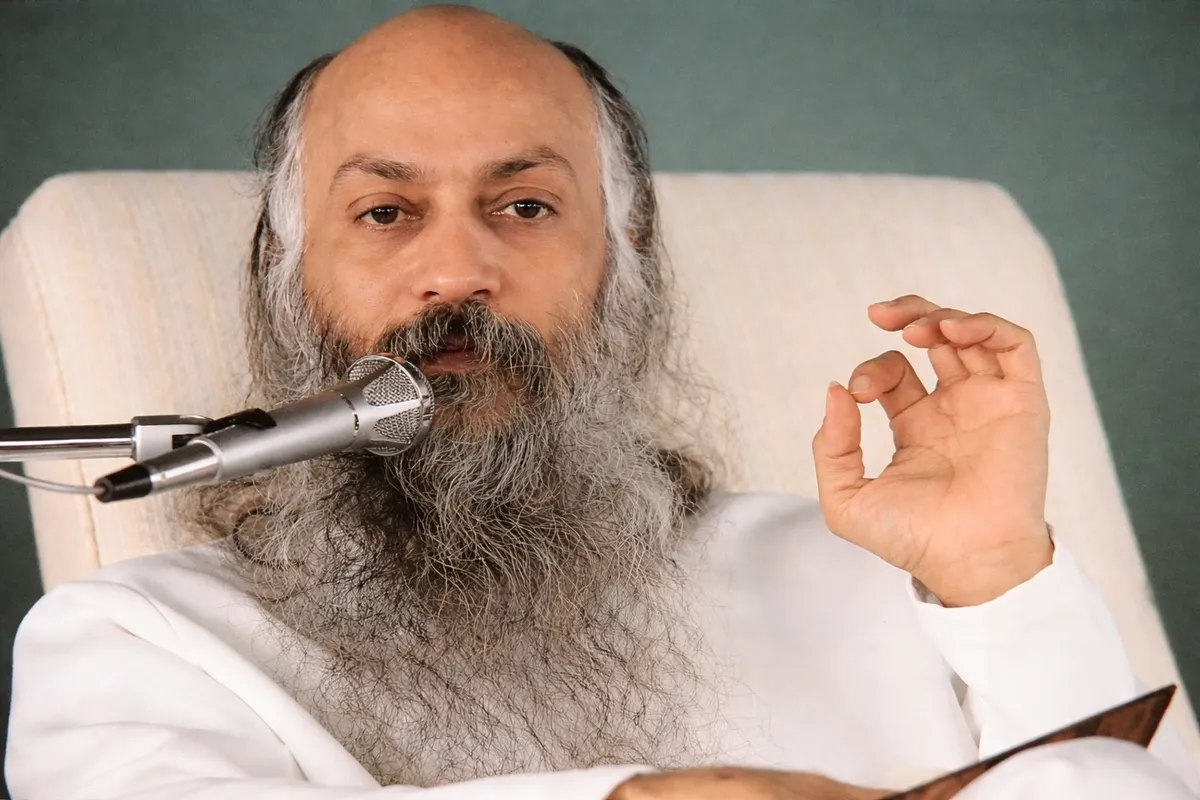
You can stay awake while dying only if you’re enlightened; otherwise, nature puts you to sleep.
From the Discourses
Passages where Osho speaks to this question — each links to the complete discourse.
Question: BELOVED OSHO, IS IT POSSIBLE TO DIE CONSCIOUSLY WITHOUT BEING ENLIGHTENED? Nirah, existence follows certain laws -- and there are no exceptions. If one wants to die consciously, the only way is to be enlightened. Death is such a great surgery: your soul is being taken apart from the body and mind, with which it has been involved for seventy or eighty years. Even for a small operation you need anesthesia; and this is the greatest operation in existence. Unconsciousness is nothing but nature's way of giving you anesthesia. Unless you are completely unidentified with body and mind, you cannot die consciously -- and a death which is not conscious is a great opportunity missed. Enlightenment is an absolute necessity. Enlightenment only means that your whole being is conscious: there are no dark corners left inside you.
Beloved Osho, it is stated that man becomes unconscious at the time of death. Why is this so? Is it due to the terror of death or the process of death?
Ananda said, "But you are a little late. We have given our permission that the master can disappear into the whole, and he has already entered the first stage. So please forgive us, it is not our fault. Forty-two years you have postponed; now wait a few thousand years more. When another Buddha appears, another enlightened man, then don't be so foolish." But Buddha opened his eyes. He said, "Ananda, this will be a condemnation for me -- that a man had come thirsty, and I was still alive and I could not quench his thirst. I can delay death a little bit, but his question has to be answered; otherwise the poor fellow will feel guilty his whole life." A conscious man dies in a totally conscious way, step by step. And if he wants to return before he has taken the fourth step, he can come back. His…
If a being is enlightened, how can he die?
He never dies because he is already dead. You die because you cling to life. Then life has to be taken away, then you have to die. An enlightened being never dies because he does not cling to life. He has voluntarily given it up; he is already dead. But it appears to you that he also dies like you. That is only appearance -- don't be deceived by the appearance. A Buddha dies, of course. A Mahavir dies. Baal Shem will die, Moses will die -- everybody will die. And they die just like you on the surface, but that is only the surface. Watch an ordinary man dying. He makes every effort not to die, he clings to life to the very last, he cries and weeps tears of anguish and fear and trembling. A horror surrounds him; he is terror-struck. And then watch an enlightened man dying;…
Osho, to remain awake even in death—or to successfully orchestrate a conscious death in meditation—what preparations should a seeker make concerning the body-system, the breath-system, the state of the breath, the state of prana, celibacy, willpower, etc.? Kindly shed detailed light on this.
But even in a cinema hall, where it is easier because it is all shadows, we do not remain witnesses. If we inspected the handkerchiefs of those exiting, we would know how many cried. We all know nothing is on the screen—only light and shadow. Yet everything “happens” there, and we become participants. Do not be mistaken that while watching a film you are merely a viewer—you become a participant. Someone pleases you, someone repels you; you identify. If we cannot be witnesses even to a film, how will we be witnesses in life? Life, too, is not much more than a film. At depth, like the play of rays on the screen, life is the play of electrical particles. If you reduce the body or a wall to its ultimate component, you find only electric particles. The difference between the screen and this is not great—two-dimensional there, three-dimensional here.…
One friend has asked: one can die fully conscious, but how can one be in full consciousness at birth?
Remember, the darker the night, the brighter the stars. The flash of lightning stands out like a silver strand, the darker the clouds are. Similarly, when, in its full form, death surrounds us from all sides, at that moment the very center of life manifests in all its glory -- never before that. Death surrounds us like darkness, and in the middle, that very center of life -- call it atman, the soul, shines in its full splendor; the surrounding darkness makes it luminous. But at that moment we become unconscious. At the very moment of death, which could otherwise become the moment to know our being, we become unconscious. Hence one will have to make preparations towards raising one's consciousness. Meditation is that preparation. Meditation is an experiment in how one attains to a gradual, voluntary death. It is an experiment in how one moves within and then leaves…