
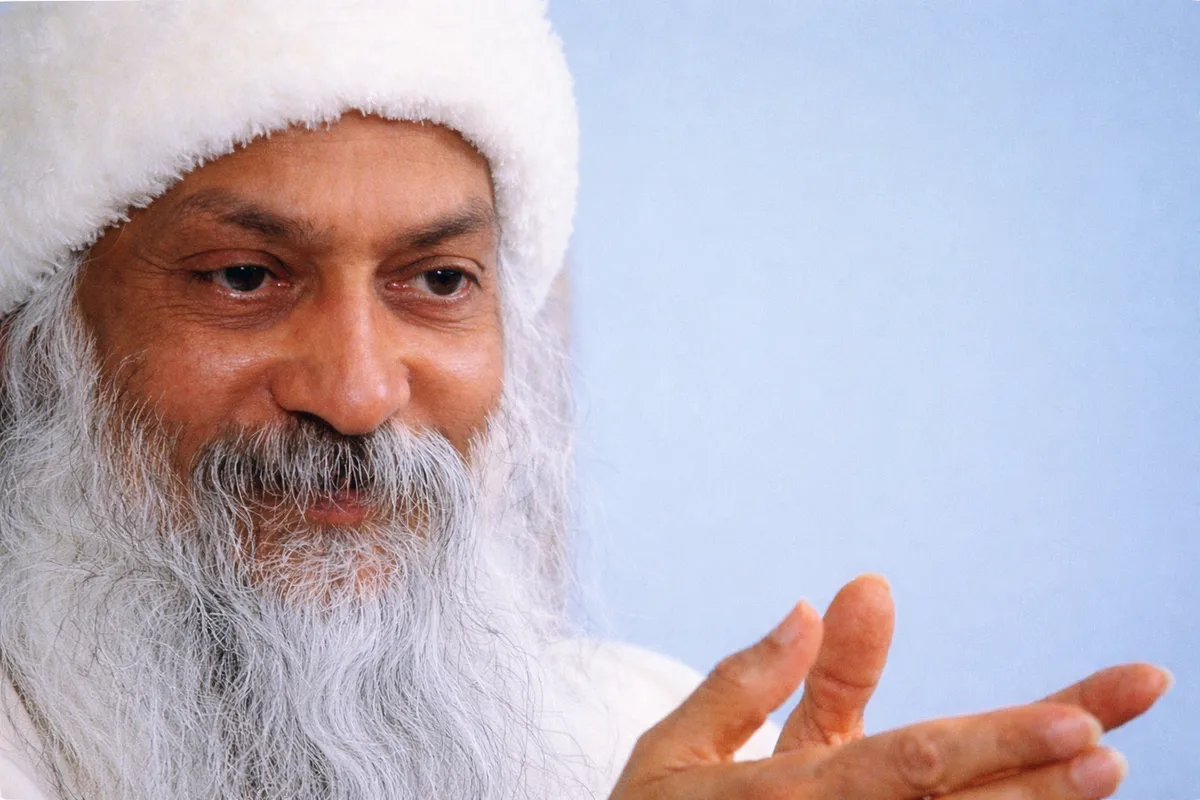
Change your inside first, and the outside of your life will naturally change too.
From the Discourses
Passages where Osho speaks to this question — each links to the complete discourse.
You said last night that a change in the outer or inner and physical or mental aspects can bring a change in consciousness. That means that changes on the periphery also affect the consciousness, the center. But then why do you emphasize changing the center, instead of changing the outer, the periphery?
This is the trouble: you go on catching the words and missing the meaning. The periphery also belongs to you; it is part of the center. The periphery is part of the center, it is the outer part of the center, but it is not different from the center. Can you create a periphery without the center? Or can you create a center without the periphery? They are not separate, they are one. The periphery is the center looked at from without. If you change your periphery, the center will also be affected for two reasons: firstly, the periphery is part of the center, and secondly, what will change the periphery but the center? What will change the periphery? The center will change the periphery. But my emphasis on starting the work from the center is still there because if you start changing the periphery it will take a longer…
A friend has asked: Osho, if in the mother’s womb man and woman create the opportunity for a soul to be born, does that mean souls are separate and there is no all-pervading Soul? He also asked: I have said many times that truth is one, God is one, the soul is one—then don’t these two statements seem contradictory, opposed?
These two statements are not opposed. The Divine is one; in truth the soul is one. But bodies are of two kinds. One is what we call the gross body, which we can see; the other is the subtle body, which we cannot see. When death happens, the gross body falls away, but the subtle body does not die. The soul abides within two bodies, a subtle body and a gross body. At death the gross body drops. This body made of earth and water, of bone, flesh and marrow, falls. What remains is an extremely subtle body—of thoughts, subtle sensations, subtle vibrations, subtle filaments. That filament-woven body begins the journey again with the soul and takes birth anew by entering a new gross body. When a new soul enters a mother’s womb, it means the subtle body has entered. At ordinary death only the gross body falls, not the…
Last night you said that by changing the outer, the inner remains unchanged, untransformed. But is it not true that the right food, right labour, right sleep, right actions and behaviors are also important factors for inner transformation? Isn't it a mistake to ignore the outer completely?
THE OUTER CANNOT CHANGE THE INNER, but the outer can help, or it can hinder. The outer can create a situation in which the inner can explode more easily. The thing to be remembered is this: that the outer transformation is not the inner. Even if you have done everything and the situation is there, the inner is not going to explode. The situation is necessary, it is helpful, but it is not the transformation. And those who get involved with the outer.... The outer is a vast phenomenon. You can go on changing for lives and you will never be satisfied, and something or other will remain to be changed, because unless the inner changes, the outer can never be perfect. You can go on changing it and polishing it and conditioning it. You will never feel satisfied. You will never come to a situation where you can feel,…
Question: at first sight, sannyas appears to be something that limits one's activities. Why does one have to change one's clothes to red? Why should one have to change his appearance, since sannyas is something that is within rather than without?
Gurdjieff used to say a very meaningful thing: that as you are now, you have no soul. He was both right and wrong. You have a soul, but you do not know about it. You are the outside, and so clothes are very meaningful. Because of clothes a person becomes beautiful and because of clothes a person becomes ugly. Because of clothes he becomes respected; because of clothes he is not respected. A judge has to wear certain clothes -- a supreme court justice has to use a particular robe -- and no one asks why. With that robe he is a supreme court justice; without that robe he is no one. This is how man is. When I look at a man he is more his clothes than his mind. And this is as it should be, because we belong to the body, we are identified with the body.…
Osho, a friend has asked: the meditation you speak of—will it make any difference to one’s character and life, or not?
Certainly it will! And, in fact, character and life do not change by any other route. Meditation changes the inner consciousness. And when the inner consciousness changes, the outer conduct changes of its own accord. It cannot remain unchanged. When you change, how can your behavior remain old? It will change. Your old behavior was linked to your consciousness. And when consciousness itself has changed within, behavior cannot remain the same. Now, a man is smoking a cigarette. The whole world may advise him, “Don’t smoke.” I say, he won’t stop. And if he does stop, he will start some other, equally useless habit in its place. If he doesn’t exhale smoke, he’ll chew betel; if not betel, he’ll chew mud; if not mud, he’ll sit with people and gossip. But that idle habit of moving the lips will continue. He cannot stop it. Because the smoker is really saying…