
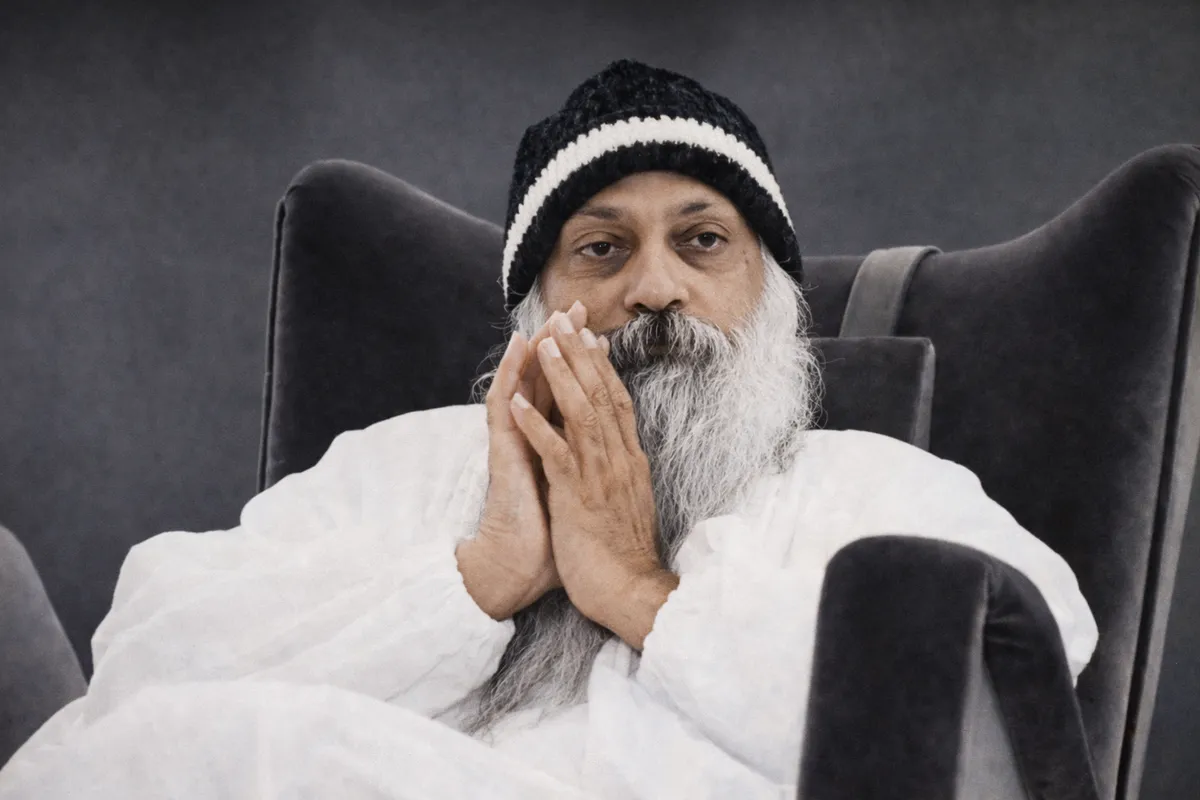
Your mind is like borrowed clothes from society, but your consciousness is your naked, original self; real silence appears when the clothes drop—not when they’re just quieter.
From the Discourses
Passages where Osho speaks to this question — each links to the complete discourse.
Are mind and consciousness two separate things or is the silent mind (or the concentrated mind) what is called 'consciousness'?
IT DEPENDS. IT DEPENDS ON YOUR DEFINITION. But to me, mind is that part which has been given to you. It is not yours. Mind means the borrowed, mind means the cultivated, mind means that which the society has penetrated into you. It is not you. Consciousness is your nature; mind is just the circumference created by the society around you, the culture, your education. Mind means the conditioning. You can have a Hindu mind, but you cannot have a Hindu consciousness. You can have a Christian mind, but you can't have a Christian consciousness. Consciousness is one; it is not divisible. Minds are many because societies are many; cultures, religions are many. Each culture, each society, creates a different mind. Mind is a social by-product. And unless this mind dissolves, you cannot go within; you cannot know what is really your nature, what is authentically your existence, your consciousness.…
We are not the body and we are not the mind either. Mind is also part of the body. The visible part is called body, the invisible part is called mind. It is a psychosomatic mechanism and we are the witness of it. We are in it but we are not it. This is the greatest experience. Once it has happened your life goes through a radical change. Then you are never the same again. It is a breakthrough. The whole effort here is to bring this breakthrough closer and closer. Every support, every technique and device is provided for this breakthrough so that you can see yourself as a witness of it all, as pure consciousness. To know oneself as pure consciousness is to be free of all bondage. It is to be free of birth and death, it is to be free of time.
A friend has asked: Osho, it is said that not even a leaf moves without God’s will. If that is true, then our whole life runs according to His will. Then the good and bad thoughts that arise in us, the good and bad actions that happen—are they also according to His will?! Then what is the purpose of sadhana? What meaning is there in changing oneself?
If this point truly lands, then sadhana has no further purpose. Sadhana has begun. If only this much occurs to you—that whatever is being done, God is doing it—then my sense of doership is finished. All of sadhana is only this: that my ego dissolve. Then He is doing the good, He is doing the bad. Then there is no question of good and bad at all. He is doing it—both are His doing. He gives suffering; He gives joy. Birth is His, death is His. Bondage His, liberation His. Then there is no question of me. There is no need for me to come in between. Then there is no need for sadhana—because sadhana has happened; it has begun. This very understanding becomes the supreme sadhana. This very insight cuts the root of life’s disease. For the whole disease is the ego, the notion that “I am doing.” This…
Osho, are the two opposites?
Yes, the two are opposites. Its moving condition, its dynamic state, is the mind; and its settled, vibrationless stillness is the soul. The mind is not a thing; the mind is activity. So as long as the consciousness within us is active, that accumulated stream of activities is called the mind. And when consciousness has become inactive and activities have dropped to zero, that inactive consciousness is called the soul. Active consciousness is mind; perfectly stilled, steady consciousness is the soul.
And to know such a state, when you are aware and alert, fully conscious and watchful and there are no thoughts there, your whole consciousness for the first time in your life returns back on itself. Becomes aware of awareness. You become conscious of consciousness. In the silence, when the chattering mind is no more there, one realizes oneself. Unless the mind is silent, you cannot realize yourself. You will remain involved with the thoughts and those thoughts are almost meaningless -- memories, fragments of memories, imagination, dreams, daydreams, all mixed up. It is a chaos. Even if sometimes you find some beautiful thoughts moving, they are all borrowed. You have heard them, you have read them, but they are not yours. And that which is not yours is not true. This has to be remembered. Everything borrowed is untrue. Only your own realization can give you authentic truth.