
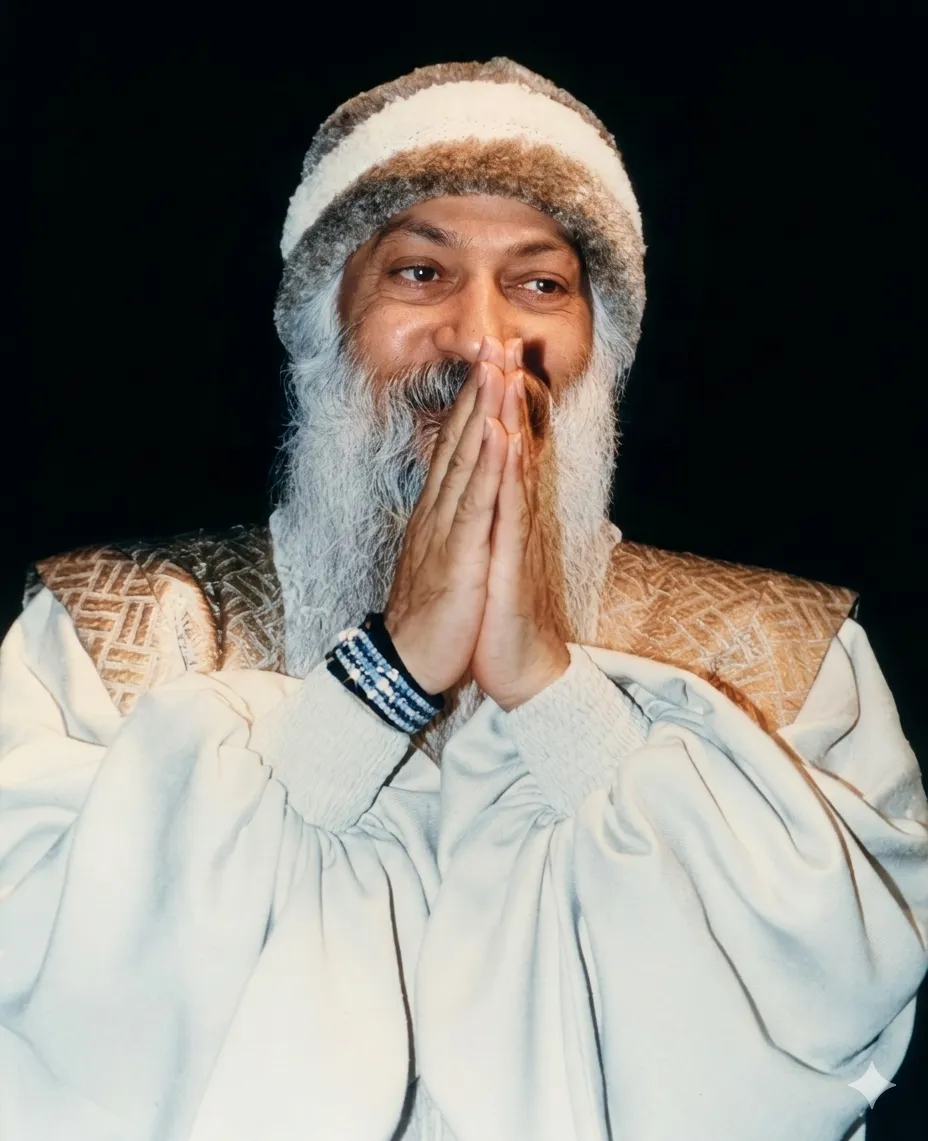
When you wake up inside, you cling less to your body, so it may not stay perfectly healthy—and being sick doesn’t mean you’re enlightened.
From the Discourses
Passages where Osho speaks to this question — each links to the complete discourse.
Osho, is it possible that by attaining your state of consciousness a person could remain perfectly, physically healthy? Or is that not possible—that such is the law of Tao? Because I have heard that all true masters have been physically unwell.
Ramakrishna said, “Sharada, you do not listen. The day you bring the plate and I turn over in bed to the other side and do not look at your plate, understand that only three days of my life remain.” Sharada thought he was joking. But that is exactly what happened. One day Sharada entered his room with the food. Ramakrishna neither rose from the bed nor took any interest; instead, he turned his face toward the wall. The plate slipped from Sharada’s hand. She remembered what Ramakrishna had said years before. Ramakrishna said, “Whether the plate falls or not, nothing will change now. I am here only three more days. And today I will tell you—because you used to ask again and again and I kept silent—today I tell you that all my bonds with the body have broken. Somehow I have been holding on to a tiny bond—the bond…
The questioner asks: “Is it true that when the soul descends—when self-realization happens—the body too changes completely in every respect?”
That Word is hidden in you; nowhere else to go—not to Kashi, not to Kaaba. It pervades your every pore, your heartbeat—its very throb. Like music asleep in the veena—touch it and it wakes. But the inner veena is more marvelous: there is no instrument, no strings—only music—the unstruck sound. Enter and you will find no veena and no player—yet a wondrous, timeless music without beginning or end. To hear that music is to hear God. That music overflowed in Muhammad when the Quran descended; he trembled. It overflowed in the Vedic rishis—hence the Vedas are called apaurusheya—not composed by man. Whenever anything of worth is spoken, it comes from there; the rest is rubbish. Whenever truth or beauty appears, know it comes from there—whether the smile of a child or the passing beauty of a woman—deeper, it comes from there. The Gita, the Quran, the Bible—all arise there. And…
Osho, what do those people mean who say that, so that there is no explosion, one should search within with a subtle, refined vision...
But the effortless awakening I speak of—once it arrives, there is no question of its departure, because you did not bring it; it came. Gradually you and awakening are not two; you are the awakening. You did not make even anger “the other,” so how would awakening be “other”? It becomes you. There is no question of its return. Whatever we have truly known cannot be unknown. You cannot undo knowing. Yes, what we have merely learned by rote can wobble. But what is known—like a child who comes to know love; once he knows, he cannot un‑know it. Knowing becomes part of you; it cannot fall away. Reading four books about love is different; that can be forgotten. Through the experiment of awakening, whatever happens in us reveals itself gradually. Awakening is not something that comes from outside; it is your inner being uncovering itself. If it were an…
If faith can move the mountains, why can you not heal your own body?
I don't have any body. This feeling that you have a body is absolutely wrong. The body belongs to the universe; you don't have it, it is not yours. So if the body is ill or if the body is healthy the universe will take care of it. And a person who is in meditation should remain a witness, whether the body is healthy or ill. The desire to be healthy is part of ignorance. The desire not to be ill is also part of ignorance. And this is not a new question -- this is one of the oldest questions. It has been asked of Buddha; it has been asked of Mahavir. Ever since there have been enlightened persons, the unenlightened have always asked this question. Look... Jesus said faith can move mountains, but he died on the cross. He couldn't move the cross. You or someone like you…
The body is quickly affected. If the body has some disease, some affliction—if someone is gravely ill, a lifelong patient—can he still experience self-bliss or not?
Yes. About what you ask—“one who can experience self-bliss”—such a person has no awareness at all that “the body is mine.” Whether your body is healthy or ill, whether the pain is noticed by you or not, it has nothing to do with self-bliss. If even a little taste of self-bliss happens, that very little taste will make it clear to you that you are not the body. Then your notions about this body will become like the notions you have about someone else’s body. Your relation to this body will be almost like an actor’s relation to his role in a play. Just as when Sita of Rama was abducted—that was one thing. Valmiki writes that he went from tree to tree, weeping, asking, “Where is my Sita?” Even today in the theater, Sita of Rama is carried off, and this stage-Rama too goes from tree to tree asking,…