
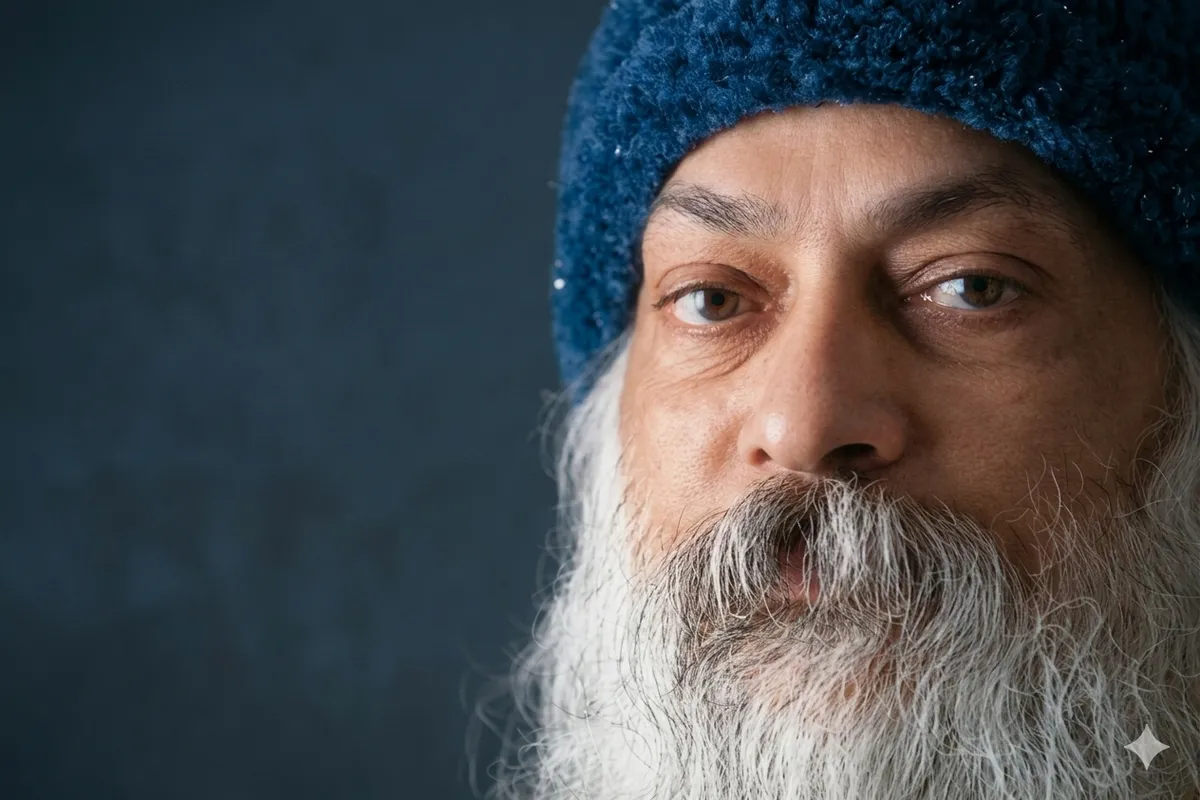
According to Osho, Bergson’s “intuition” only looks like Zen; it isn’t and cannot be. Bergson speaks about intuition from the head, without meditative, existential realization, whereas Zen demands direct experience—satori, a lived luminosity evident in ordinary life. Philosophies and anti-intellectual stances remain verbal unless embodied; Zen is content (experience), while Bergson offers only a similar container (concepts).
Bergson talks about intuition with his head, but Zen is about actually living and feeling it.
From the Discourses
Passages where Osho speaks to this question — each links to the complete discourse.
Henri bergson also proposes a philosophy of intuition. Is not his approach exactly like zen?
Here in the world of transcendence, two plus two is five, not four. In the ordinary world, two plus two is four; in the world of meditation, wholeness, totality, two plus two is five, never four -- because the whole is more than the sum of its parts. Something new arises. When you put the clock together, the 'tick' arises. When you take the parts apart, the 'tick' disappears. That 'tick' is the transcendental thing, that 'tick' is life, that 'tick' is meditation, that 'tick' ultimately is God. Logic cannot give you that 'tick'. Logic is a prostitute -- always remember. Logic can go with anybody -- anybody who is ready to pay. Logic is sophistry. You can use logic for God, you can use the same logic against God. You can use logic for meditation and you can use the same logic against meditation. Logic has no love, logic…
Osho, what is zen?
Sagar, IT IS ALMOST IMPOSSIBLE TO ANSWER because Zen is not a philosophy, it is not a doctrine. It is an experience, an experience of your own interiority, of your own subjectivity -- not an objective experience. If it were some object outside you, there would be a possibility of describing it, of analyzing it, of defining it. It is indefinable by its very nature; it is not within the grasp of intellect. It is an experience of dropping out of your mind, disappearing from your mind into your being, slipping out of the mind and entering into your being. The mind is a false entity; your being is your real face, your original face. The mind is created by the society, hence there are different kinds of minds -- Hindu mind, Christian mind, Jewish mind -- but the being is one; it is neither Christian nor Hindu nor Mohammedan.…
Osho, I cannot understand the philosophy of zen. What should I do to understand it?
When all words are gone, your mirror has no more dust on it, no more mist on it. When you look at things you collect impressions; that is the dust -- that's what you call thinking. When you see a rose flower, the rose flower is outside you but it makes a reflection inside you. The rose flower will fade away by the evening, the petals will fall and disappear, but the inner rose flower, the rose that has become imprinted in your memory will continue. It will remain forever with you, you can always remember it. And if you are a sensitive, aesthetic, artistic person you can visualize it again and again; you can imagine it as if it is true. In fact, if you try you will be surprised: you can even experience the fragrance of the rose again. If you create the whole situation in your imagination:…
Question: The first question: IN THOMAS MERTON'S VIEW: "ZEN IS NOT A SYSTEMATIC EXPLANATION OF LIFE, IT IS NOT AN IDEOLOGY, IT IS NOT A WORLD VIEW, IT IS NOT A THEOLOGY OF REVELATION AND SALVATION, IT IS NOT A MYSTIQUE, IT IS NOT A WAY OF ASCETIC PERFECTION, IT IS NOT MYSTICISM AS IT IS UNDERSTOOD IN THE WEST; IN FACT IT FITS NO CONVENIENT CATEGORY OF OURS. HENCE ALL OUR ATTEMPTS TO TAG IT AND DISPOSE OF IT WITH LABELS LIKE PANTHEISM, QUIETISM, ILLUMINISM, PELAGIANISM, MUST BE COMPLETELY INCONGRUOUS. "BUT THE CHIEF CHARACTERISTIC OF ZEN IS THAT IT REJECTS ALL SYSTEMATIC ELABORATIONS IN ORDER TO GET BACK AS FAR AS POSSIBLE TO THE PURE, UNARTICULATED AND UNEXPLAINED GROUND OF DIRECT EXPERIENCE. THE DIRECT EXPERIENCE OF WHAT? LIFE ITSELF." BELOVED MASTER, HAS THOMAS MERTON GOT IT?
Osho, do you really think zen is full of zest, zip, zap and zing?
The father, not wanting to leave his son without an answer, says, 'Listen to the following, son. Let us suppose that two men come into a restaurant, one with dirty hands and the other with clean hands. Which one is going to go and clean his hands?' 'The one with dirty hands, of course, Daddy!' 'Very good,' says the father. 'Now let's suppose that the two men walk into a restaurant, one with dirty hands and the other with clean hands. Which one is going to go and wash his hands?' 'The one with dirty hands, Dad. I just told you!' 'No, not this time, son. The one who will go and wash his hands is the one who already has clean hands, because he is in the habit of cleaning them. The one with dirty hands is in the habit of keeping his hands dirty.' 'What a mess, Daddy!'…