
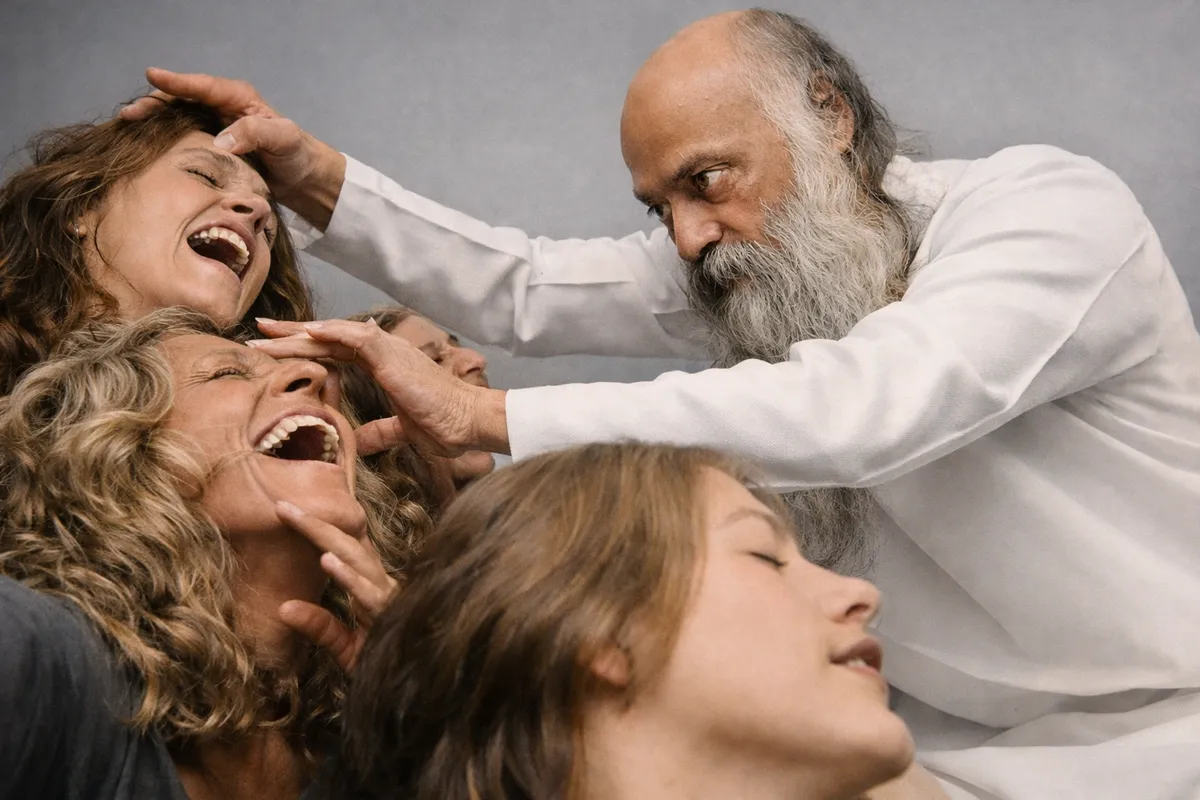
Don’t try to fix the ego; wisely use your energies so the fake “I” melts and your real self (like God inside) shines.
From the Discourses
Passages where Osho speaks to this question — each links to the complete discourse.
Osho, into what should the power of the ego be transformed?
So those three experiments I have spoken of for the purification of life—purification of the body, of thought, and of feeling—if these three experiments continue, in doing them you will find the ego has dissolved. Anger will not dissolve in that sense; ego will dissolve. The energy of anger will continue in new forms. No “energy of ego” will remain. When ego dissolves, nothing is left behind—no residue. Anger or sex do not dissolve in that sense; they are transformed. They remain present in other forms. The energy of anger remains; it functions in another way. It may become compassion, but the energy is the same. And in this world, those who are very angry—if their energy is transformed—they can be filled with just that much compassion, because the energy takes a new form. Energy is not destroyed; it takes new forms. As I said, those who are very sexual…
Osho, does the ego have some elixir of life? Even on the verge of dying it seems to revive—who knows from where, how, and why?
Haven’t you seen that the harder it is to obtain the woman you fall in love with, the more your love seems to grow? Had Majnu got his Laila, you would never even have heard his name. The whole crux of the Majnu-Laila story is that he never got her. Quite possibly, had he got her, they would have ended in divorce. Stories proceed in strange ways. Because he did not get her, he kept weeping, aching, wandering deserts and mountains, calling “Laila, Laila!” Have you ever seen any husband doing that? Ask a husband and perhaps he hasn’t even properly looked at his wife’s face in twenty years. You too are a husband or a wife—try this: close your eyes and try to recall your spouse’s face. You will find it difficult. The faces of film actresses will come, but your wife’s face will not come clearly. And if…
Osho, may the color of that flower fade so that only the fragrance remains; let the head go if it must, but let honor remain. Let Your glory be proven by my negation. May I efface myself so completely that only You remain.
No need to rush. Don’t even start trying to erase the “I.” The “I” is such a clever craftsman that if you set out to erase it, it will hide behind the eraser. One day the ego will rise and proclaim, Look, I have destroyed my ego! Now I am egoless! Who is as humble as I? Such a declaration is the ego’s own. Awaken within. Watch and recognize the routes of ego. There is no need to fight. Fight only if you wish to lose—if you want to be defeated. Then how does ego go? Ego dissolves through awareness alone—just as darkness disappears when a light is lit. You don’t have to shove darkness out! You don’t have to slash it with a sword! You don’t wrestle with darkness. If someone starts wrestling with darkness, thumping his chest, do you think he will ever win? He will die fighting,…
Osho, a Sufi poet has said— “Erase your very self if you desire rank, for the seed, mingling with dust, turns into flowers and gardens.” Osho, will you bestow your grace to erase my self, so that my inner seed may sprout, blossom, and bear fruit?
This so‑called fraternity of priests and saints is very clever. To the rich they say “Laxmi-Narayan”—to the poor, “Daridra-Narayan.” To the rich they say, “Your wealth is due to past merits.” To the poor they say, “Don’t worry; bear poverty with peace and contentment; ahead, a great rank awaits.” That is why no revolution has happened in this country in five thousand years. How could it? The poor are consoled, “In heaven you will be first—don’t worry.” He sits waiting for heaven—for tomorrow, which never comes. Tomorrow is an outright lie. Premmurti, first of all—do not desire rank. What will you do with rank? What does “rank” mean? That others will honor you! Why do we seek respect from others? Because we feel an inferiority complex within. This psychology must be understood clearly. The person who feels inferiority within seeks respect from others so that somehow the inner pit may…
Osho, what is the fundamental anguish of human life?
There is only one anguish: that a human being cannot become what he was born to be. There is only one anguish: that the seed remains a seed and does not bloom like a flower; that it cannot scatter its fragrance to the infinite winds; cannot converse with the moon and stars; cannot offer its colors to the sky; cannot be expressed. If the poem within the poet cannot be revealed—anguish. If the painter cannot paint—anguish. If the dancer cannot dance—if chains lie on his feet—anguish. Anguish means only this: that what we are meant to be—our innate nature and destiny—does not come to fruition, and we are forced to be something else. Then anguish is born. Then melancholy gathers over life. And all those countless people you see burdened with sorrow, living in a kind of hell—the reason is only this: each has come carrying the seed of becoming…