
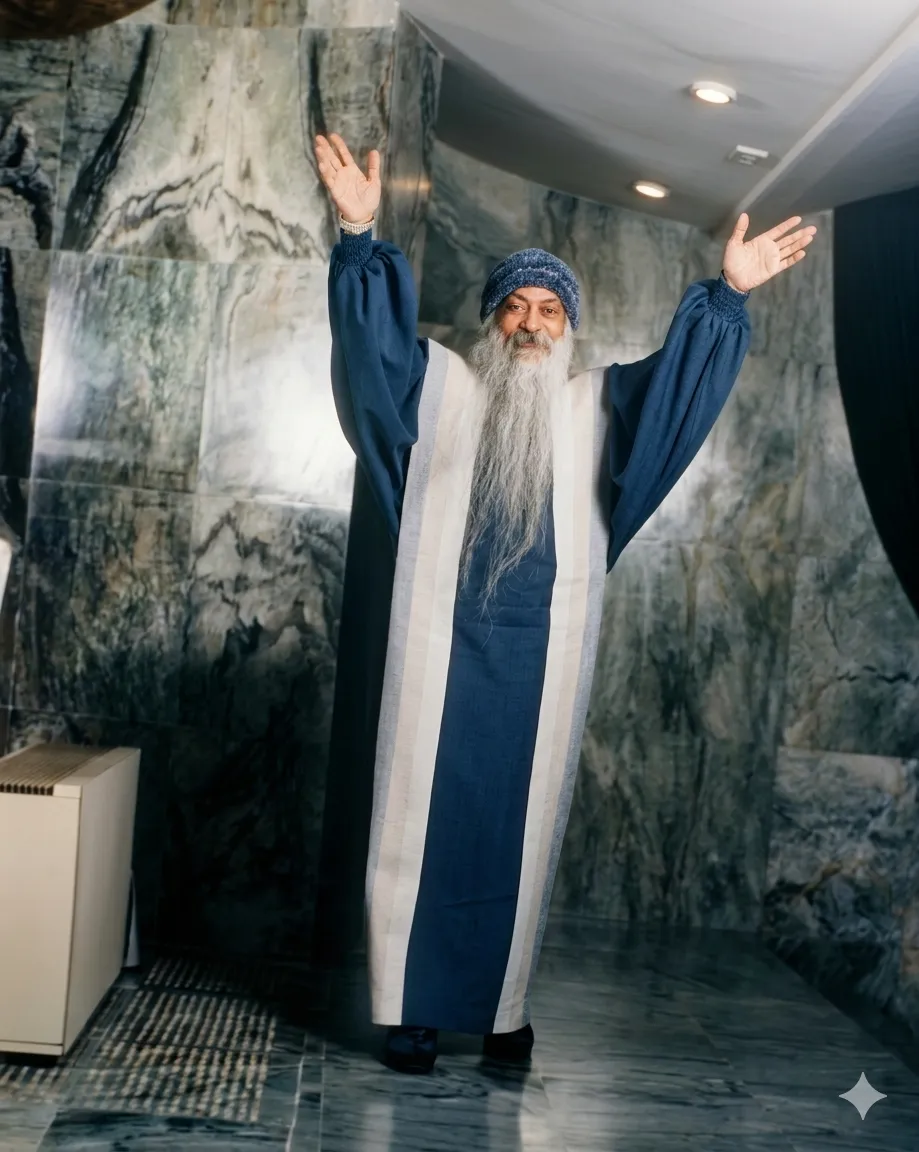
We wear names, roles, and memories to get by, but then forget they’re just labels and mistake them for who we are.
From the Discourses
Passages where Osho speaks to this question — each links to the complete discourse.
"in which way does the modernized original mind become identified with the dust of the past knowledge and experience?"
Religion starts when you become frustrated, totally frustrated, with the world of name and form and when the whole thing looks meaningless. It is! Ultimately it IS meaningless. This feeling of meaninglessness of the world that is created around name and form makes you uneasy. That uneasiness is the beginning of a religious search. You become uneasy because with this label you cannot become totally identified. The label remains a label; you remain what you are. This label covers you a little, but it cannot become your totality. And sooner or later you become fed up with this label. You want to know who you really are. And the moment you ask sincerely, "Who am I?" you are on a different journey; you are transcending. This identification is natural. There is another reason why it is so easy to become identified. This is a room. If I say to you,…
In moods of extreme desire, be undisturbed.
THIS SO-CALLED UNIVERSE APPEARS AS A JUGGLING, A PICTURE SHOW. TO BE HAPPY, LOOK UPON IT SO. OH BELOVED, PUT ATTENTION NEITHER ON PLEASURE NOR ON PAIN, BUT BETWEEN THESE. OBJECTS AND DESIRES EXIST IN ME AS IN OTHERS. SO ACCEPTING, LET THEM BE TRANSFORMED. We have double standards -- one standard for one oneself and another standard for everyone else. This double-standard mind is going to be in deep misery always. This mind is not just, and unless your mind is just you cannot have a glimpse of the truth. Only a just mind can leave this double standard. Jesus says, "Don't do to others what you would not like done to you." This means a similar standard is needed. This technique is based on the idea of a single standard: "OBJECTS AND DESIRES EXIST IN ME AS IN OTHERS...." You are not exceptional, although everyone thinks he is…
But Osho, as I understand it, there are certain subjects like chemistry, physics, or medicine where positive values are essential. What are your views about that?
Einstein was doing an experiment. He had failed seven hundred times, yet every morning he came into the laboratory laughing, ready to begin again. The young assistant with him was exhausted. “Is this old man mad? Seven hundred failures—and again he starts fresh!” The youth was tired; he said, “We should drop this now. How many times have we been defeated?” Einstein said, “Defeated? You’re crazy—each time we have won.” “Where have we won? Every experiment has failed.” Einstein answered, “In seven hundred directions we have searched, and we now know truth is not there. We have succeeded seven hundred times. Truth is being endlessly eliminated into nearness. Suppose truth will reveal itself on the seven hundred and fifteenth attempt; then fourteen more eliminations are needed. Then only that will remain; it cannot escape. Where will it go? We have searched seven hundred paths and found it absent. That much…
The nun chiyono studied for years, but was unable to find enlightenment. One night, she was carrying an old pail filled with water. As she was walking along, she was watching the full moon reflected in the pail of water. Suddenly, the bamboo strips that held the pail together broke, and the pail fell apart. The water rushed out; the moon's reflection disappeared -- and chiyono became enlightened. She wrote this verse: this way and that way I tried to keep the pail together, hoping the weak bamboo would never break. Suddenly the bottom fell out. No more water; no more moon in the water -- empti
A real seeker is never against anything. He is for something, but never against something. He is for God, but never against the world, because finally the world belongs to God. If I see your face in a mirror and it is beautiful, should I be against the mirror? Really, I should be thankful because it reflected you. But I will not focus myself on the mirror; I will be in search of you who was reflected in the mirror. I will have to leave the mirror, but not because I am against it. I will have to turn my face away from the mirror, but not because I was against it. I will be thankful to it because it mirrored something, and in the reflection it was so beautiful -- but now I must go to find the original source. <q>THE WATER RUSHED OUT; THE MOON'S REFLECTION DISAPPEARED --…
Question: FOCUS ON FIRE RISING THROUGH YOUR FORM FROM THE TOES UP UNTIL THE BODY BURNS TO ASHES BUT NOT YOU. MEDITATE ON THE MAKE-BELIEVE WORLD AS BURNING TO ASHES AND BECOME BEING ABOVE HUMANAS, AS SUBJECTIVELY, LETTERS FLOW INTO WORDS AND WORDS INTO SENTENCES, AND AS, OBJECTIVELY, CIRCLES FLOW INTO WORLDS AND WORLDS INTO PRINCIPLES, FIND AT LAST THESE CONVERGING IN OUR BEING Whenever you get identified with any memory, any knowledge, any experience, any name and form, that I is born. Then you are young, you are old; you are rich, you are poor; you are beautiful or you are not beautiful; you are educated or you are not educated; you are respected or you are not respected -- then you go on getting identified with things which accumulate around you and the ego is born. Ego is identification with the mind.