
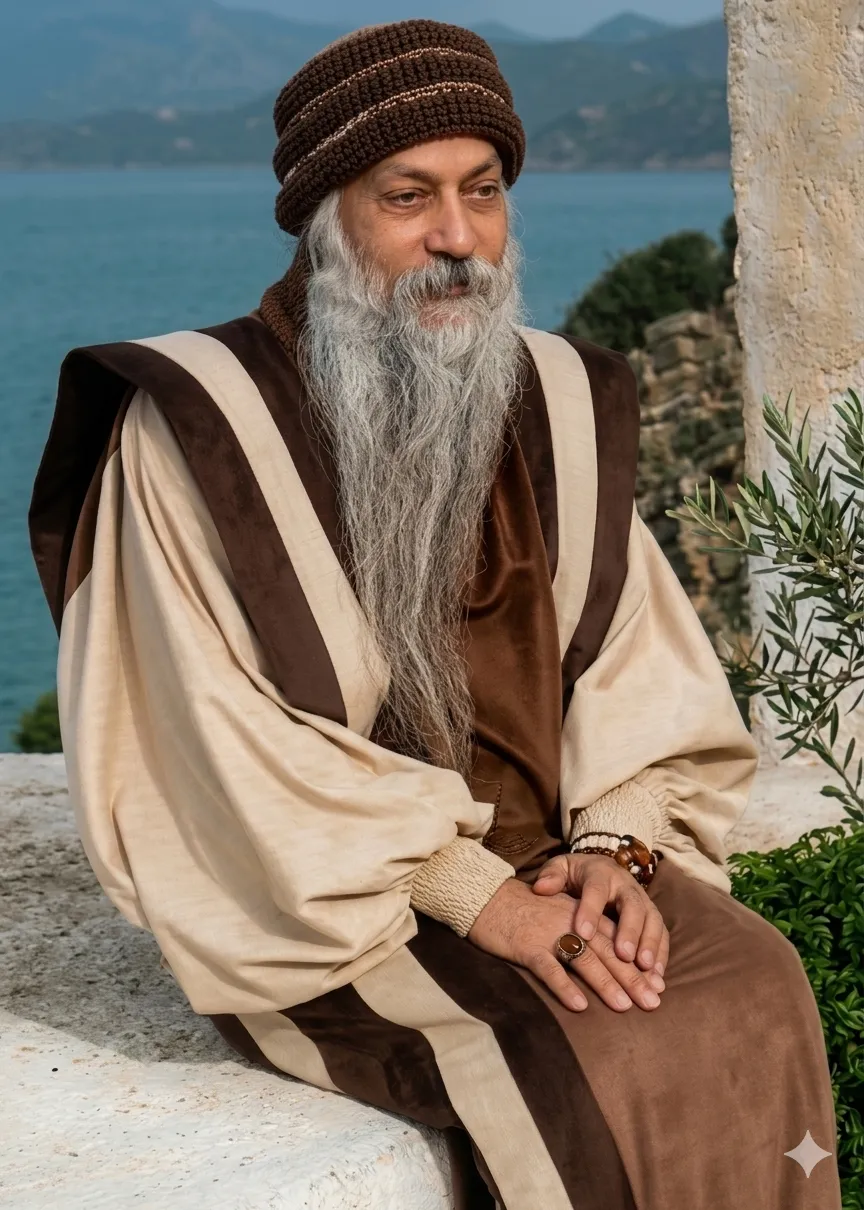
According to Osho, the mind is the reactive surface of our consciousness—the outer ring that answers blows from the outside. It functions as reaction itself: a push arrives, and it says, 'defend yourself.' Like waves raised by wind upon the sea's surface, mind rises and falls with impacts, while deeper consciousness remains beyond these conditioned ripples.
Your mind is the part that quickly reacts to outside events, like water making waves when the wind blows.
From the Discourses
Passages where Osho speaks to this question — each links to the complete discourse.
So then what is this mind?
In fact, the reaction to the blows that come from outside upon the outer layer of our consciousness—that reaction is the mind; mind is reaction. For example, you are sitting and I give you a push; the mind will say, “A push has come—defend yourself.” So it is the very outer ring of our consciousness. Just like the surface of the sea: when the wind blows, waves rise upon it from the wind’s impact.
Osho, what is mind?
As I see it, mind is not an object—it is only a function. This fan is running. There is the fan’s moving state and there is its still state. When the fan stops, we do not ask where the “movement” went, because movement was not an object. Movement was simply an activity of the fan. The fan that was moving has become still. The being within us—its moving state is the mind, and its still state is the soul.
Are mind and consciousness two separate things or is the silent mind (or the concentrated mind) what is called 'consciousness'?
IT DEPENDS. IT DEPENDS ON YOUR DEFINITION. But to me, mind is that part which has been given to you. It is not yours. Mind means the borrowed, mind means the cultivated, mind means that which the society has penetrated into you. It is not you. Consciousness is your nature; mind is just the circumference created by the society around you, the culture, your education. Mind means the conditioning. You can have a Hindu mind, but you cannot have a Hindu consciousness. You can have a Christian mind, but you can't have a Christian consciousness. Consciousness is one; it is not divisible. Minds are many because societies are many; cultures, religions are many. Each culture, each society, creates a different mind. Mind is a social by-product. And unless this mind dissolves, you cannot go within; you cannot know what is really your nature, what is authentically your existence, your consciousness.…
Osho: To think is the nature of the mind. And if you don't think then there is no mind. A state of no-mind comes, then you know. That is nature, this too is nature; that is not against this nature which creates ignorance, creates unknowing, creates conflict. We have not known the total mind, we have known only the mind which thinks. If you transcend it then you know the total mind -- which knows. Thinking is one thing, knowing is quite another. QUESTION: THE NATURE OF THE MIND IS TO THINK, AND THEN IT CEASES TO THINK. WHAT DO YOU DO IN ORDER TO CAUSE IT NOT TO THINK? DOES IT NATURALLY NOT THINK? Osho: If you become aware of your thinking process, then the process by and by is dissolved.
But Osho, as I understand it, there are certain subjects like chemistry, physics, or medicine where positive values are essential. What are your views about that?
Einstein was doing an experiment. He had failed seven hundred times, yet every morning he came into the laboratory laughing, ready to begin again. The young assistant with him was exhausted. “Is this old man mad? Seven hundred failures—and again he starts fresh!” The youth was tired; he said, “We should drop this now. How many times have we been defeated?” Einstein said, “Defeated? You’re crazy—each time we have won.” “Where have we won? Every experiment has failed.” Einstein answered, “In seven hundred directions we have searched, and we now know truth is not there. We have succeeded seven hundred times. Truth is being endlessly eliminated into nearness. Suppose truth will reveal itself on the seven hundred and fifteenth attempt; then fourteen more eliminations are needed. Then only that will remain; it cannot escape. Where will it go? We have searched seven hundred paths and found it absent. That much…