
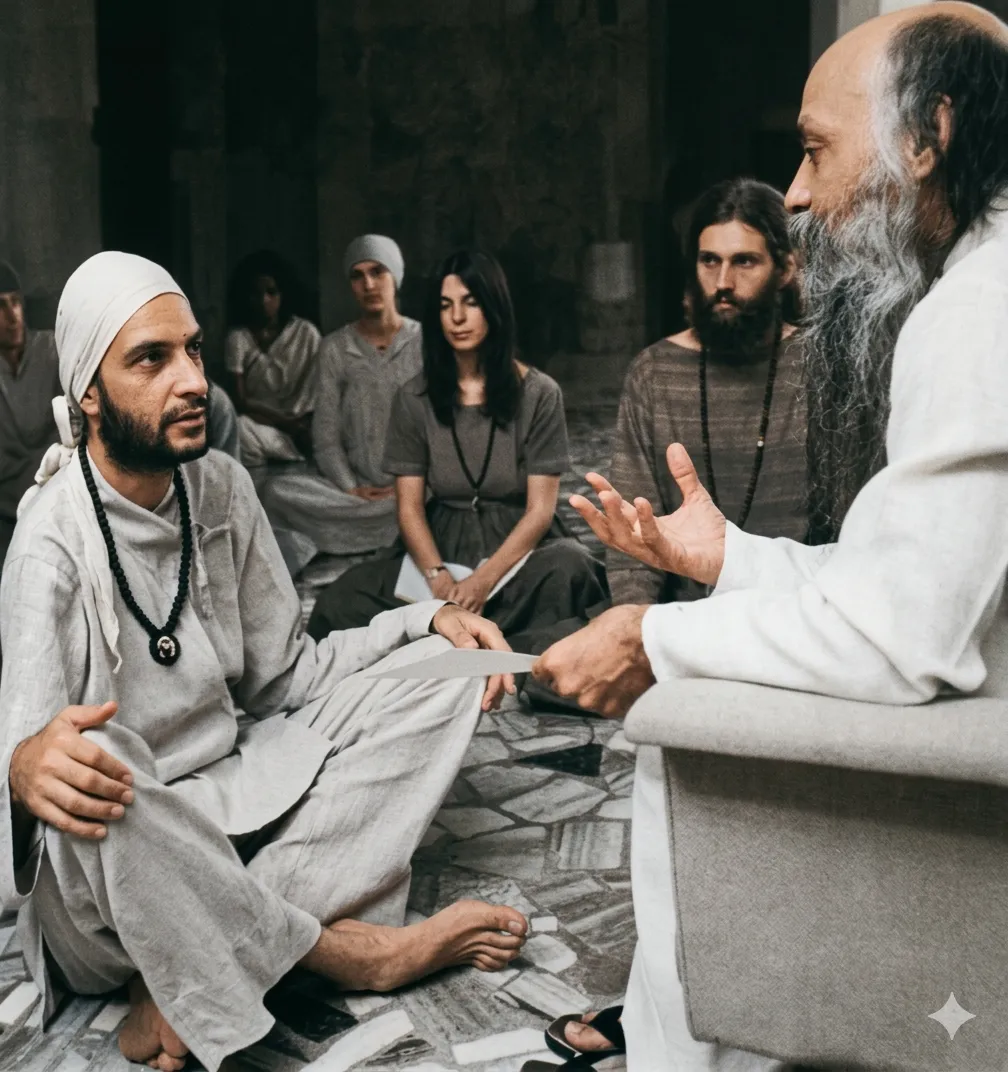
According to Osho, a mature mind doesn't react from stored conclusions; it responds freshly from present-moment awareness. Maturity is deep trust in your own consciousness - innocence, openness, responsiveness - rather than reliance on past knowledge or egoic certainty. Immaturity clings to the stale past and becomes reactionary. True maturity isn't about age or experience, but about continuously learning, seeing anew, and meeting life as it flows, here and now.
Being mature means trusting your awareness and meeting each moment fresh instead of acting from old ideas.
From the Discourses
Passages where Osho speaks to this question — each links to the complete discourse.
You told me that my mind is immature. What does it mean to have a mind that is mature?
To think that you know is to be immature. To function from knowledge, from conclusion, is to be immature. To function from no-knowledge, from no conclusion, from no past, is maturity. Maturity is deep trust in your own consciousness; immaturity is a distrust in your own consciousness. When you distrust your consciousness you trust your knowledge, but that is a substitute and a very poor substitute at that. Try to understand this -- it is important. You have been living, you have experienced many things; you have read, you have listened, you have thought. Now all those conclusions are there. When a certain situation arises. you can function in two ways. You can function through all the accumulated past, according to it -- that's what I mean by functioning through a center. through conclusions, through experience, stale, dead -- then whatsoever you do your response is not going to be…
What is maturity? How can I be mature?
You will have to understand first what immaturity is. That will give you the idea of what maturity is. Immaturity has a few ingredients in it. One, immaturity is a sort of dependence. A child depends on the parents; he is immature. If you are still depending, you are immature. You may depend on God or you may depend on me, but it is immaturity. You are still seeking your parents. Maybe your parents are gone and lost; now you are projecting your parents. There are many people who come to me and I can see immediately in their eyes they are searching for their father. It is not accidental that the pope is called the pope. "Pope" means "papa". People are looking for a divine daddy, continuously. This is immaturity. When are you going to stand on your own feet? How long are you going to remain a dependent…
Question: BELOVED OSHO, WHAT ARE THE QUALITIES OF A MATURE PERSON? The qualities of a mature person are very strange. First, he is not a person. He is no more a self. He has a presence, but he is not a person. Second, he is more like a child -- simple and innocent. That's why I said the qualities of a mature person are very strange, because maturity gives a sense as if he has experienced, as if he is aged, old. Physically he may be old, but spiritually he is an innocent child. His maturity is not just experience gained through life. Then he will not be a child, and then he will not be a presence; he will be an experienced person -- knowledgeable but not mature. Maturity has nothing to do with your life experiences.
What is maturity?
MATURITY is to know that nothing can be done. Maturity is acceptance of existence as it is: YATHA BHUTAM. Maturity is not to desire things otherwise. Maturity is relaxing with the whole. Immaturity is conflict, struggle. The part fighting with the whole is immaturity. The part come to be in tune with the whole, coming to a harmonious settlement with the whole -- not in defeat but in understanding is maturity. Nothing can be done. To realize that is maturity. And also: Nothing matters. You allow it deep into your heart that nothing matters. All is good as it is, is maturity. Otherwise people remain childish. When you are desiring you are childish. Every desire is a complaint against existence. Every desire is a discontent with the way you are, the being you are. And every desire brings frustration in its wake, because it cannot be fulfilled. Desire brings future…
What is the difference between maturity and aging?
A great difference, a vast difference, and people always remain confused about it. People think to age is to become mature, but aging belongs to the body. Everybody is aging, everybody will become old, but not necessarily mature. Maturity is an inner growth. Aging is nothing that you do, aging is something that happens physically. Every child born, when time passes, becomes old. Maturity is something that you bring to your life -- it comes out of awareness. When a person ages with full awareness he becomes mature. Aging plus awareness, experiencing plus awareness, is maturity. You can experience a thing in two ways. You can simply experience it as if you are hypnotized, unaware, not attentive to what is happening; the thing happened but you were not there. It didn't happen in your presence, you were absent. You just passed by. It never struck any note in you. It…