
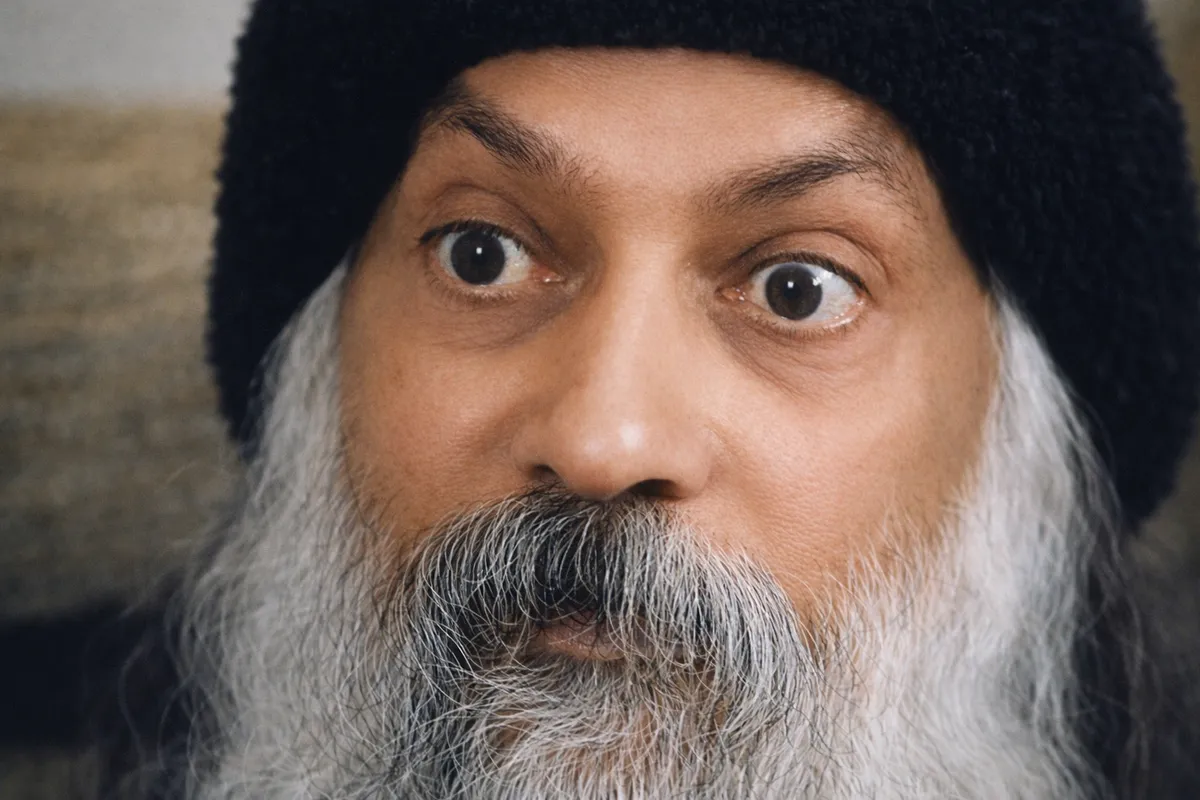
According to Osho, the ego is manufactured by the mind's judging and choosing—accumulating what serves 'me' (wealth, knowledge, respect) and discarding the rest. Freedom comes by ceasing choice, letting accumulation stop, and resting as utter emptiness—then even dropping the notion 'I am empty.' In this Mahashunyata, the inner slate is blank; no 'I' remains, and truth speaks through you.
Stop judging and collecting things for 'me'; be so empty you even drop the idea of being empty—then ego fades.
From the Discourses
Passages where Osho speaks to this question — each links to the complete discourse.
It is further asked, “How can one be free of the ego?”
All these things are interconnected. It is in the judging, critical vision that the ego is manufactured. “This is useful to me; this is not.” What seems useful, I accumulate; what does not, I discard. The sum total that forms from gathering what serves “me”—that very accumulation is the ego. I pile up wealth, gather knowledge, collect respect, accumulate success; I collect the ‘good-good’ and drop the ‘bad-bad’—thus the ego is created. The ego is simply the aggregate, the heap, of the items selected by the mind. When the mind does not choose at all—when there is no choosing—nothing is accumulated. Then one lives utterly empty, lives as a void. The slate remains clean; there is no writing upon it. And when the inner paper is blank, the ego does not arise. The very moment something is written on that inner paper, the ego is born. Anything written—and the ego…
Osho, what is the fundamental anguish of human life?
There is only one anguish: that a human being cannot become what he was born to be. There is only one anguish: that the seed remains a seed and does not bloom like a flower; that it cannot scatter its fragrance to the infinite winds; cannot converse with the moon and stars; cannot offer its colors to the sky; cannot be expressed. If the poem within the poet cannot be revealed—anguish. If the painter cannot paint—anguish. If the dancer cannot dance—if chains lie on his feet—anguish. Anguish means only this: that what we are meant to be—our innate nature and destiny—does not come to fruition, and we are forced to be something else. Then anguish is born. Then melancholy gathers over life. And all those countless people you see burdened with sorrow, living in a kind of hell—the reason is only this: each has come carrying the seed of becoming…
Beloved Osho, how can I leave my ego outside the front gate? It follows me like a shadow and even hides behind my back and then I am not able to see it.
I said, "I understand perfectly well. You don't understand with whom you are talking." But I did not leave the chair. I told him that whatever he wants to do, he can do. He can go to the vice-chancellor, he can bring the vice-chancellor... "I am going to remain in this chair." He said, "What is the purpose of all this mess?" I said, "The purpose is to show you that it is not my sitting in the chair that is hurting you, it is your ego. If you accept it I will leave the chair. If you don't accept, then you can bring anybody to help you... but as far as I know the students, nobody is going to help." He waited a minute. There was utter silence in the class. Everybody was afraid that if the vice-chancellor came and the proctor came, there was going to be trouble…
Before it comes into existence one lives moment to moment. Who cares to remember the past? So the child up to the third or fourth year remains spontaneous, wild, natural, outside society, on the fringe. It is a cultivated phenomenon, hence it can be dropped. If it were natural there would be no way to drop it. Because it is put together by society it can be easily dismantled. And that's what sannyas is all about, dismantling the ego. The process is painful because you have to become too attached to it. But once you understand that the ego is the root cause of all your misery, you are ready to go through the surgery. It is better to be finished with it in one stroke rather than to go on being miserable for your whole life.
And whenever there is a man with a sincere enquiry the answer is not very far. In fact the answer is always hidden in the question itself; all that is needed is a sincere heart to enquire. When the question is authentic... Our questions also are not authentic, they come out of borrowed knowledge. For example if a Christian comes he will ask a question that no Hindu is ever going to ask. If a Hindu comes he will ask a question that no Mohammedan is ever going to ask. A Mohammedan asks a question which no Buddhist would ever ask. I have known all these people -- they come with different questions. I was puzzled, puzzled because if the question is real then it can't be that a Christian will not ask something and only a Hindu will ask it. If the question is real it is everybody's question.