
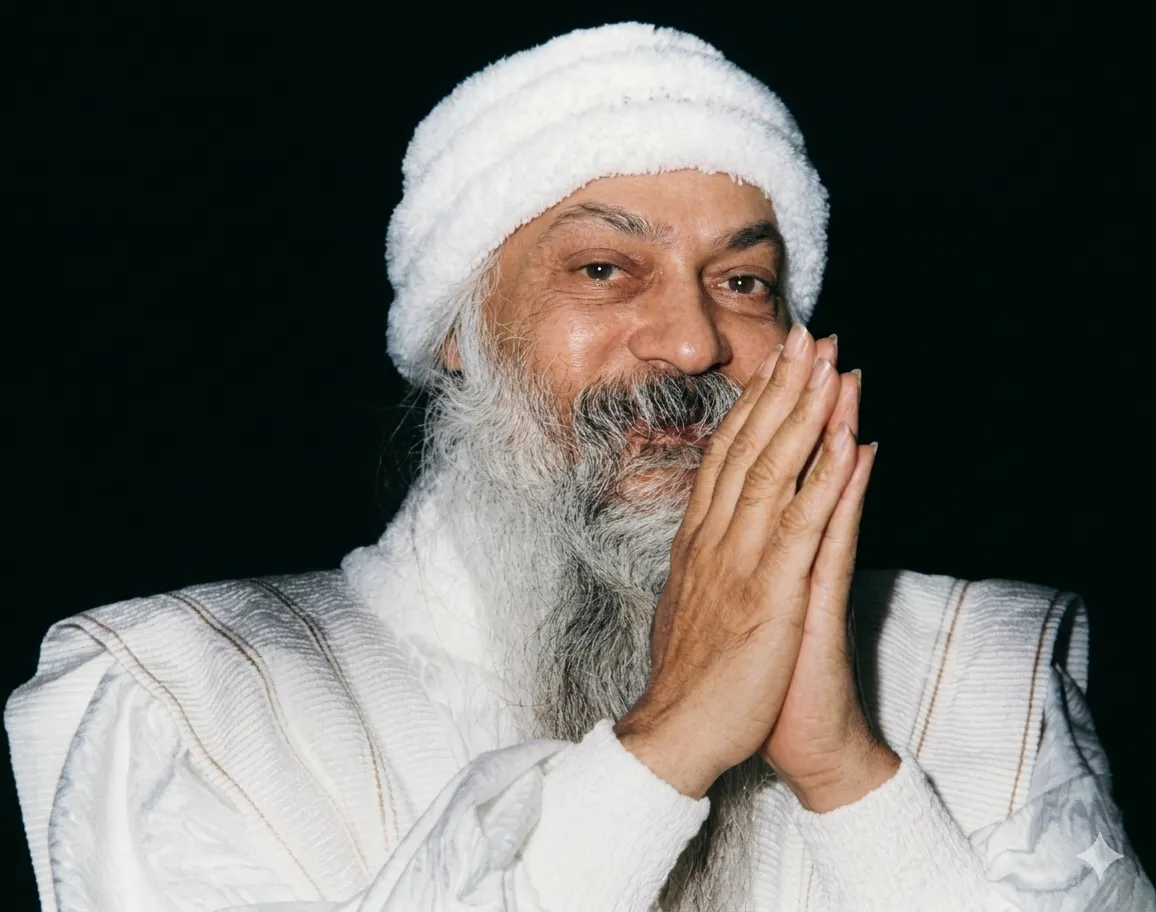
According to Osho, a true devotee has no ego. Ego belongs to the 'skull'—the noisy intellect that identifies as 'me.' Devotion (bhakti) is a divine 'madness' where the wave merges into the ocean; in such vastness, the 'I' disappears and one depends wholly on the Divine. If ego remains, it's the skull masquerading as devotion.
When love for the Divine takes over, the ‘me’ melts; if you still feel important, it’s just your busy mind pretending to be devoted.
From the Discourses
Passages where Osho speaks to this question — each links to the complete discourse.
You have asked: "Can a devotee have ego?"
Impossible. Because if there is ego, a devotee cannot be a devotee. A renunciate can have ego, a knower can have ego, but a devotee cannot. For the very first condition of being a devotee is that there be no ego. That is not the first condition for being a renunciate. To be a renunciate the conditions are: leave wealth, leave status, leave the world. But then the ego of having renounced becomes dense: “I left so much wealth, I gave up so much prestige, I left a beloved wife, beautiful children, a full household, all comforts.” The renunciate says, “Give up things!” By giving up things the ego becomes stronger; the ego of renunciation is born. But the devotee does not tell you to leave things; the devotee says, “Drop the ego.” That is his first condition. So either he is not a devotee at all if there is…
Osho, “A devotee will remain a devotee; he can never become God,” as Islam, Christianity, and, among Hindus, Madhvacharya have maintained. What is the basis of this doctrinal system? Can it also be used as a method, like a technique?
He spoke rightly; this is the final state of a devotee. He arrived there through prayer. While he prayed in the church, all was fine—then he stopped praying, because he came to the moment Kabir describes: “Who is to worship whom, when the two have become one, duality has dissolved?” When he declared duality dissolved—no church, no worship; whom to worship?—the trouble began. “This man is dangerous—either corrupted or supremely enlightened.” The common people will take him as corrupt. The Pope sent word: stop this talk; it will not be allowed. And they expelled Eckhart from the Church—the most Christian was cast out as un-Christian! That is why I say: if Christ were to come again, he would not be allowed to be Christian; the Church would expel him—just as it did Eckhart. Eckhart’s words are as precious as Kabir’s. If anyone in Christianity stands beside Kabir, it is Eckhart.…
Questioner: a comparative study of a sthitaprajna, one settled in his intelligence, and a devotee, remains to be made by you.
For this reason I say the lovers of today are devotees of tomorrow; they have no way but to turn to devotion. When they know for themselves that it is impossible to be one with an embodied person, they will turn to God, who is bodiless, because it is quite possible to be really one with him. So sooner or later every lover is going to turn into a devotee, and every word of love is going to turn into a prayer. This is how it should be. Otherwise there is no escape from the torture and misery of love. A lover who refuses to be a devotee is bound to be in everlasting anguish. Ironically, while his longings are those of a devotee, he is trying to fulfill them through ordinary love. His aspirations are running in one direction and his efforts in another, and so frustration is inevitable.…
It is asked: “The devotee cannot forget the Worshiped One even till the final state...?”
Therefore very few have been devotees; yogis have been many. Your understanding is perhaps the reverse. You may think there have been many devotees. Devotees have been almost none, because to be a devotee is audacity. In being a yogi there is no such dare. You remain your own master—stand on your head, do postures, hold the breath, do whatever you wish; but you remain the master. Resolve keeps getting stronger, the ego sharper, the edge keener. Therefore look at the edge of the yogi’s ego—it shines like a sword! The devotee bows. The devotee scatters himself. The devotee becomes very graceful, soft, delicate. The yogi becomes stony, obstinate, stiff; the notion of “doing” takes hold. The yogi seeks siddhis, power; the devotee goes only to lose himself. “Ultimately, for liberation is the dissolution of the deity’s image also necessary?” You are the one who is lost. The worshiper is…
It is asked: “Devotion must be with form.”
All forms are dreamlike. The formless is truth; form is the dream. But where we are standing is the world of forms. We are still within the dream. Even to awaken, we must travel a little within the dream. Devotion must be with form—it simply is. There cannot be formless devotion, because in the formless what remains to be done, when the doer is no more! Devotion will be with form, but God is formless. Therefore, one day devotion too must go. At the completion of devotion, devotion itself disappears. When prayer is fulfilled, prayer too goes. When meditation is complete, meditation becomes useless—it should. Whatever becomes complete becomes useless. So long as it is incomplete, it is fine—go to the temple, perform the worship. Do it, but remember: do not forget that this is only the beginning. It is the beginning of the school of life, not the end.…