
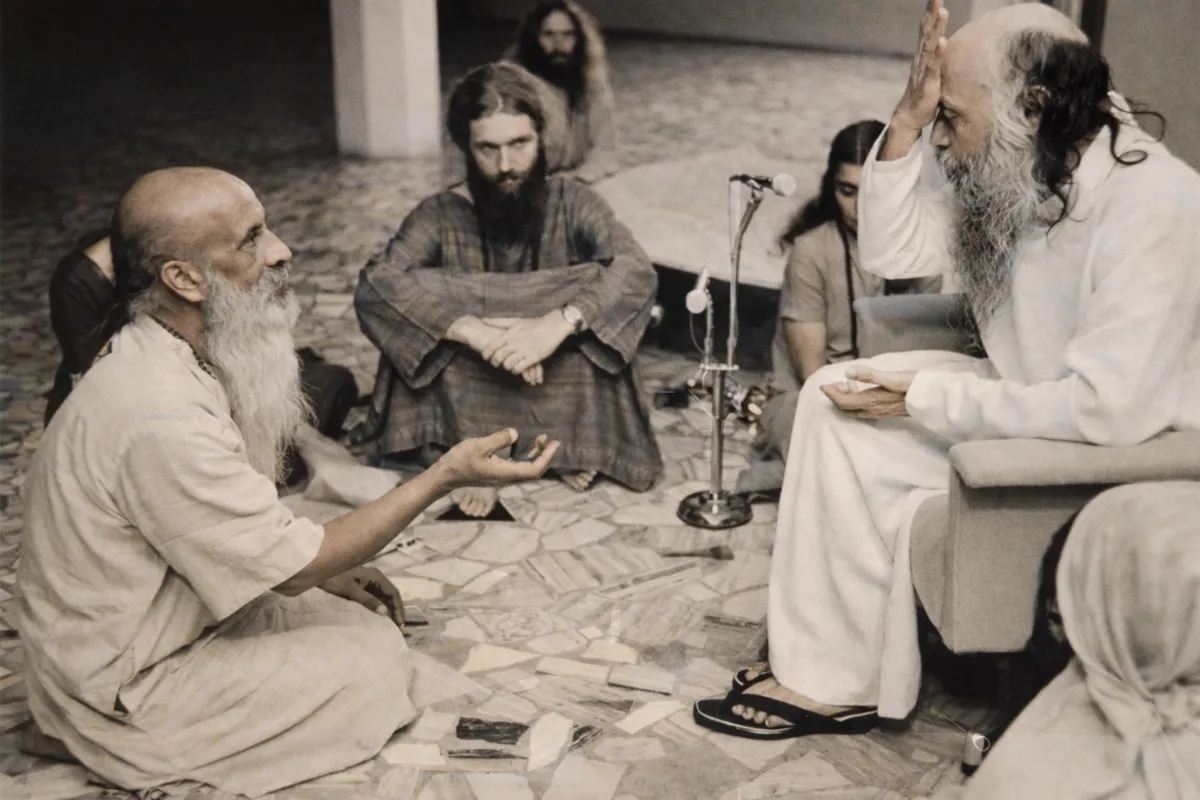
Being a devotee means letting go of the “I” completely; when the ego is gone, only God is seen.
From the Discourses
Passages where Osho speaks to this question — each links to the complete discourse.
You have asked: "Can a devotee have ego?"
Impossible. Because if there is ego, a devotee cannot be a devotee. A renunciate can have ego, a knower can have ego, but a devotee cannot. For the very first condition of being a devotee is that there be no ego. That is not the first condition for being a renunciate. To be a renunciate the conditions are: leave wealth, leave status, leave the world. But then the ego of having renounced becomes dense: “I left so much wealth, I gave up so much prestige, I left a beloved wife, beautiful children, a full household, all comforts.” The renunciate says, “Give up things!” By giving up things the ego becomes stronger; the ego of renunciation is born. But the devotee does not tell you to leave things; the devotee says, “Drop the ego.” That is his first condition. So either he is not a devotee at all if there is…
Osho, “A devotee will remain a devotee; he can never become God,” as Islam, Christianity, and, among Hindus, Madhvacharya have maintained. What is the basis of this doctrinal system? Can it also be used as a method, like a technique?
He spoke rightly; this is the final state of a devotee. He arrived there through prayer. While he prayed in the church, all was fine—then he stopped praying, because he came to the moment Kabir describes: “Who is to worship whom, when the two have become one, duality has dissolved?” When he declared duality dissolved—no church, no worship; whom to worship?—the trouble began. “This man is dangerous—either corrupted or supremely enlightened.” The common people will take him as corrupt. The Pope sent word: stop this talk; it will not be allowed. And they expelled Eckhart from the Church—the most Christian was cast out as un-Christian! That is why I say: if Christ were to come again, he would not be allowed to be Christian; the Church would expel him—just as it did Eckhart. Eckhart’s words are as precious as Kabir’s. If anyone in Christianity stands beside Kabir, it is Eckhart.…
So the friend has asked: "When tears begin to flow, an ego takes hold within—ah, blessed fortune!—how I am drowning in the nectar of devotion!"
Accept death. In accepting death, the ego cannot remain. Once you truly see that death is certain—it will be, whether today or tomorrow or the day after; there is no way to avoid it; no one has ever escaped—where will you run? Running and running, all arrive at the same place: into the mouth of death. Embrace it. In that embrace the ego dies. I had little awareness; otherwise, in the course of life, with every breath, a revolution would have arisen within me. I had little awareness, little sensitivity—no vigilance, no wakefulness. …Otherwise, all through life, with every breath, a revolution would have arisen within me. With every breath the possibility of revolution arrived—and I kept missing it. With every breath a revolution could have occurred; the ego could have been dropped, and an entry into the realm of the Divine could have opened—but awareness was scant. Awaken this…
Osho, you said... then you will find that the devotee is God. The question arises: if one devotee prefers to be God and another wants to remain only a devotee, then which of the two is superior?
The one who wants to be God will not be able to be. And the one who wants to remain a devotee will become God. The question of superior or inferior does not arise, because only one of the two will happen. The one who does not want to be will be. The one who wants to be will be deprived. That very wanting is of the ego. But the matter is a little delicate. Sometimes humility too belongs to the ego. Beware that your humility may not be of the ego. Perhaps you are saying, “No, I don’t want to be,” because you know that those who refuse are the ones who attain. Then you are clever. Then your humility is adulterous. Your humility is not pure, not sacred, not virginal—it is like a prostitute. The one who wants to be God, whose ego says, “I must become God,”…
Osho, can a disciple’s love for his true Master and the disciple’s ego both persist together?
Ego is the stair you have used till now; surrender is your foot—searching for the new. Until your foot rests on the new, you cannot lift it from the old—nor should you, else you will fall flat on your face. Once the foot has found its grip on the new step, then lift it; then there is no fear. Once your foot settles in surrender, there will be little difficulty in lifting it from the ego. But there is no need to hurry. Let things happen in their natural way, patiently. Do not be anxious: “If I have ego, how will surrender happen?” When a room is dark, do you ask, “There is so much darkness here, and not of a day or two, but of lifetimes—who knows since when! If I light a little lamp here—will it burn? Will it burn in such great darkness?” You don’t ask this,…