
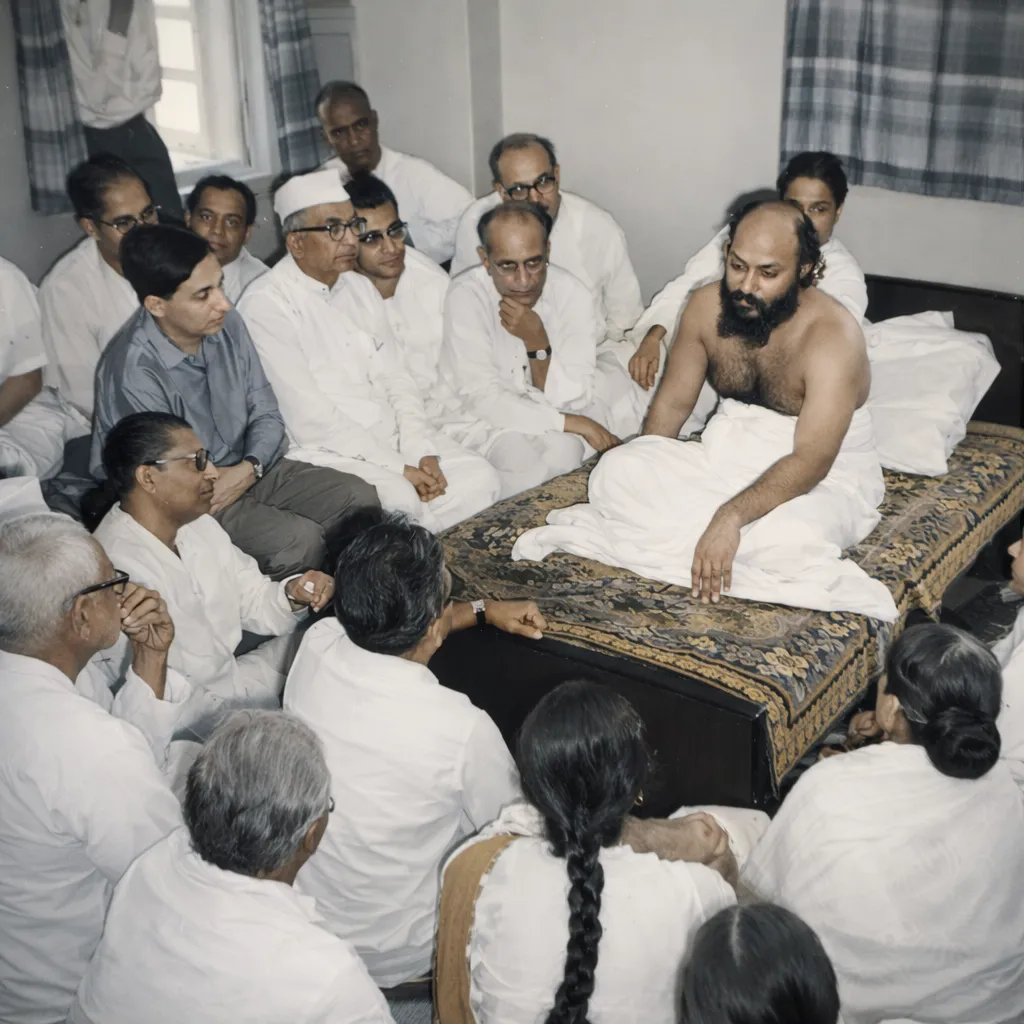
You don't need beliefs—just discover how you belong to everything, and the lonely, lost feeling stops.
From the Discourses
Passages where Osho speaks to this question — each links to the complete discourse.
One friend asks: why should we be religions when we do not know the beginning, when we do not know the end; when we have no knowledge of god or atman? Why can't a buddha who experiences the truth give this experience to all?
No one wants you to be religious -- at least Lao Tzu does not tell you to be. Religious people have created such confusion that it is better if they cease to exist. No one wants you to be religious. Lao Tzu says only this: "Be what you are." You may ask, "Why should we be what we are?" The answer is that that is all you can be. There is no way of becoming something else. You may try to become something you are not, but you will simply be wasting your life. Then you might say, "Why should we not waste our life?" Nobody can stop you from doing what you like. Buddhas also accept defeat. They cannot make you realise truth. What can sages do? All they can do is to tell you of the bliss they have attained; the peace, the enlightenment, that they have received.…
A friend has asked, Osho, why should we be religious when neither the beginning nor the end is known, and there is no trace of God or soul? The enlightened ones speak of truth—if that truth is real, why can’t they make everyone experience it?
No one is telling you to be religious—at least Lao Tzu would not. The so-called religious people have created so much disturbance that it is better you do not become one of them. Lao Tzu does not say, “Be religious.” He simply says: be what you are. You may ask, why should I be what I am? Because that is the only thing you can be. There is no way to be anything else. Yes, you can try to be something else—and in that trying your life can be wasted. You may then say, why not waste life? No one can stop you. And precisely for this reason even the enlightened ones are defeated and cannot give you the knowledge of truth—because you say, why should we know the truth? What can the enlightened do? They can speak. They can try to awaken in you the thirst for the joy…
Osho, please shed light on what walls stand between religion and man.
There aren’t many walls—just one: ego. Though there are many bricks in that wall, and they all get mortared in the same way: whatever is against nature becomes a brick for the ego. I teach a natural life. My message is straight and simple. Live simply. Don’t run away from anywhere; don’t avoid anything. Whatever God has given is auspicious—give thanks. And if he has given mud, he gave it in the hope that lotus flowers would bloom from it. And if he has given iron, he did so in the hope that you also have the philosopher’s stone within—find it. At its touch, iron becomes gold. And not merely gold—fragrance comes into gold. And don’t keep asking the pundit-priests. Avoid them. They neither know nor have experience. But in this world very few are simple-hearted enough to say, “I don’t know.” If someone asks you something, even if you…
Question: A friend has asked: Osho, where is God? Do not ask this. First, find yourself. And I tell you, the one who finds himself never again asks, “Where is God?” Because wherever the self is found, there God is found as well. I have heard a story. I have heard that when the earth was made, everything was created, man was created—and the moment man was made, God became worried. He asked the gods, “I am in great trouble. I have created man, but he will stand at my door every day with a thousand questions. I want to avoid this. Tell me a place where I can hide and this man cannot reach me.” The gods said, “Go hide on Everest.” God said, “You don’t know—very soon a Hillary will be born, a Tenzing will be born; they will climb Everest.
Osho, what is the definition of God?
Words are very small. If you say God is light, then what of darkness? The scriptures have said that God is light. Suppose we accept this as a definition—then what about darkness? Where will darkness go? Darkness is too; in fact it is far more than light. Light sometimes is and sometimes is not; darkness is always, eternal. Where will you place darkness? If you say God is light, darkness is left out. If you say God is darkness, then light is left out. If you say God is both darkness and light, a contradiction arises: they cannot be together. Try to have both darkness and light in the same room. If you bring in light, darkness disappears; if you preserve darkness, you cannot have light. Then how can both be together? That becomes an impossibility. So you cannot say “both” either. Then the fourth device is to say: it…