
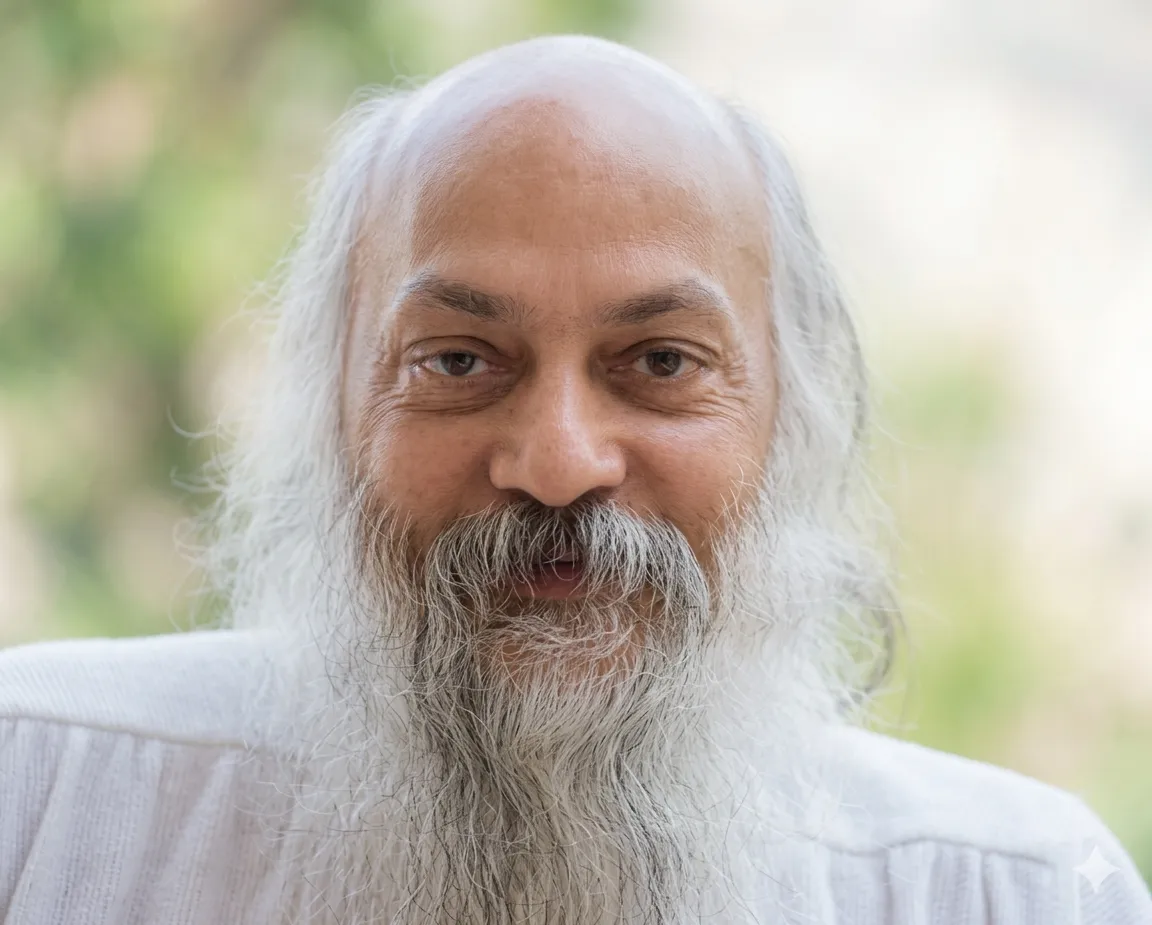
You fear losing your body and stuff because you think that’s all you are; find the quiet watcher inside and the fear eases.
From the Discourses
Passages where Osho speaks to this question — each links to the complete discourse.
Question: BELOVED OSHO, WHY IS MAN AFRAID TO LEAVE HIS BODY AND HIS POSSESSIONS? And if man kills in such situations, where he has the upper hand -- no fear, no danger -- it is a game; and if a lion kills a man, THAT'S a tragedy. Strange! The lion was also playing a game, and he was playing fairly without any weapons, naked, open. Man is afraid of losing his body and his possessions. Possessions are extensions of your body. Your house, your bank balance, your furniture, your paintings -- everything that you have collected is somehow connected with your body. And you know only that you are a body, so when death faces you, you are afraid of losing your body and your possessions -- naturally, because you don't know anything which is beyond death.
Osho, there is one more thing I want to understand in the first question: how is it that objects—possessions—hypnotize and possess their owner, the possessor? What are the reasons?
In the very desire to become a master lie the seeds of slavery; because whatever we decide to master, we also, unknowingly, have to become its slave. We become slaves because our mastery depends upon that which we own. Without it, our ownership cannot exist. And when ownership depends on something, how can we be the owner of our ownership? The real master is that upon which it depends. If I have ten slaves, I am the master of ten slaves; but my mastery depends on those ten slaves being there. If these ten slaves are lost, my mastery will be lost with them. The key to that mastery is not in my hands; it is in the hands of those ten slaves. In a very deep sense they have become my masters, because without them I cannot be a master. And how can we be masters of those without…
Osho, what is attachment? Why do we become so attached to things, ideas and persons? And is there freedom from attachment?
“So do one thing,” she told the courtesan. “I will pay you whatever you ask. Go to him at midnight. He meditates at midnight—has done so for thirty years. I want to know whether meditation has happened or not before I die. His hut door is only latched; no one ever goes there. Open it and go in. Whatever he says, notice every word and tell me. Go and embrace him—then come back and report. Before I die, I want to be sure that my service was not in vain.” The courtesan went. She opened the door. The monk was startled. He opened his eyes—he had been sitting in meditation—and shouted, “You wicked woman! Why are you here? Get out! What need have you to come at midnight?” But his tongue faltered; his body trembled. The woman had taken her money; she went right in. He cried, “Stay back! Why…
Osho, today I would like to invite your views on the issue of vanity and fear. To me, sir, this issue also seems valuable to analyze. As I have understood it: immaturity brings vanity; vanity brings pride; pride brings prejudices; prejudices ultimately result in comparison; comparison results in divisions and ends in destruction. Sir, this vicious circle appears very decisive and destructive to humanity at large. Many scholars have said that this culture of mankind is very ancient. Would you please enlighten us on this aspect of life?
Fear is certainly man’s deepest and most fundamental problem. Nothing is more important than fear, because our whole culture, civilization, religion, education—the entire arrangement of our life—has been made to avoid fear. And a precious formula of life is: whatever we try to escape, we never escape. We hoard wealth to avoid fear; we gather friends to avoid fear. We marry, we build families. We form societies and nations to avoid fear. But fear does not end through these; rather, new fears arise. There is prayer in the temple, namaz in the mosque, and a call to God in the church—behind all of it, our fear is working. Wealth is from fear, and religion too is from fear. One becomes a householder out of fear; and if one becomes a renunciate, that too is out of fear. One commits sin from fear—that if he does not, he will fail, he…
Question: POSSESSING NOTHING, WANTING NOTHING. HE IS FULL OF POWER. FEARLESS, WISE, EXALTED. HE HAS VANQUISHED ALL THINGS. HE SEES BY VIRTUE OF HIS PURITY. HE HAS COME TO THE END OF THE WAY, OVER THE RIVER OF HIS MANY LIVES, HIS MANY DEATHS. BEYOND THE SORROW OF HELL, BEYOND THE GREAT JOY OF HEAVEN, BY VIRTUE OF HIS PURITY. HE HAS COME TO THE END OF THE WAY. ALL THAT HE HAD TO DO, HE HAS DONE. AND NOW HE IS ONE. These are the last golden sutras of THE DHAMMAPADA: POSSESSING NOTHING, WANTING NOTHING. HE IS FULL OF POWER. Why does man want to possess? It is one of the most fundamental things to be understood. Unless you understand why there is a constant hankering to possess more and more things, money, power, you will not be able to get rid of this insanity of possessiveness.